




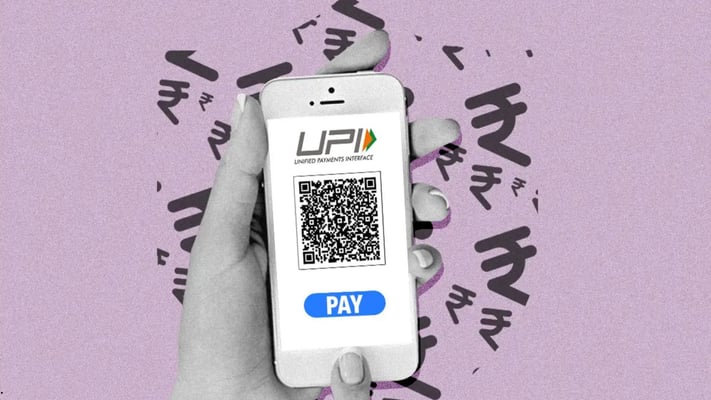



India's widely used click-and-pay Unified Payments Interface (UPI) system will introduce a fractional charge on certain merchant transactions above Rs 2,000, while consumers will continue to make UPI payments without paying any transaction fee, according to a government notification and rules issued by the National Payments Corporation of India (NPCI), as reported by NDTV.

The revised UPI Merchant Discount Rate (MDR) framework will come into effect from October 15, NDTV reported.
Under the new framework, a 0.4% charge will apply to eligible UPI transactions made by consumers when paying merchants, according to the NPCI's revised rules for UPI. The charge will apply to transactions above the Rs 2,000 threshold and will be paid within the merchant payment ecosystem rather than directly by consumers.

The MDR has been capped at Rs 300 per transaction, according to details reported by NDTV. The Finance Ministry has also advised banks to ensure that merchants do not transfer the cost of this charge to customers.
For specific merchant categories, including railways, telecom services, insurance and fuel, the structure will be different. The NPCI has stated that a flat charge of Rs 5 will apply to UPI payments above Rs 2,000 in these categories.
Importantly, consumers will not be required to pay the newly introduced charge when making UPI payments. The NPCI clarified that person-to-person transactions, as well as person-to-merchant payments of up to Rs 2,000, will remain outside the scope of MDR.
"Consumers will continue to transact free of cost using UPI as they have been doing till now. Person-to-Person (P2P) transactions and Person-to-Merchant (P2M) transactions up to Rs 2,000 remain outside the scope of MDR," it said.
How The New UPI Charges Will Work
In practical terms, when a consumer makes a payment above Rs 2,000 to an eligible merchant, the merchant will bear the applicable 0.4% charge. For example, a merchant transaction of Rs 2,001 would attract a charge of approximately Rs 8 under the percentage-based MDR structure, subject to the applicable rules and cap.
However, the same threshold does not apply to person-to-person payments. If an individual sends more than Rs 2,000 to a friend or family member through UPI, the transaction remains free because it is classified as a P2P payment.
According to NDTV, the distinction between merchant payments and person-to-person transfers is a key part of the revised framework. The announcement is intended to clarify how higher-value merchant transactions will be treated while ensuring that ordinary consumers do not face a direct fee for using UPI.
The NPCI has also pointed out that the charges remain lower than those associated with several other digital payment instruments, including credit cards, debit cards and digital wallets.
Government Clarifies UPI Will Remain Free For Consumers
For several weeks, the government had repeatedly maintained that UPI payments up to Rs 2,000 would remain free. However, there had been uncertainty over whether transactions above that threshold could eventually attract charges and, more importantly, whether those costs could be passed on to consumers.
The latest announcement provides clarity on the treatment of higher-value merchant payments, NDTV reported. It also addresses concerns among users who had feared that the introduction of an MDR could result in them having to pay additional charges when making larger UPI payments.
The revised framework retains free UPI payments for 95% of low-value transactions, particularly those below Rs 2,000, along with small merchant transactions, the NPCI said.
The payments body described the new MDR as a "reasonable charge" that would help support the continued expansion of UPI to more users and merchants. It said the framework would also help fund investments in areas such as payment-system resilience, cybersecurity and innovation.
The move comes as UPI continues to play a major role in India's digital payments ecosystem, with millions of consumers and businesses relying on the platform for everyday transactions.
Small Merchants To Remain Protected
The revised framework also seeks to protect small merchants from additional costs by keeping eligible transactions up to Rs 2,000 free, according to the Finance Ministry.
The ministry further clarified that MDR should not be confused with a government tax. The charge is not a tax collected by the government. Instead, the amount is distributed among participants in the digital payments ecosystem, including banks and payment applications, to help support the infrastructure, operations and continued expansion of digital payment services.
NDTV reported that the clarification is significant because the introduction of MDR could otherwise have led to confusion among consumers and merchants over who ultimately receives the money and whether it represents a government levy.
The government has also outlined additional measures aimed at encouraging digital payment adoption among smaller businesses.
Dedicated Fund For Small Merchants
As part of the revised framework, a dedicated fund for small merchants will be established to support digital payment infrastructure, the payments body said.
The initiative will focus on enabling digital payment infrastructure at existing merchant locations, as well as expanding such facilities in Tier 3 cities and smaller markets.
According to NDTV, the move is aimed at strengthening India's digital payment ecosystem beyond major cities and ensuring that smaller merchants also have access to the infrastructure required to accept digital payments.
The NPCI said the revised MDR framework is intended to balance the need to maintain free and accessible digital payments for consumers with the requirement to provide sustainable financial support to the broader payments ecosystem.
For consumers, the key takeaway remains that UPI payments will continue to be free. Person-to-person transfers will not attract MDR, while eligible person-to-merchant transactions up to Rs 2,000 will also remain outside the MDR framework.
For larger merchant payments, however, the applicable MDR will be borne by the merchant under the new framework, with banks being advised to ensure that the charge is not passed on to consumers.
The revised rules are set to take effect from October 15, marking a significant change in the way certain higher-value UPI merchant transactions are handled while preserving the zero-cost model for consumers using UPI for everyday payments.



ISSUE


Leave a Comment