




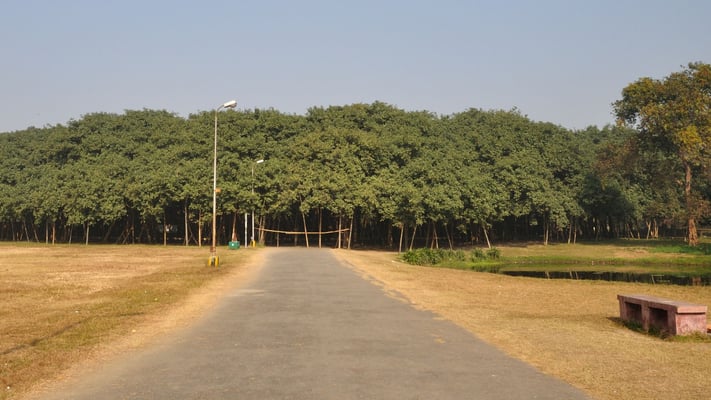


A natural wonder in Howrah, West Bengal, the Great Banyan has stood for more than 250 years and continues to grow despite losing its original trunk.
India is home to several natural wonders, but few are as remarkable as the Great Banyan tree in Howrah, West Bengal. Spread across an extraordinary 4.67 acres, this centuries-old tree has earned its place in history as the world's largest banyan tree, creating the unusual sight of what appears to be an entire forest growing from a single tree, as reported by the Times of India.

Located inside the Acharya Jagadish Chandra Bose Indian Botanic Garden in Shibpur, the Great Banyan is estimated to be more than 250 years old. With its sprawling branches and thousands of aerial roots, the tree resembles a vast green landscape rather than a single living organism, the Times of India has reported.
Banyan trees are known for their remarkable ability to spread through aerial roots that grow downwards from their branches and eventually take root in the soil. Over time, these roots develop into supporting structures, allowing the tree to expand across large areas.

According to the Times of India, what makes the Great Banyan particularly extraordinary is that it continues to thrive despite losing its original trunk. After suffering damage from two powerful cyclones and being affected by disease, the tree's main trunk was removed in 1925 to prevent the infection from spreading.
However, this did not stop its growth. The tree continued expanding through its aerial roots, which now number an astonishing 3,772. Today, the Great Banyan stands as a remarkable example of nature's resilience, with its vast network of roots and branches making it appear like a miniature forest.
Interestingly, although the botanical garden houses hundreds of exotic plant species collected from different parts of the world, the Great Banyan remains its most celebrated attraction.
A garden rooted in history
The botanical garden itself has a fascinating history dating back to 1787, when Colonel Robert Kyd of the East India Company established it, as reported by the Times of India.
The original purpose was largely commercial, with plans to cultivate economically valuable plants, including spices, tea and teak. Over the centuries, however, the garden evolved into an important centre for botanical research and conservation.
According to a report by the Times of India, it was renamed the Acharya Jagadish Chandra Bose Indian Botanic Garden in 2009 in honour of the renowned Indian scientist Jagadish Chandra Bose.
Among its many botanical treasures, the Great Banyan has become the garden's defining landmark, attracting visitors fascinated by its unusual size, age and remarkable survival.
More than just a tree, the Great Banyan represents the extraordinary ability of nature to adapt and endure. Its story is a reminder that even when a central structure disappears, life can find new ways to grow, the Times of India has reported.
A forest formed by a single tree is indeed a rare natural spectacle, making the Great Banyan one of India's most fascinating living wonders.


ISSUE


Leave a Comment