




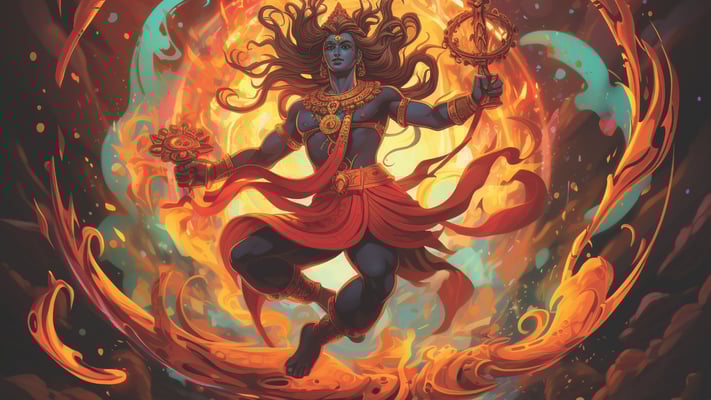



Motion is the fundamental condition of all manifest reality. What we often perceive as rest is merely inertia, an appearance created by limited reference points. From the helical strands of DNA to the vast movements of galaxies, nothing in the cosmos is truly still.

Even as the Earth hurtles through space along with the solar system, we experience ourselves as stationary because our frame of reference is confined to objects around us. Rest, in this sense, is an illusion born of relative perception.
Ancient Indian wisdom captured this truth symbolically in the image of Shiva as Nataraja, the cosmic dancer, where creation is understood as the rhythmic play of energy in motion. Yet our misunderstanding of motion runs deeper than physics. We also fail to understand how motion operates within our own lives.
For most of our existence, we act without awareness. Action precedes choice; habit substitutes intelligence. Inertia, born of ignorance, governs behaviour at individual and collective levels. We enter systems already in motion and are carried by them, surrendering agency without noticing the loss. The result is inner fragmentation, characterised by stress, exhaustion, and a sense of disconnection from oneself and the world.
The recovery of wholeness does not require withdrawal from life but a transformation in how we participate in it. Awareness of action is the simplest and most powerful entry point. When attention is brought to physical movement, something as ordinary as walking, the spell of inertia begins to break. Initially, the body resists; it carries the weight of accumulated rigidity. With sustained awareness, movement softens. Effort gives way to flow, and flow to a sense of being carried by motion rather than producing it.
This shift is accompanied by subtle physiological changes: breathing deepens, the nervous system relaxes, and the body feels lighter. What is taking place is not merely a mechanical adjustment but a reorganisation of embodied consciousness. Energy moves from dense, constricted patterns toward more fluid and expansive states. The body becomes not an obstacle to awareness but its instrument.
As attention stabilises, awareness naturally turns inward. One becomes sensitive to subtler currents of energy and to the psychic heart, the meeting point of individual and universal consciousness. Breath assumes a quiet rhythm; pauses arise effortlessly. The boundaries of individuality soften, and the self is experienced not as a closed unit but as a permeable presence in continuous exchange with the world.
From this expanded state, empathy emerges spontaneously. The separation between self and other loosens, giving rise to intuitive insight into one’s place and responsibility within the larger whole. Action becomes offering rather than compulsion; surrender arises from understanding rather than force.

This is not just one yoga among many, but their convergence of karma, bhakti, raja, and jnana united in lived awareness. In reclaiming conscious motion, the individual rediscovers integrality: as a person, as a cosmic participant, and as a being rooted in transcendence.


ISSUE


Leave a Comment