




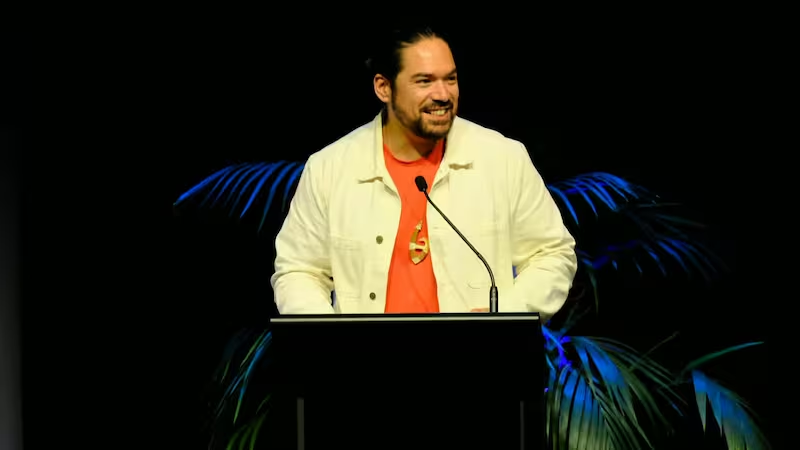


A director of a Wellington-based business is rethinking his relationship with technology, attempting to “decouple” from major tech giants like Meta, Microsoft and Google. However, his journey has revealed that stepping away from big tech is far more complex than simply switching platforms. Reported by 1News.
Vincent Olsen-Reeder, who works in what he describes as the "AI technology space", admits he is not an expert. Over the past few weeks, he has been exploring alternatives to widely used software, driven by concerns that current systems do not adequately protect user privacy and security.

“I’ve just been feeling lately they’re not serving me like they used to be," he said. "This isn’t a way I want my life documented or recorded.”
His concerns deepened after reading Minority Rule by Ash Sarkar, which challenged his perception of digital platforms.
“One of the things that she mentions is we aren’t users of these products, we are the contributors to their products, and I never thought about myself like that.
“I always thought of myself as a Facebook user, but actually I’m a Facebook seller and Facebook are the purchaser of my data – they’re just purchasing it for free.”
Reflecting on the extent of personal data shared online—and how it is used by platforms to build products and generate profit—he decided to take action.
“I am selling, and I am selling for free, but I am selling myself. I am selling every keystroke, I am selling every file, I am selling every photo to them for free, for their own use. It’s a bit creepy when you start thinking about it like that.”
The Growing Concern
Olsen-Reeder’s concerns echo a broader unease about reliance on large, predominantly US-based tech companies. In 2025, tech critic and podcaster Paris Marx warned of growing dependence on American digital infrastructure, raising questions about digital sovereignty.
There are also fears about potential misuse of data, especially as tensions between big tech firms and governments highlight the risks of an under-regulated industry.
Social media platforms, originally designed to connect people, are no longer fulfilling that purpose in the same way, Olsen-Reeder believes.
“It used to be, Facebook for example, the ability to catch up with friends that I don’t get to see every day, the ability to keep track of their lives and share in their successes, and see what they’re up to in a really easy way. But more and more, Facebook are not delivering that anyway.
“It’s very ad orientated, it’s very politically orientated. We already know from algorithm stuff they’re starting to hide people’s individual feeds to give you more adverts, more politically polarising stuff to keep you on the platform typing.”
The Act of Decoupling
His efforts to reduce reliance on big tech have been extensive. Over two weeks, Olsen-Reeder has changed his computer’s operating system, switched browsers, cancelled his ChatGPT subscription, and removed all data from OpenAI. He is also transitioning to a more secure email provider, deleting his Facebook data, and closing his account.
Additionally, he has adopted alternative word processing software, invested in a privacy-focused mapping application, and started using a virtual private network (VPN).
Despite his efforts, he acknowledges that the process has involved significant trial and error. As a director of ReoPol Ltd, a Māori language-focused business, and someone with a PhD in te reo Māori revitalisation and bilingualism, he still finds the transition challenging.
He estimates spending around two hours each day working to limit the data he shares or remove existing data from platforms.
One of the key challenges has been compatibility between systems.
“I’ve migrated my Google calendar to a new calendar platform that’s private, and of course when I did that the time systems didn’t talk to each so now my entire Google calendar is out by a day and three hours. So all of these things don’t talk to each other anymore, but that’s the price that you pay for trying to do something like this."
He also pointed out the financial cost of maintaining privacy.
“People might be interested to know that you have to pay for your privacy, so none of this stuff is free anymore. This is something that comes with the privilege of access to money.
"It's really sad that the tools that are free, they’re free for a reason - that’s because you’re paying another way.”
Even with these efforts, Olsen-Reeder remains realistic about the limitations.
“None of those things guarantee that data about me isn’t going to go anywhere, but it’s like you’re trying to find the best-case scenarios that you possibly can.”
The Takeaway
Despite his actions, Olsen-Reeder is not advocating for complete disconnection from the internet.
“I don’t want to disconnect completely. I work over the internet. I’m in the AI technology space, so for me, it’s not about disconnecting.

"It’s about seeking out really great avenues to keep my data safe, keep my data protected. But also to try and pre-empt what other people might want to do with my data and taking proactive steps to keep the decision-making level of what happens to it as close to me as possible.”
His experience has led him to stress the importance of awareness among everyday users about the terms they accept when using digital services.
He also believes that experts and academics must communicate these issues more clearly to the public.
“Now’s the time to put it in plain English, get it out of the lecture theatre, out of the university tower and put it in front of actual people and say ‘do this, don’t do that, here’s how you can do it for free, here’s what you might have to give up’.
"Just do it and do it as fast as you possibly can cause I’m reasonably tech literate but it’s hard.”


ISSUE

Leave a Comment