




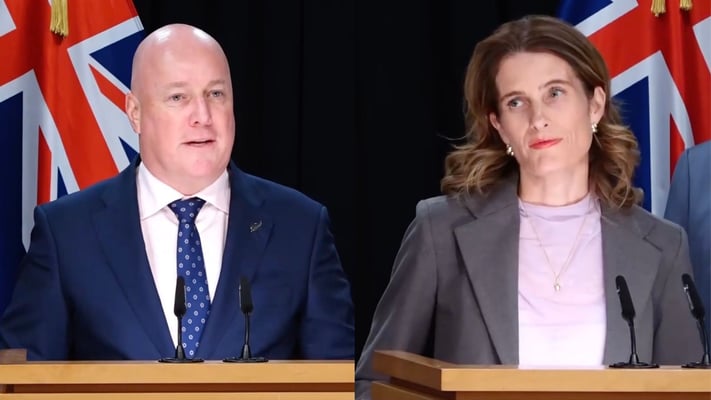



The Government has unveiled a revised national fuel shortage response plan that could see limits placed on how much fuel New Zealanders can buy during a severe crisis, while businesses may face spot checks to ensure compliance with fuel-saving targets.
According to a report by 1News, Prime Minister Christopher Luxon said the most extreme level of the framework, phase four, remained “highly unlikely”, but argued the updated system was necessary because previous proposals were “too complex”.

Luxon said the Government was “not interested in doing Covid 2.0” with complicated rules and instead wanted a simpler structure that would be easier for the public and businesses to understand.
The revised plan, released alongside Finance Minister Nicola Willis and Associate Energy Minister Shane Jones, changes when mandatory fuel restrictions would come into effect, as reported by 1News.
Under the new framework, rationing measures would only apply in phase four, the highest alert level, rather than phase three as previously planned. Treasury modelling suggested this phase could coincide with diesel prices reaching $5 a litre or more.
“Modelled scenarios indicate that it is highly unlikely we would ever get to phase three or four of the fuel response plan, but, as a prudent Government, we are ensuring that New Zealand is prepared for whatever the global environment brings,” Willis said.
“It is better to have a plan you don’t use than to need one and be caught short,” 1News has quoted.
Luxon described the type of crisis that could trigger phase four as a major disruption to diesel imports over an extended period.
“The kind of scenario you're looking at when you get to phase four is, you know, you can imagine a scenario where you've lost 30% of your diesel import for the month ... and actually there's a disrupted supply for six months,” as quoted by 1News.
“While this is highly unlikely, the Government would set a fuel reduction target and apply a simplified framework of priority users to ensure fuel goes where it’s needed most.”
Willis added: “It's very hard to imagine a scenario in which phase four is needed.”
New Zealand entered phase one of the fuel response plan on March 27, involving close monitoring of fuel supplies amid ongoing uncertainty in the Middle East and global energy markets.
According to a report by 1News, the Government said refiners in Singapore and South Korea had reassured officials that crude oil supplies were secured through July and August, while suppliers had diversified away from Gulf sources to countries including the United States, Mexico, Oman, Latin America and Canada.
“Suppliers have committed to proactively sharing information on any disruptions to future crude oil feedstock orders,” Willis said.
“This effectively provides New Zealand an early warning system,” 1News has quoted.
Under the revised structure, phase two would focus on conserving fuel and securing additional supply during short-term disruptions, while phase three would encourage voluntary reductions in fuel use and potentially expand public transport services.
Mandatory restrictions would only begin under phase four, where fuel users would be split into four groups: critical users, food and freight operators, commercial and community users, and the general public.
Emergency services, health providers, schools, courts, banks, media outlets and essential utilities would receive priority access with no fuel caps.
Food and freight companies would also receive uncapped fuel access but would need to submit fuel-saving plans and meet government reduction targets. Spot checks could be carried out under the Petroleum Demand Restraint Act 1981 to ensure compliance, as reported by 1News.
Retailers, tradespeople and universities would face stricter savings requirements, while the general public would be limited to a set amount of fuel each week.
Exceptions could be made for people with genuine needs, including rural workers or those travelling long distances for funerals.
Willis said the system would rely heavily on public cooperation rather than aggressive enforcement.
“If there was someone who was running around being a boy racer, racing up and down the country using excess fuel, and that became obvious to the community, you'd be able to clock their fuel use with their fuel card,” as quoted by 1News.
“But, equally, [someone might say] 'oh, I've noticed that person's filling up a lot,' and it actually became clear it was because they were a nurse having to travel long distances.”
“We're not cracking down on that. We need to have common sense. We need to be practical. This is not about having a police officer on every corner,” 1News has quoted.
The Government described the proposal as “a high-trust regime”, saying most New Zealanders would likely comply voluntarily.
Officials also confirmed that carless days would not be considered under the revised plan.
Willis said the updated framework followed extensive consultation with businesses and industry groups.
“In the unlikely event we ever need to move to phase four, it is critical that business and industry have a clear understanding of the objectives and measures, and can put them into action,” 1News has quoted.
“That is why we have taken the time to consult, and the feedback we received has shaped the revised plan.”
“We heard that the earlier proposed approach, particularly around the priority bands, was too complex and needed simplifying,” as quoted by 1News.
The Government said it consulted more than 320 organisations, held 11 webinars attended by nearly 6000 people, and received over 1200 submissions before finalising the revised strategy.



ISSUE


Leave a Comment