

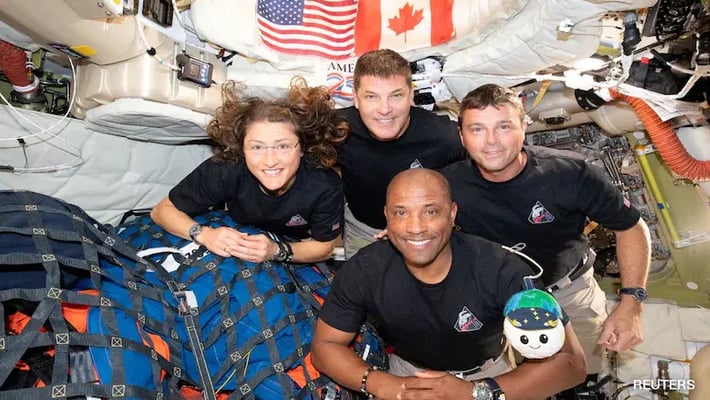

Artemis II re-entry smooth, minor heat shield charring noted
The astronauts who journeyed around the moon and safely returned during NASA’s landmark Artemis II mission described their re-entry into Earth’s atmosphere as smooth overall. However, the mission’s commander noted some charring on the Orion capsule’s crucial heat shield. Reported by NDTV.
The four astronauts splashed down in the Pacific Ocean last Friday, completing a nearly 10-day test flight that took them farther into space than any humans have travelled before. Their gumdrop-shaped Orion capsule circled the far side of the moon before beginning its high-speed return.
According to NDTV...Re-entering Earth’s atmosphere at roughly 32 times the speed of sound, the final phase of the mission served as a critical test for the Orion spacecraft, built by Lockheed Martin. NASA plans to use the capsule again for another mission in Earth’s orbit ahead of a future lunar landing.
"We came in fast, and we came in hot," Artemis II mission commander Reid Wiseman told reporters during the crew’s first press conference after returning to Earth.
In the coming months, NASA engineers will closely analyse extensive data to assess how well Orion performed. Special attention will be given to the heat shield, a vital component that protects astronauts from temperatures reaching up to 5,000 degrees Fahrenheit (2,760 degrees Celsius) during re-entry.
During the earlier Artemis I mission in 2022, Orion’s heat shield experienced more damage than expected, including cracks and layers of material charring off. This led to a detailed two-year investigation.
Rather than redesigning the heat shield, NASA adjusted the angle and trajectory of re-entry for Artemis II to reduce heat stress. Wiseman noted that he and mission pilot Victor Glover “maybe saw two moments of a touch of char loss” during descent.
After the capsule was recovered by a naval ship, Wiseman observed “a little bit of char loss on what's called the shoulder,” referring to the edge of the heat shield.
Falling at least 32 times the speed of sound
Images taken after splashdown showed an unusual white mark along the edge of the heat shield. However, NASA Administrator Jared Isaacman dismissed concerns, stating that the shield behaved similarly during high-heat ground tests.
“No chunks missing,” Isaacman told Reuters, adding that underwater images confirmed the shield remained intact. “The heat shield performed as expected, and I'm thrilled, because now we're done with this thing.”
Glover described the re-entry experience as “a very intense 13 minutes and 36 seconds.”
NASA had initially reported that the capsule reached a peak speed of 24,664 mph (39,692 kph), or about Mach 32—just short of the record set during the Apollo 10 mission.
However, Glover later revealed that onboard systems showed speeds as high as Mach 38.89, or 29,839 mph (48,021 kph). He noted that NASA may release updated figures once measurements are verified, as calculating speed in space remains complex.
As the capsule slowed due to atmospheric friction, a sequence of parachutes deployed. An initial set reduced speed before detaching, followed by a final set that guided Orion to a gentle splashdown at about 17 mph.
Describing the moment when the first parachutes detached, Glover said, "We went back to free fall... I've never been BASE jumping, I've never been skydiving, but if you dove off a skyscraper backwards, that's what it felt like."
The Orion capsule is designed to transport astronauts to and from space, launching aboard NASA’s Space Launch System rocket. Future missions will see it dock with lunar landers being developed by SpaceX, led by Elon Musk, and Blue Origin, founded by Jeff Bezos. These landers aim to carry astronauts to the moon as early as 2028, although technical challenges could delay that timeline.
The landers are expected to undergo their first orbital tests during the Artemis III mission planned for next year.
Sharing his personal confidence in the spacecraft, Wiseman said, "They could put the Artemis III Orion on the Space Launch System tomorrow and launch it and the crew would be in great shape."
The astronauts who journeyed around the moon and safely returned during NASA’s landmark Artemis II mission described their re-entry into Earth’s atmosphere as smooth overall. However, the mission’s commander noted some charring on the Orion capsule’s crucial heat shield. Reported by NDTV.
The four...
The astronauts who journeyed around the moon and safely returned during NASA’s landmark Artemis II mission described their re-entry into Earth’s atmosphere as smooth overall. However, the mission’s commander noted some charring on the Orion capsule’s crucial heat shield. Reported by NDTV.
The four astronauts splashed down in the Pacific Ocean last Friday, completing a nearly 10-day test flight that took them farther into space than any humans have travelled before. Their gumdrop-shaped Orion capsule circled the far side of the moon before beginning its high-speed return.
According to NDTV...Re-entering Earth’s atmosphere at roughly 32 times the speed of sound, the final phase of the mission served as a critical test for the Orion spacecraft, built by Lockheed Martin. NASA plans to use the capsule again for another mission in Earth’s orbit ahead of a future lunar landing.
"We came in fast, and we came in hot," Artemis II mission commander Reid Wiseman told reporters during the crew’s first press conference after returning to Earth.
In the coming months, NASA engineers will closely analyse extensive data to assess how well Orion performed. Special attention will be given to the heat shield, a vital component that protects astronauts from temperatures reaching up to 5,000 degrees Fahrenheit (2,760 degrees Celsius) during re-entry.
During the earlier Artemis I mission in 2022, Orion’s heat shield experienced more damage than expected, including cracks and layers of material charring off. This led to a detailed two-year investigation.
Rather than redesigning the heat shield, NASA adjusted the angle and trajectory of re-entry for Artemis II to reduce heat stress. Wiseman noted that he and mission pilot Victor Glover “maybe saw two moments of a touch of char loss” during descent.
After the capsule was recovered by a naval ship, Wiseman observed “a little bit of char loss on what's called the shoulder,” referring to the edge of the heat shield.
Falling at least 32 times the speed of sound
Images taken after splashdown showed an unusual white mark along the edge of the heat shield. However, NASA Administrator Jared Isaacman dismissed concerns, stating that the shield behaved similarly during high-heat ground tests.
“No chunks missing,” Isaacman told Reuters, adding that underwater images confirmed the shield remained intact. “The heat shield performed as expected, and I'm thrilled, because now we're done with this thing.”
Glover described the re-entry experience as “a very intense 13 minutes and 36 seconds.”
NASA had initially reported that the capsule reached a peak speed of 24,664 mph (39,692 kph), or about Mach 32—just short of the record set during the Apollo 10 mission.
However, Glover later revealed that onboard systems showed speeds as high as Mach 38.89, or 29,839 mph (48,021 kph). He noted that NASA may release updated figures once measurements are verified, as calculating speed in space remains complex.
As the capsule slowed due to atmospheric friction, a sequence of parachutes deployed. An initial set reduced speed before detaching, followed by a final set that guided Orion to a gentle splashdown at about 17 mph.
Describing the moment when the first parachutes detached, Glover said, "We went back to free fall... I've never been BASE jumping, I've never been skydiving, but if you dove off a skyscraper backwards, that's what it felt like."
The Orion capsule is designed to transport astronauts to and from space, launching aboard NASA’s Space Launch System rocket. Future missions will see it dock with lunar landers being developed by SpaceX, led by Elon Musk, and Blue Origin, founded by Jeff Bezos. These landers aim to carry astronauts to the moon as early as 2028, although technical challenges could delay that timeline.
The landers are expected to undergo their first orbital tests during the Artemis III mission planned for next year.
Sharing his personal confidence in the spacecraft, Wiseman said, "They could put the Artemis III Orion on the Space Launch System tomorrow and launch it and the crew would be in great shape."




Leave a Comment