




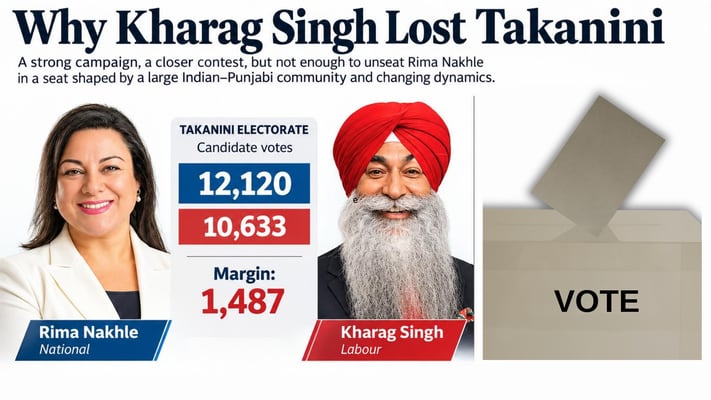


In one of New Zealand’s most visibly Punjabi-influenced electorates, Labour’s Indian-origin candidate mounted a spirited challenge but fell short. Was it divided migrant loyalties, an absent traditional Labour vote, or simply an incumbent who understood her constituency better than many expected?
Takanini delivered one of the more intriguing contests of the 2026 general election. In an electorate where Punjabi shops, Indian businesses and the magnificent Sri Kalgidhar Sahib Gurdwara reflect the growing presence of New Zealand’s Sikh community, Labour’s Kharag Singh appeared to have a genuine opportunity to make political history.
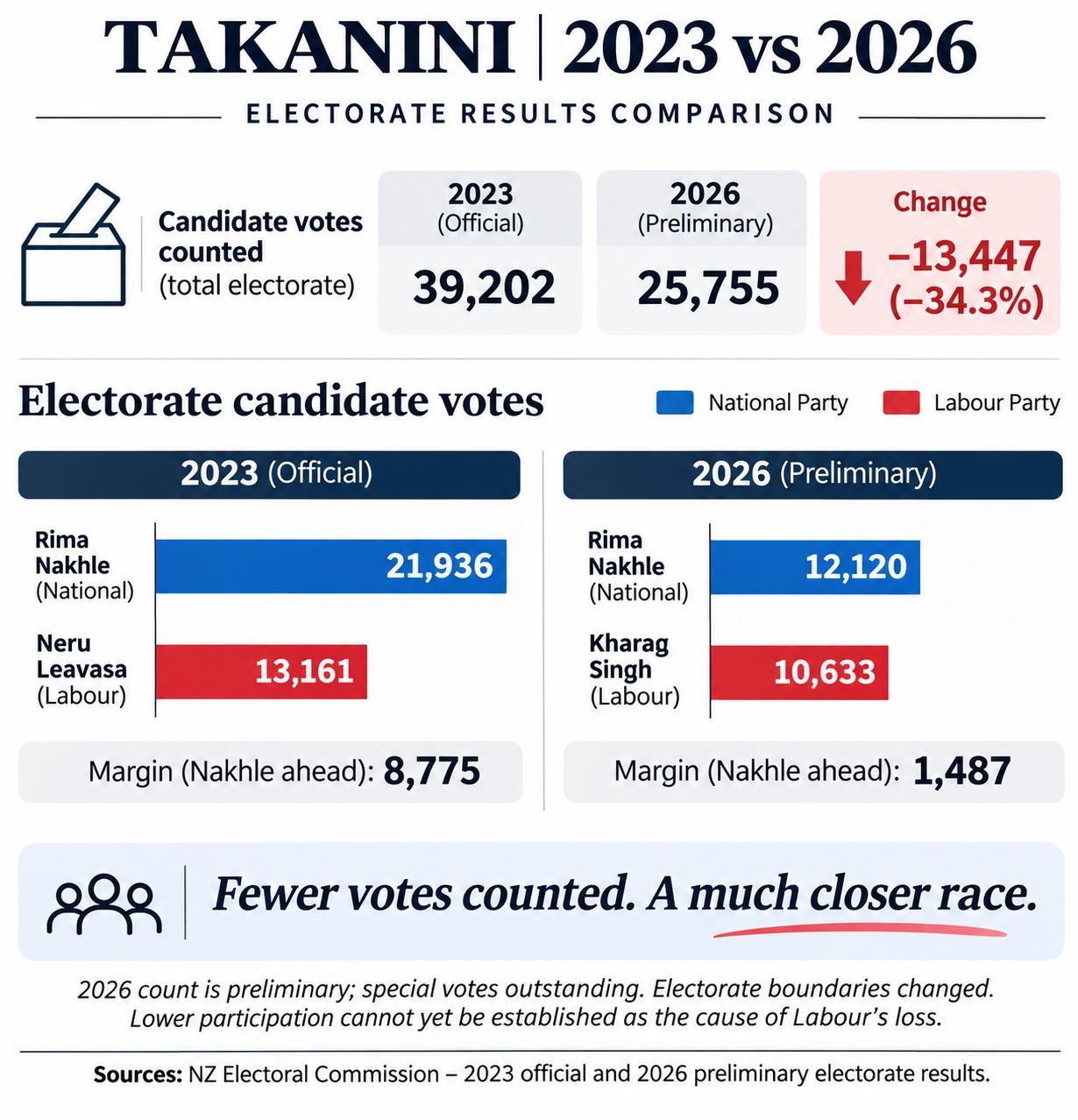
Yet, when the preliminary votes were counted, National’s Rima Nakhle had prevailed, securing 12,120 votes against Singh’s 10,633, a margin of 1,487.
For Singh, who ran a highly visible campaign, it was a disappointing outcome. For Nakhle, it was a significant political achievement, particularly considering how dramatically her majority had narrowed.
In a spirited response, Singh told The Indian Weekender that, as a Sikh, he was guided by a beautiful principle given by their Guru — Chardi Kala, which means remaining in high spirits, staying positive and keeping faith, whatever the circumstances.
He said that, regardless of the outcome, "we remain in Chardi Kala, with gratitude in our hearts".
Singh said the campaign had received a strong mandate from voters, with more than 10,000 votes cast in his favour.
"We were very positive, our team worked really really hard," he said.
"People opened a lot of doors and we made a lot of good friends in this journey."
He said special votes were still to be counted and expressed hope that the result could change.
"Special votes are yet to come and we hope we can flip it," he said.
Singh also extended Diwali and Bandi Chhor Divas greetings to the Indian diaspora, the Sikh community and everyone celebrating the festivals.
"Happy Diwali and Bandi Chhor Divas to everyone."
An official comment from Nakhle is awaited.
But beneath these numbers lies a more complicated story about ethnicity, political loyalty, community representation and possibly the voters who never turned up.
A constituency where the Punjabi presence is unmistakable
Drive through Takanini and the transformation is evident. Indian grocery stores, sweet shops, Punjabi businesses and Sikh community institutions have become defining features of the local landscape.
The presence of New Zealand’s largest gurdwara, Sri Kalgidhar Sahib, reinforces Takanini’s importance as a centre of Sikh religious and cultural life.
While claims that Punjabi voters constitute nearly half the electorate remain unverified, their growing visibility and political significance are difficult to overlook.
Both major parties recognised this.
Singh’s campaign was energetic and conspicuous, with Labour’s red hoardings appearing across the electorate. Nakhle maintained a strong local presence, drawing upon relationships cultivated with Indian and Sikh communities over several years.
The importance of these voters was underlined by visits from both Christopher Luxon and Chris Hipkins to the Takanini Gurdwara.
For Kiwi-Indians, such attention reflects a welcome recognition that migrant communities are increasingly central to New Zealand’s political conversation.
Did the Punjabi vote divide?
One plausible explanation for Singh’s defeat is that Punjabi voters did not consolidate behind him despite their shared cultural background.
In 2023, Nakhle defeated Labour’s Pasifika candidate, Neru Leavasa, by 8,775 votes. This time, Singh reduced that preliminary margin to just 1,487.
It is tempting to interpret this as evidence that Singh attracted a substantial share of Punjabi voters who previously supported National.
That possibility deserves investigation, but electorate results do not identify voters by ethnicity. Neither can we establish how many switched parties.
Nakhle’s longstanding relationships with Sikh and Indian communities may have helped her retain support, while Singh’s candidacy offered voters another form of community representation.
Importantly, Indian voters cannot be treated as a single political bloc.
For migrant families and small-business owners, law and order, immigration pathways, economic stability and the cost of living can matter as much as a candidate’s cultural identity.
National emphasised its record on crime, while Labour campaigned on affordability and economic pressures. How individual Punjabi voters weighed those arguments remains unknown.
The broader lesson is that shared ethnicity does not automatically translate into shared political allegiance.
The Pasifika question Labour must examine
Perhaps the most interesting unanswered question concerns Takanini’s Pasifika communities.
In 2023, Leavasa secured 13,161 votes for Labour. Singh received 10,633 in the 2026 preliminary count.
Was Leavasa’s Pasifika identity instrumental in mobilising voters who were less enthusiastic about Labour’s new candidate? Did some traditional Labour supporters feel insufficiently represented? Or were they simply less engaged in this election?
These questions deserve serious examination.
Pasifika communities have historically been an important part of Labour’s South Auckland support. Yet the campaign’s visible emphasis on Indian and Sikh engagement raises a legitimate question about how effectively both candidates connected with the electorate’s other communities.
It would be unfair, however, to conclude that Pasifika voters stayed home because Singh was not Pasifika. Social media visibility is not a reliable measure of community engagement, and there is no verified ethnic turnout data establishing such a decline.
The mathematics nevertheless illustrates the stakes. With Nakhle ahead by 1,487 votes, an additional 1,488 votes for Singh, with all other totals unchanged, would have reversed the preliminary result.
Whether those votes were available among non-participants is another matter entirely.
The boundary change complicates everything
One crucial factor is the redrawing of Takanini’s electoral boundaries.
The electorate lost areas to Botany, Papakura, Manurewa and Ōtāhuhu. Some traditionally National-leaning neighbourhoods were removed, making comparisons with 2023 particularly difficult.
Total candidate votes counted fell from 39,202 in 2023 to 25,755 in the 2026 preliminary result, a reduction of approximately 34%.
At first glance, that suggests a substantial participation problem.
But the comparison is misleading without accounting for boundary changes and special votes still awaiting inclusion.
Until official enrolment and turnout statistics become available, claims of widespread voter abstention remain unproven.
A victory for relationships over assumptions?
Nakhle deserves recognition for defending her seat against a determined challenger.
Her continued engagement with Indian and Sikh communities demonstrated that political relationships developed over time can matter more than assumptions about ethnic solidarity.
Singh, meanwhile, showed that an Indian-origin Labour candidate could mount a competitive challenge in a constituency with a prominent migrant population.
His defeat should not be interpreted as rejection by the Punjabi community. Equally, his strong showing does not prove that Punjabi voters abandoned National.
The wider election also offered a reminder about the limits of divisive politics. In neighbouring Papakura, Hannah Tamaki contested the seat for Vision New Zealand, a party advocating restrictions on immigration. Its limited preliminary support provides little evidence of broad electoral enthusiasm for that platform.
The unanswered question
Ultimately, Singh’s defeat may reflect several overlapping factors: Nakhle’s established community relationships, divided candidate preferences, wider concerns about economic management and public safety, and potentially uneven participation among Labour’s traditional supporters.
But none can yet be isolated as the decisive cause.
For Kiwi-Indians, Takanini represents something larger than one election result. It demonstrates the growing political visibility of migrant communities while reminding us that representation and electoral support are not interchangeable.
The official results, demographic analysis and voting-place statistics will eventually provide a clearer picture.
Until then, one conclusion stands: Kharag Singh made Takanini competitive, but Rima Nakhle retained enough support to withstand the challenge. The real story is not simply who won, but how a changing electorate is reshaping New Zealand politics.


ISSUE

Leave a Comment