




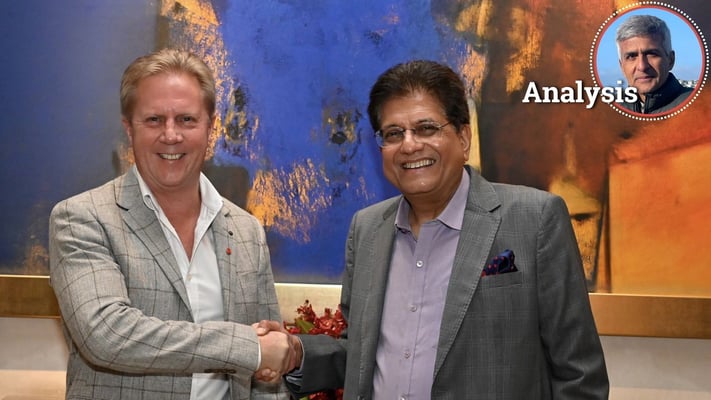



The New Zealand-India Free Trade Agreement is poised to enter the legislative process in New Zealand, with cross-party support from the opposition Labour Party, amid anti-India racist sentiment stoked by ruling coalition partner, New Zealand First.
Minister for Trade and Investment Todd McClay returns from India next week with a trade agreement signed and ready to be tabled in the New Zealand Parliament.
But prior to his departure for New Delhi over the weekend, McClay faced tough questions in parliament fired at him by coalition partner and prime critic of the trade deal, New Zealand First’s Winston Peters.
Peters grilled McClay on the Temporary Employment Entry (TEE) visa and the provision allowing visa holders to bring their family members to New Zealand, “as is the case with temporary entry visa holders from other FTA partners, such as China, Thailand, and the Phillipines.”
It is on this point that the fine print in the NZ-India FTA requires to be amplified for clarity.
Parliament heard that every year 1,670 high skilled workers can enter New Zealand via a special visa that allows them to stay for three years and mandated them to “return home” at the end of that period.
The government says the trade agreement with India is different from other agreements because it “does not give them a right automatically to bring family members here.”
However, the government has left a window ajar for Indian workers barred from bringing their families to New Zealand. They are free to apply for visas “in other parts of New Zealand policy around immigration.”
Critics of the FTA have called out an apparent discriminatory bias in its text.
Peters milks that to dramatic effect by noting:
“An Indian chef coming here under the Indian Free Trade Agreement will have fewer rights than a Chinese chef coming in under the China-New Zealand FTA. In other words, an Indian chef is worth less to the National Party than a Chinese chef?”
McClay skirts the issue of parity raised by Peters by falling back on an artless literalist approach that relies heavily on textual accuracy.
“That was not part of the negotiation, nor is it part of the trade agreement. No commitments were made in that area.”
Clearly, the National Party is delinking trade from migration to blunt the objections raised by its coalition partner, New Zealand First.
The cracks exposed within the ruling coalition around perceived discriminatory clauses, contained in the FTA, are absurdly theatrical, considering that New Zealand First has earned notoriety for coining the racially-charged phrase “butter chicken tsunami,” aimed at exaggerating migrant inflows from India.
Peters builds on that apocalyptic vision of New Zealand’s borders being breached by mass migration from the Third World by buttressing it with numbers.
“On average, a visa holder will bring their partner and two children with them.”
He follows this up with a poser:
“Doesn’t the 5,000 TEE visa and the FTA mean that up to 20,000 more Indians are able to come to New Zealand?”
McClay counters by invoking the emotive image of the toiling immigrant working long hours to keep the economy running in New Zealand.
International students from India, the other bugbear of populist politicians fearful of a demographic shift in the wake of uncapped student numbers, sees McClay pivoting to the back foot. He is quick to point out that controls are in place to manage the numbers.
But it is around the $33 billion investment target, spread over a period of 15 years, that the sophistry, generated by the FTA’s text, peaks.
“Aspirational” is a key word bandied about by Trade Minister McClay to hedge his position in the event that the FTA’s investment target is not met. It is noteworthy that the trade minister cites the High Commissioner of India to New Zealand to source the word, saying, “In fact, a month or two ago, the Indian High Commissioner to New Zealand stated this publicly and said the figure that has been mentioned is aspirational.”
No doubt, McClay is seeking to corroborate his stand on the investment target of the FTA by aligning it to India’s position, articulated by a representative of the Government of India in New Zealand.
The trade minister is at pains to establish that “the New Zealand Government, through the India free trade agreement, has not taken on a commitment to invest an amount of money in India.”
Instead, the government has “taken on a commitment to promote investment in India.”
In other words, the trade deal between New Zealand and India rests on goodwill and trust, and is not defined strictly in dollar terms.
On the tricky issue of a clawback of benefits by India if the investment target is not met by New Zealand, McClay is not inclined to be alarmist. He prefers to view that as part of the nitty-gritty of monitoring the agreement.
The bottomline, as McClay and supporters of the trade deal see it, is:
“A country of 5 million people selling to a country of 1.4 billion people.”




ISSUE


Leave a Comment