

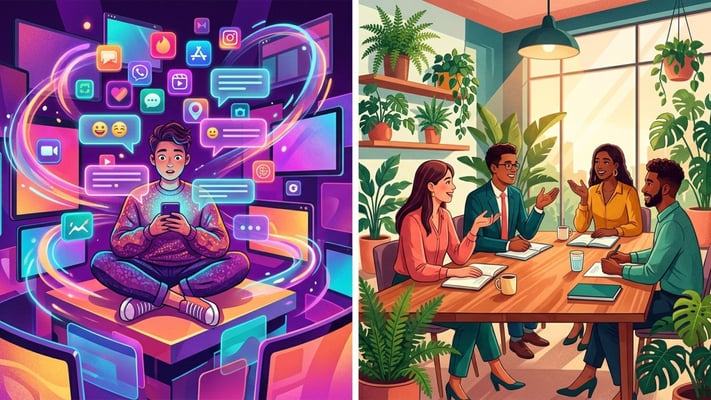
The divergence between digital fluency and interpersonal resilience
Every generation grows up with tools that quietly shape how it thinks and relates to other people. For young people today, those tools sit in their pockets, move at great speed, and run on algorithms built to predict what they want before they even ask.
As instant messaging, feeds, and AI become the backdrop of daily life, a basic human skill is starting to slip away: emotional literacy.
Emotional literacy isn't just about having feelings. It is the day-to-day work of figuring out what is actually going on inside your own head, sitting with discomfort instead of running from it, and picking up on what someone else is trying to say without spelling it out.
Older generations picked this up through the slow, often awkward friction of offline life, waiting out a heavy silence, hashing out an argument face-to-face, or staying in a hard conversation because there was no easy way out. Today’s youth are growing up in spaces carefully designed to remove that friction altogether.
You can see how this plays out in small daily habits. When a conversation gets tense, a quick swipe changes the topic. When boredom or loneliness creeps in, an algorithm immediately serves up an endless feed of short videos to numb the feeling before a person even has a chance to ask why they feel that way.
Unlike a real friend or mentor, an AI won't misread your tone, call you out with an uncomfortable truth, or ask for your patience. That kind of buffer feels comforting in the moment, but it robs people of the everyday social friction they need to build real emotional resilience.
Over time, leaning on screens creates a wide gap between how fluent someone is with technology and how fluent they are with people.
Heavy, complicated feelings like grief, mixed emotions, or quiet frustration get flattened into reaction emojis, memes, and two-line texts. Because a screen strips away posture, eye contact, and the slight edge in someone's voice, people get far fewer chances to read emotional nuance on the fly.
This gap shows up starkly in modern workplaces. Many young professionals entering hybrid offices handle technical workflows effortlessly, yet freeze when dealing with unscripted human tension. Routine constructive feedback from a manager can feel like a personal crisis when you aren't used to reading vocal tone, and prickly team disagreements often get buried under polite emails instead of being talked through directly.
As AI takes over more routine administrative and analytical work, the skills that actually matter for leadership, empathy, real listening, and making a team feel safe to speak up, become harder to replace. Fixing this doesn't mean throwing out our phones or treating new technology like the enemy. It just means taking emotional education as seriously as we take digital skills.
In practice, that starts with protecting spaces where people must interact offline. Sports teams, arts programmes, local volunteering, and simple phone-free conversations, at the dinner table and at the office, force people to compromise, collaborate, and read the room in real time. It is important to move past automatic answers like "I'm fine" or "I'm busy" to actually name feelings like disappointment, burnout, or uncertainty.
Technology will keep evolving, giving us faster and slicker ways to stay in touch across distances. Still, no screen can replicate the quiet nerve it takes to sit with someone else's discomfort, admit when you are vulnerable, or handle a tough conversation with grace. Helping today’s generation build real emotional literacy ensures they stay in charge of their own inner lives, rather than letting the algorithms in their hands do the steering.
Every generation grows up with tools that quietly shape how it thinks and relates to other people. For young people today, those tools sit in their pockets, move at great speed, and run on algorithms built to predict what they want before they even ask.
As instant messaging, feeds, and AI become...
Every generation grows up with tools that quietly shape how it thinks and relates to other people. For young people today, those tools sit in their pockets, move at great speed, and run on algorithms built to predict what they want before they even ask.
As instant messaging, feeds, and AI become the backdrop of daily life, a basic human skill is starting to slip away: emotional literacy.
Emotional literacy isn't just about having feelings. It is the day-to-day work of figuring out what is actually going on inside your own head, sitting with discomfort instead of running from it, and picking up on what someone else is trying to say without spelling it out.
Older generations picked this up through the slow, often awkward friction of offline life, waiting out a heavy silence, hashing out an argument face-to-face, or staying in a hard conversation because there was no easy way out. Today’s youth are growing up in spaces carefully designed to remove that friction altogether.
You can see how this plays out in small daily habits. When a conversation gets tense, a quick swipe changes the topic. When boredom or loneliness creeps in, an algorithm immediately serves up an endless feed of short videos to numb the feeling before a person even has a chance to ask why they feel that way.
Unlike a real friend or mentor, an AI won't misread your tone, call you out with an uncomfortable truth, or ask for your patience. That kind of buffer feels comforting in the moment, but it robs people of the everyday social friction they need to build real emotional resilience.
Over time, leaning on screens creates a wide gap between how fluent someone is with technology and how fluent they are with people.
Heavy, complicated feelings like grief, mixed emotions, or quiet frustration get flattened into reaction emojis, memes, and two-line texts. Because a screen strips away posture, eye contact, and the slight edge in someone's voice, people get far fewer chances to read emotional nuance on the fly.
This gap shows up starkly in modern workplaces. Many young professionals entering hybrid offices handle technical workflows effortlessly, yet freeze when dealing with unscripted human tension. Routine constructive feedback from a manager can feel like a personal crisis when you aren't used to reading vocal tone, and prickly team disagreements often get buried under polite emails instead of being talked through directly.
As AI takes over more routine administrative and analytical work, the skills that actually matter for leadership, empathy, real listening, and making a team feel safe to speak up, become harder to replace. Fixing this doesn't mean throwing out our phones or treating new technology like the enemy. It just means taking emotional education as seriously as we take digital skills.
In practice, that starts with protecting spaces where people must interact offline. Sports teams, arts programmes, local volunteering, and simple phone-free conversations, at the dinner table and at the office, force people to compromise, collaborate, and read the room in real time. It is important to move past automatic answers like "I'm fine" or "I'm busy" to actually name feelings like disappointment, burnout, or uncertainty.
Technology will keep evolving, giving us faster and slicker ways to stay in touch across distances. Still, no screen can replicate the quiet nerve it takes to sit with someone else's discomfort, admit when you are vulnerable, or handle a tough conversation with grace. Helping today’s generation build real emotional literacy ensures they stay in charge of their own inner lives, rather than letting the algorithms in their hands do the steering.


Leave a Comment