




New Zealand & India Free Trade Agreement finalised: Details inside
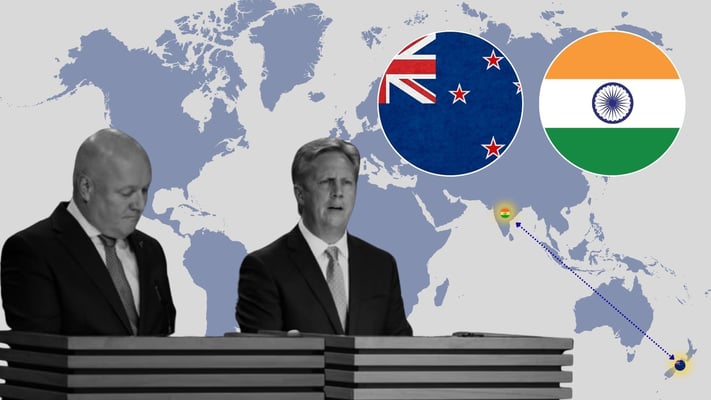



New Zealand and India have concluded a Free Trade Agreement after several rounds of negotiations between the two countries.
The announcement came today as Prime Minister Christopher Luxon and Trade and Investment Minister Todd McClay held a press conference.
Negotiations began on 21 March this year and concluded after nine months. The Agreement is to be signed in the first half of next year.
The Free Trade Agreement between the two nations offers New Zealanders unprecedented access to 1.4 billion Indian consumers, Minister Todd McClay said today.
“This once-in-a-generation Agreement creates opportunities New Zealand exporters have never had in India. This deal is in New Zealand’s best interest and will deliver thousands of jobs and billions in additional exports,” McClay said.
The Agreement removes and reduces tariffs on 95 per cent of New Zealand’s exports.
While offering New Zealand exporters an equal or better footing than their competitors, the deal opens access to India’s rapidly expanding middle class.
“The Indian economy is forecast to grow to NZ$12 trillion by 2030. The India-NZ Free Trade Agreement unleashes huge potential for our world-class exporters to the world’s largest country and will significantly accelerate progress towards New Zealand’s ambitious goal of doubling the value of exports over 10 years,” McClay added.
“In a world-first New Zealand will have duty-free access for a large kiwifruit quota – nearly four times our current exports - with a 50 per cent tariff applying outside quota. For the first time in an FTA, India has agreed preferential market access for apples and mānuka honey," McClay said.
What does this mean for New Zealand:
1.Tariff elimination or reduction on 95 per cent of exports,
2. Duty-free access on almost 57 per cent of New Zealand’s exports from day one, increasing to 82 per cent when fully implemented, with the remaining 13 per cent being subject to sharp tariff cuts.
3. Immediate tariff elimination on sheep meat, wool, coal and over 95 per cent of forestry and wood exports
4.Duty-free access on most seafood exports, including mussels and salmon, over seven years
5.Duty-free access on most iron, steel and scrap aluminium, over 10 years or less
6.Duty-free access for most industrial products, over five to 10 years
7.50 per cent tariff cut for large quota of apples – nearly double recent average exports
8.Duty-free access for kiwifruit within a quota almost four times the recent average exports, and tariff halved for exports outside of quota.
9.Duty-free access for cherries, avocados, persimmons and blueberries, over 10 years.
10.Tariffs on wine reduced from 150 per cent to either 25 or 50 per cent (depending on the value of the wine) over 10 years plus Most Favoured Nations (MFN) commitment.
11.Tariffs on mānuka honey cut from 66 per cent to 16.5 per cent over five years.
12.MFN status and liberalisation across services exports.
13.Duty-free access for dairy and other food ingredients for re-export from day one.
Duty-free access for bulk infant formula and other high-value dairy preparations over seven years. 50 percent tariff cut for high value milk albumins within a NZ-specific quota equal to current export volumes.
McClay said the FTA has broad services coverage and builds significantly on India’s WTO commitments with a focus on financial services, e-payments and FinTech, and includes an MFN clause to future-proof our services trade.
What does it mean for Dairy?
Previously, efforts to secure a Free Trade Agreement with India have stalled over dairy.
McClay explained in order to protect specialist and iconic New Zealand product names in each other’s markets, the countries have agreed to establish Geographical Indication rules comparable to those with the EU.
“This FTA future-proofs New Zealand’s dairy access by offering a right to negotiate should India give better access to comparable countries, by triggering an automatic consultation process to consult and upgrade.”
“New Zealand exporters will enjoy duty-free access for dairy and other food ingredients for re-export through the FTA, opening the door to greater collaboration and processing, and offer access to India’s growing number of FTA partners through a dedicated fast-track mechanism,” McClay said.
“To better provide the skills to grow the New Zealand economy the Agreement establishes a process for up to an average of 1,667 skilled 3-year work visas per year”
These temporary visas will focus on priority jobs where New Zealand has skills shortages, including doctors, nurses, teachers, ICT and engineering and are non-renewable, he added.
“In addition, to ensure our tourism and rural sectors have the workers they need we have aligned our Working Holiday Scheme with Australia’s Indian FTA, providing up to 1,000 places each year."
The Agreement includes a Treaty of Waitangi clause allowing to meet Treaty obligations, as well as Chapters on Customs Facilitation and Clearance, Technical Barriers to Trade, Sanitary and Phyto-Sanitary Standards, Culture, Trade and Traditional Knowledge, Economic Cooperation, Trade and Sustainable Development.
“We've also agreed to review the FTA one year after entry into force, which provides a mechanism to pursue further improvements into the future,” McClay explained.
“Trade grows the economy and creates jobs - the NZ India Free Trade Agreement is about future-proofing opportunities for our exporters and allowing Kiwi companies to continue to punch above their weight on the world stage.”
For more information go to: www.mfat.govt.nz/nz-india-fta.
New Zealand and India have concluded a Free Trade Agreement after several rounds of negotiations between the two countries. The announcement came today as Prime Minister Christopher Luxon and Trade and Investment Minister Todd McClay held a press conference.Negotiations began on 21 March this year...
New Zealand and India have concluded a Free Trade Agreement after several rounds of negotiations between the two countries.
The announcement came today as Prime Minister Christopher Luxon and Trade and Investment Minister Todd McClay held a press conference.
Negotiations began on 21 March this year and concluded after nine months. The Agreement is to be signed in the first half of next year.
The Free Trade Agreement between the two nations offers New Zealanders unprecedented access to 1.4 billion Indian consumers, Minister Todd McClay said today.
“This once-in-a-generation Agreement creates opportunities New Zealand exporters have never had in India. This deal is in New Zealand’s best interest and will deliver thousands of jobs and billions in additional exports,” McClay said.
The Agreement removes and reduces tariffs on 95 per cent of New Zealand’s exports.
While offering New Zealand exporters an equal or better footing than their competitors, the deal opens access to India’s rapidly expanding middle class.
“The Indian economy is forecast to grow to NZ$12 trillion by 2030. The India-NZ Free Trade Agreement unleashes huge potential for our world-class exporters to the world’s largest country and will significantly accelerate progress towards New Zealand’s ambitious goal of doubling the value of exports over 10 years,” McClay added.
“In a world-first New Zealand will have duty-free access for a large kiwifruit quota – nearly four times our current exports - with a 50 per cent tariff applying outside quota. For the first time in an FTA, India has agreed preferential market access for apples and mānuka honey," McClay said.
What does this mean for New Zealand:
1.Tariff elimination or reduction on 95 per cent of exports,
2. Duty-free access on almost 57 per cent of New Zealand’s exports from day one, increasing to 82 per cent when fully implemented, with the remaining 13 per cent being subject to sharp tariff cuts.
3. Immediate tariff elimination on sheep meat, wool, coal and over 95 per cent of forestry and wood exports
4.Duty-free access on most seafood exports, including mussels and salmon, over seven years
5.Duty-free access on most iron, steel and scrap aluminium, over 10 years or less
6.Duty-free access for most industrial products, over five to 10 years
7.50 per cent tariff cut for large quota of apples – nearly double recent average exports
8.Duty-free access for kiwifruit within a quota almost four times the recent average exports, and tariff halved for exports outside of quota.
9.Duty-free access for cherries, avocados, persimmons and blueberries, over 10 years.
10.Tariffs on wine reduced from 150 per cent to either 25 or 50 per cent (depending on the value of the wine) over 10 years plus Most Favoured Nations (MFN) commitment.
11.Tariffs on mānuka honey cut from 66 per cent to 16.5 per cent over five years.
12.MFN status and liberalisation across services exports.
13.Duty-free access for dairy and other food ingredients for re-export from day one.
Duty-free access for bulk infant formula and other high-value dairy preparations over seven years. 50 percent tariff cut for high value milk albumins within a NZ-specific quota equal to current export volumes.
McClay said the FTA has broad services coverage and builds significantly on India’s WTO commitments with a focus on financial services, e-payments and FinTech, and includes an MFN clause to future-proof our services trade.
What does it mean for Dairy?
Previously, efforts to secure a Free Trade Agreement with India have stalled over dairy.
McClay explained in order to protect specialist and iconic New Zealand product names in each other’s markets, the countries have agreed to establish Geographical Indication rules comparable to those with the EU.
“This FTA future-proofs New Zealand’s dairy access by offering a right to negotiate should India give better access to comparable countries, by triggering an automatic consultation process to consult and upgrade.”
“New Zealand exporters will enjoy duty-free access for dairy and other food ingredients for re-export through the FTA, opening the door to greater collaboration and processing, and offer access to India’s growing number of FTA partners through a dedicated fast-track mechanism,” McClay said.
“To better provide the skills to grow the New Zealand economy the Agreement establishes a process for up to an average of 1,667 skilled 3-year work visas per year”
These temporary visas will focus on priority jobs where New Zealand has skills shortages, including doctors, nurses, teachers, ICT and engineering and are non-renewable, he added.
“In addition, to ensure our tourism and rural sectors have the workers they need we have aligned our Working Holiday Scheme with Australia’s Indian FTA, providing up to 1,000 places each year."
The Agreement includes a Treaty of Waitangi clause allowing to meet Treaty obligations, as well as Chapters on Customs Facilitation and Clearance, Technical Barriers to Trade, Sanitary and Phyto-Sanitary Standards, Culture, Trade and Traditional Knowledge, Economic Cooperation, Trade and Sustainable Development.
“We've also agreed to review the FTA one year after entry into force, which provides a mechanism to pursue further improvements into the future,” McClay explained.
“Trade grows the economy and creates jobs - the NZ India Free Trade Agreement is about future-proofing opportunities for our exporters and allowing Kiwi companies to continue to punch above their weight on the world stage.”
For more information go to: www.mfat.govt.nz/nz-india-fta.


Related Posts
ISSUE


Leave a Comment