




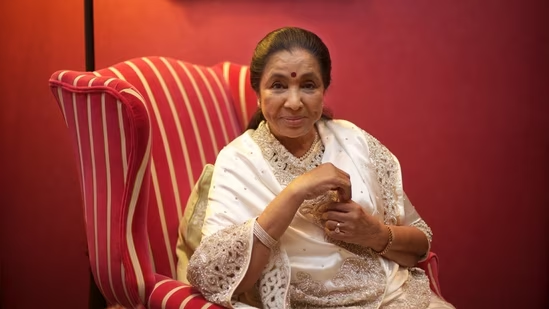



Asha Bhosle, whose voice defined generations of Indian film music and whose artistry remained unparalleled across seven decades, breathed her last at the age of 92. Reported by Hindustan Times.
According to Hindustan Times. The legendary singer had been admitted to Breach Candy Hospital in Mumbai on Saturday following a sudden deterioration in her health, with doctors reporting serious cardiac and respiratory complications.
Sources close to the family revealed that Bhosle had been in declining health for several months prior to her hospitalization and was brought to the medical facility in a deeply critical condition. She was shifted to the Intensive Care Unit late Saturday night, where she remained under close medical supervision.

Her son, Anand Bhosle, made the heartbreaking announcement on Sunday afternoon, confirming what millions of fans across the world had feared. The family has announced that her last rites will be performed the following day.
A Career Unlike Any Other
To call Asha Bhosle merely a singer would be a profound understatement. She was a phenomenon — a force of nature who reshaped the very contours of playback singing in Hindi cinema.
Among all the vocalists who graced Indian film music, her stature stood rivalled only by that of her elder sister, the late and equally legendary Lata Mangeshkar. Together, the two sisters formed a musical dynasty that dominated Bollywood for the better part of the twentieth century.
Born in 1933 into the illustrious Mangeshkar family, music was not simply a passion for Asha — it was her inheritance. She began singing professionally at the tender age of nine, displaying a maturity and command over melody that belied her years.
By 1943, she had already recorded her first film song, stepping into an industry that would soon come to revolve around her voice. As the 1950s dawned, Asha Bhosle had firmly established herself as one of Bollywood's most distinctive and in-demand playback singers, carving out a niche that was entirely her own.
In the early years of her career, she was frequently typecast, with composers and filmmakers relegating her largely to cabaret numbers and dance sequences — what today's audiences might refer to as item songs.
Yet, rather than allowing such limitations to define her, Asha transcended them with remarkable grace and range. She demonstrated a versatility that few could match, eventually lending her voice to ghazals with exquisite refinement, most memorably in the critically acclaimed film Umrao Jaan, where her performances left audiences and critics alike utterly spellbound.
Her trophy cabinet is a testament to a career of extraordinary achievement. Asha Bhosle claimed the Filmfare Best Female Playback Singer Award seven times — a record that speaks volumes about her enduring dominance in an industry never short of exceptional talent.
She also earned the National Film Award on two separate occasions: once for the soul-stirring Dil Cheez Kya Hai from Umrao Jaan, and again for the poignant Mera Kuch Saamaan from Ijaazat. These honours, spread across different eras of Indian cinema, reflect a career that never stagnated but continued to evolve and inspire.
Even in her later years, Bhosle remained deeply opinionated about the music industry she had helped build. In a candid conversation with Hindustan Times in 2023, she offered her unfiltered thoughts on the contemporary musical landscape.
She said, "Main sach bolu toh main aaj ke gaane sunti hi nahi hoon. If I have to listen to songs, I hear (late vocalist) Bhimsen Joshi's songs, classical songs and ghazals as I get to learn and simultaneously, polish and practice my songs better through that. Because of this, my capability of singing gets better, and I improvise and sing better.

I don't really find songs with excellent lyrics today, but I listen to them occasionally and sometimes, I come across good songs by (singers) Rahat Fateh Ali (Khan), Sunidhi (Chauhan) so yes, I do find some of them good, but I rarely listen to music. If I have to, then I listen to the old songs."
It was a statement that encapsulated everything about her — uncompromising in her standards, deeply rooted in the classical traditions she had grown up with, and unwilling to offer hollow praise simply for the sake of diplomacy.
A Life Marked by Resilience and Romance
Behind the brilliance of her public life lay a personal story full of turbulence, heartbreak, courage, and ultimately, love. At just sixteen years of age, in an act of extraordinary boldness for the era, Asha eloped with Ganpatrao Bhosle, a man fifteen years her senior who had been serving as her personal secretary. The union was made entirely against the wishes of her family, who viewed the relationship with deep disapproval.
What followed, however, was far from the fairy tale the young Asha may have envisioned. Her in-laws reportedly subjected her to considerable mistreatment, making her married life a source of suffering rather than joy. Summoning the same inner strength that would define her professional life, she walked away from the marriage. The couple formally separated in 1960, by which point they had three children together. For a woman of her background and era, such a decision required enormous courage, and it spoke to a spirit that refused to be broken.
Love found her again, however — and this time, in one of the most celebrated romances in the world of Indian music. Asha eventually entered into a relationship with the immensely gifted composer Rahul Dev Burman, popularly known as R.D. Burman or Pancham, the son of the iconic Sachin Dev Burman. The two had shared a creative bond for years before their personal relationship blossomed. Despite Rahul being six years her junior — and despite facing considerable resistance from the Burman family, particularly from Rahul's mother — the couple wed in 1980, in a union that brought together two of the most talented musical minds of their generation.
Their years together were marked by deep personal and artistic companionship, making Rahul Dev Burman's death in 1994 all the more devastating. Asha had lost not just a husband, but her closest creative partner and confidant.
In her final years, it was her granddaughter, the young and talented singer Zanai Bhosle, who remained by her side as her most constant companion, ensuring that the great lady of Indian music was surrounded by love, family, and the very art form she had devoted her entire life to.
The world of music has lost one of its finest voices. But the songs she left behind will continue to echo through time, long after the silence she has now become.


ISSUE


Leave a Comment