




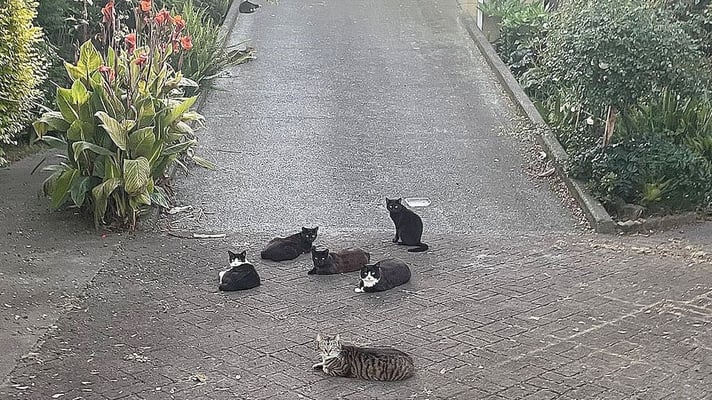




Residents in Ōpōtiki say their neighbourhoods are being overrun by cats and are calling on the Ōpōtiki District Council to introduce a policy to limit numbers. Reported by 1News.
Neil Ericksen told the council he had been dealing with stray cat issues since moving into his home two years ago.
“There have been times when I have found five cats on my patio," he said.
Ericksen said patio furniture he inherited from his mother had been ruined by the animals. Despite trying various deterrents, including repellents, pepper, water, and anti-cat mats, the problem persisted.
After borrowing animal traps from the Ōpōtiki Society for the Care of Animals (ŌSCA), he trapped seven cats in two weeks, but said it made little difference.
“Still, they come and come.”
He said the issue appeared particularly severe around Bracken Street and claimed he had seen up to 10 cats at once on the lawn of the Anglican Church in Church Street. Ericksen also pointed to clusters of stray cats near Elliot Street’s laundromat and around Mitre 10.
Julie van der Veer said her street had seen a surge in cats and kittens over the past year, mostly linked to a single property.
“[The cats] defecate on everyone else's garden and urinate on our porches.”
Reg Taia, who lives near a property where dozens of cats are fed, said the animals frequently entered his home if doors were left open.
"We don't hate cats, but we hate what dozens of cats that don't belong to us are doing to our properties,” he said.
"They chase away and kill the birds that used to frequent our backyard.”
Residents praised the council’s animal control team for successfully reducing barking dog complaints but said they were told no action could be taken on cats due to the absence of a formal policy.
Ericksen submitted research showing other councils — including Whanganui, Palmerston North, Hutt City, Wellington City, Ruapehu and Selwyn — had cat control policies.

These included limits on household cat numbers, compulsory microchipping and desexing, and rules requiring cats to be kept indoors at night. He also called for a ban on feeding cats on non-residential properties.
He said feral cats were also affecting rural areas, claiming locals blamed them for a decline in kiwi calls.
Councillor Barry Howe said he supported a cat policy, while Councillor Dean Peterson questioned whether staff had the capacity to enforce it. Council staff said resources were already stretched managing dog and horse control and livestock on roads.
Chief executive Stace Lewer asked councillors to consider whether staff should investigate the issue further as part of the upcoming long-term plan. Mayor David Moore said central government also needed to be involved.
"We've got a current government that's making lots of noise about us sticking to core business, and whether dog control is core business is even debatable to them, so we need them to step up and do their bit.”
He added that without ŌSCA, the town’s cat problem would be far worse.
ŌSCA representative Kathleen Young said she supported desexing and microchipping for all companion animals.
“Certainly, that is what we have been working on for the last 15 to 20 years.”
She said ŌSCA desexed around 140 cats last year and about 180 dogs since 2022, but warned the cost of enforcing a council-run cat policy would be high.
“I don’t see that ever happening,” she said.
“It is quite a complex problem, and I don’t see an easy solution, to be honest.”


ISSUE


Leave a Comment