




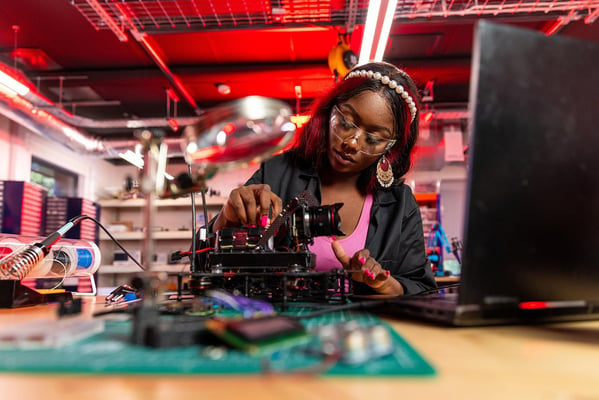



Fewer than one in 10 working engineers in the U.S. were female in 1979. Decades later, due to campaigns, scholarships, and corporate pledges, women make up about 16% of engineers.

While we have made progress since 1979, this represents only a minor change in the overall number of women engineers. The discipline that shapes the infrastructure, climate technology, artificial intelligence, and healthcare of our world remains overwhelmingly male in its composition, culture, and inherent assumptions.
So it is no longer a question of whether there is a problem; the question now is why proposed solutions change so slowly. What do women engineers believe must change?

For many years, supply was the reason for women's low participation in engineering fields, due to a lack of girls pursuing STEM fields and of women graduating with technical degrees.
However, this common story is no longer easy to rationalize. In several countries, including the UAE, Algeria, and Malaysia, more women are now graduating in engineering than men.
Yet the number of women in senior technical roles, leadership roles, and on boards at many larger engineering firms is another story entirely.
According to the World Economic Forum's 2025 Gender Gap Report, less than 20% of women have senior roles in the technology and infrastructure sectors. Graduation and employment rates are no longer correlated; there is a leak in the pipeline.
That leak has a name: attrition. An extensive study of female engineers from five countries showed that about 40% of women left the profession within 10 years, not because they were unsuccessful from a technical perspective, but because they could not tolerate unsatisfactory workplace cultures and the costs of doing so.
Isolation, the absence of visible female role models, consistent underrepresentation in projects, and what research calls micro-aggression fatigue have been identified as the principal reasons behind this. In this view, representation is about retention rather than talent.
Mentorship in engineering has become more developed than it used to be. There are now formal mentoring programs at almost all large companies.
However, most of the women engineers who leave those companies say these women's programs did not help them find work.
The important difference, which consistently appears in the research and in the experiences of women engineers in these careers, is not between being mentored and not being mentored, but between being mentored and being sponsored.
Sponsorship means an advocate uses their credibility to help someone advance in their job or career. Today, sponsorship is not equally available to everyone.
Studies by Lean In and McKinsey show that men are more likely to be sponsored than women at every stage of their careers, with the disparity even greater in STEM fields.
This lack of sponsorship creates significant barriers to advancement, since most people move only at a pace consistent with their competency until someone advocates for them and accelerates their progress.
Several global engineering companies now measure sponsorship relationships alongside mentoring relationships and hold executives accountable for both to ensure equity across all levels of employment.
Early results are surprising: companies that track both relationships have improved retention of female engineers promoted to leadership roles compared with companies that leave these networks informal and unregulated.
In Scandinavia, gender parity in engineering is treated less as a diversity initiative and more as an economic imperative. Norway's state oil company, Equinor, has operated a structured gender-balance program since 2008 and now reports that 35% of its technical leadership is female — more than double the global industry average.
The mechanism is not quotas alone, though Norway does maintain board representation requirements. It is the supporting infrastructure: blind-reviewed promotions, shared parental leave taken equally by men and women, and active data publication that holds departments publicly accountable.
In India, where women represent around 30% of engineering graduates but fewer than 14% of the engineering workforce, a different set of interventions is gaining traction.
Organizations such as NASSCOM and the Society of Women Engineers India chapter have moved beyond networking events toward structured re-entry programs for women who stepped out of the workforce — often for caregiving — and want to return.
Tata Consultancy Services' Second Career Internship program, now running across multiple technical disciplines, has graduated thousands of returning women engineers into permanent roles.
The lesson is transferable: the profession loses women at multiple points, and rebuilding re-entry pathways matters as much as preventing early exit.
The evidence increasingly points to a clear conclusion: individual solutions — a mentorship coffee, a conference scholarship — cannot compensate for structural conditions that make engineering inhospitable.
The firms and countries making the most measurable progress share a common feature: they treat the problem as a systems problem, gather data rigorously, and hold decision-makers accountable for outcomes rather than intentions.
The women engineers who have built careers in those environments do not describe them as perfect. They describe them as possible.


ISSUE


Leave a Comment