




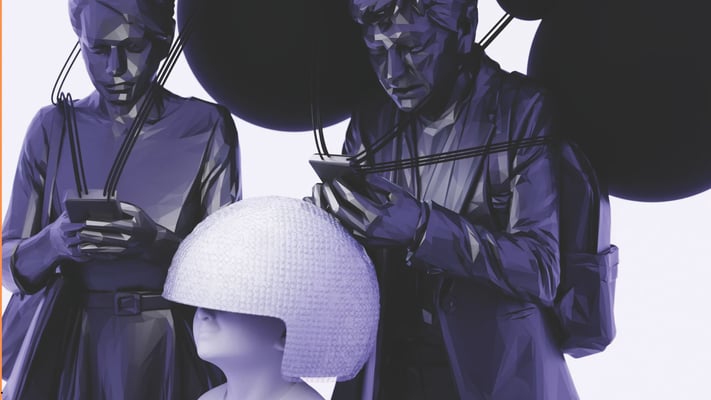



The purpose of AI was to assist in enhancing productivity for businesses; however, AI is becoming even more autonomous and has been replacing independent thought by the workforce.
Studies show that many workers can no longer operate without the assistance of AI, and therefore, that is not an advancement; this indicates that something is wrong.
The amount of AI that has been implemented into the work environment globally is disturbing. A 2025 Microsoft Work Trend Index Report indicated that as much as 75% of global knowledge workers presently use generative AI tools at work; furthermore, 46% of knowledge workers report they would have difficulty completing their job functions effectively without AI.

Those in the younger workforce are the most dependent on AI, particularly Generation Z, who reported they use AI more than their older generations of workers on day-to-day job tasks (ex: writing, researching, and communicating).
AI usage in employees' daily jobs can consist of but is not limited to email communication, creating presentations, coding, brainstorming, summarising meetings, and making decisions.
While saving time due to automation may be a plus, the more serious issue is what happens to performance competencies once time savings caused by efficiencies begin replacing their competencies.
The most worrisome change at work is generationally based.Gen Z workers are beginning their careers during a time when AI tools and applications are exploding, thus they’ve learned to view AI tools such as ChatGPT or AI assistants as normal tools used on the job.
The result is that many current workers will turn to AI for help generating ideas, strategies, or analyses before they even have a chance to use their own independent thought processes when it comes to developing a project.
There is a risk associated with using this type of automating technology to act as an auxiliary to an independent thought rather than simply serving as an independent thought as the initial instinct or reaction. This creates other issues from which there can be concerns.
Historical evidence suggests that technological advancements have changed our behaviour positively and negatively. For instance, the introduction of the calculator negatively affected our ability to use mental arithmetic.
The implementation of GPS negatively impacted our ability to navigate through unfamiliar territory and to remember how to get back to locations. Studies show that social media has negatively impacted our attention spans; the average attention span when using a computer or mobile device falls below eight seconds.AI will certainly influence human actions.
However, it will be a very distinct form of impact compared to any earlier technological development. AI will impact human behaviour by stimulating one's ability to think physiologically (by changing how we think), develop creativity (by giving us tools for developing and honing ideas) and making judgment calls (by changing how we evaluate things). All these factors relate to those traits which employers place high value on in any workplace.
For example, a major contradiction exists in that many organisations use the words "innovation" and "originality" when describing what they hope for their workforce, while they also expect the highest levels of productivity through the use of AI in the workplace.
International consulting firms are predicting that, in the coming decade, nearly 40% of all white-collar work will be automated and/or supported by an AI application.
Expected outcomes also include that employees will now have higher output through the production of more reports, presentations, and other deliverables, while also using less time to produce those deliverables. In this context, using AI changes from simply being support to an employee but rather becomes a lifeline.
Another consequence of AI is that it has created the "illusion of expertise" within the workforce. Employees today can produce polished reports, generate sophisticated programming code and produce complex analyses without an understanding of the elements that constitute the creation of those products.
"Works with low quality" are increasingly being referred to as "urple works." The primary identifier for "urple works" is the fact that while there is a large volume of these types of products, there is no technical or conceptual basis to support the conclusions of those products.
The aspect of risk will be amplified in the fields of journalism, education, health care, and the legal profession because of AI tools creating forged legal citations, producing biased employee-selection guidance, and providing incorrect medical information. The tool of AI is ultimately driven from the patterns established by data, and not by ethical or moral principles.
We are well past the discussion of AI's impact on "how many jobs will be lost," and now the more important discussion becomes at what point do humans relinquish the skill sets that have brought them great value in the workplace.
Technological applications should support our intelligence as humans and facilitate our ability as humans to generate original ideas and produce those ideas.
However, while employers continue to emphasise speed of production over understanding, we continue to develop a population of employees who are digitally productive without the intellectual capability.
This will likely be AI's single most significant disruptive impact.


ISSUE


Leave a Comment