




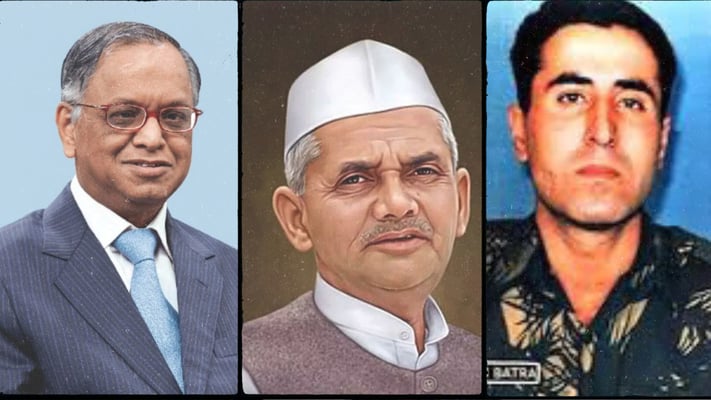



There comes a moment in every life when we must decide what truly defines us. The RIGHTS we demand or the RESPONSIBILITIES we uphold. Rights make life comfortable. Responsibilities make life meaningful.

Rights are about what the world owes us. Responsibilities are about what we owe to the world. And history shows us one truth again and again: the people who changed humanity were not those who fought for privileges, but those who carried burdens with courage.
When we choose responsibility over rights, we rise above self‑interest and step into a larger purpose. That is where character is born. That is where legacy begins. Presenting 3 Inspiring stories which will consolidate any reader’s faith about RESPONSIBILITY over RIGHTS

Story 1 Lal Bahadur Shastri: Duty Before Privilege. India's second Prime Minister, Lal Bahadur Shastri, lived one of the simplest lives among world leaders. When the country faced a severe food shortage in 1965, he did not merely ask citizens to reduce food consumption.
Instead, he appealed for everyone to skip one meal every week. More importantly, his own family observed the same discipline before asking the nation to follow. His message was powerful because he practiced responsibility before expecting cooperation. Leadership is never about claiming privileges.
It is about carrying responsibilities first. Even today, Shastri ji remains respected not because of the authority he held, but because of the responsibility he lived.
Story 2 – Captain Vikram Batra: Responsibility Above Life Itself In the summer of 1999, during the Kargil War, a young Indian Army officer named Captain Vikram Batra was given the responsibility of recapturing Point 5140, one of the most strategically important peaks occupied by enemy forces.
The mission was extremely dangerous. The mountain was steep, the enemy was positioned at higher ground, and every step forward meant risking life. But Captain Batra did not think about his own safety. He led his soldiers from the front, displaying extraordinary courage and determination.
During the operation, his famous words, "Yeh Dil Maange More", reflected not a desire for personal glory, but the spirit of a soldier who was ready to give everything for his duty. After successfully capturing Point 5140, he was assigned another difficult mission at Point 4875. During this battle, while rescuing an injured officer and leading his men against heavy enemy fire, Captain Batra made the supreme sacrifice.
He was only 24 years old. For his unmatched bravery, leadership, and devotion to duty, he was awarded India's highest wartime gallantry award, the Param Vir Chakra, posthumously. Captain Vikram Batra's life teaches us a profound lesson: Rights ask, "What do I deserve?" Responsibility asks, "What can I give?" He had the right to protect his own life, to think about his future, and to choose comfort.
But he chose responsibility over personal safety. Because great souls understand that some duties are bigger than life itself. Also a great learning that "A nation is not protected only by weapons; it is protected by people who consider their responsibilities greater than their own rights."
Story 3 : Narayana Murthy - The Responsibility That Built India’s Tech Revolution Long before Infosys became a global powerhouse, Narayana Murthy lived in a small apartment, writing code on borrowed computers. He didn’t begin with rights - he began with responsibility.
Murthy believed that India could compete globally if someone took responsibility for building an ethical, transparent, world‑class company. He refused bribes, rejected shortcuts, and insisted on values even when the company had no money to pay salaries.
When Infosys went public, Murthy made a decision that shocked the corporate world: he distributed wealth among employees, creating thousands of first‑generation millionaires. His philosophy was clear: “Performance leads to recognition. Recognition leads to respect.
And respect leads to power. But responsibility must lead every step.” Murthy’s story reminds us that responsibility is not about carrying weight — it is about lifting others.
SOME LIFE LESSONS FROM THESE STORIES : Our rights make us free. Our responsibilities make us worthy. When everyone demands rights, conflicts increase. When everyone fulfils responsibilities, rights naturally flourish. "Rights give us freedom to live. Responsibilities give our lives a reason to matter. History remembers not those who demanded more, but those who contributed more."



ISSUE


Leave a Comment