

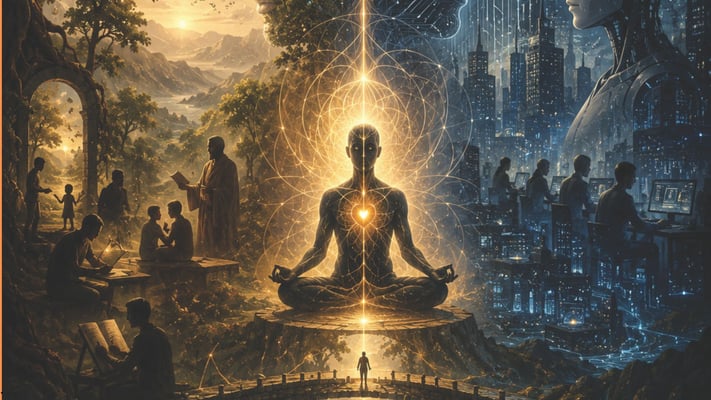

The foundational principles of conscious energetics epistemology
The epistemology of Conscious Energetics emerges from its central ontological proposition that reality is fundamentally energetic in nature and that consciousness is the intrinsic luminosity of coherent energy.
If consciousness and reality are interconnected through energetic participation, then knowledge cannot be understood merely as the passive accumulation of information. Instead, knowing itself becomes dependent upon the condition and coherence of consciousness.
This shift in epistemology has become especially necessary in the age of Artificial Intelligence. AI systems are already capable of storing, compiling, analyzing, and processing information at speeds and scales far beyond the ordinary human mind.
The traditional educational model based primarily on memorization, information retrieval, and mechanical problem-solving is therefore becoming increasingly obsolete. If human intelligence is defined only by informational capacity, machines will surpass human beings in many domains.
The future relevance of humanity therefore cannot lie merely in information processing. It must lie in those dimensions of consciousness that machines cannot authentically embody: self-awareness, ethical participation, contemplative depth, existential meaning, empathy, wisdom, and coherent integration of life. This requires a profound shift in the way knowledge itself is understood.
Modern epistemology largely treats knowledge as objective, external, and transferable independent of the state of the knower.
Conscious Energetics challenges this assumption by proposing that fragmented consciousness produces fragmented perception, while coherent consciousness deepens truth-recognition. Truth is therefore not merely informational correctness but increasing alignment between consciousness and reality.
Within this framework, reality is participatory rather than merely observational. Human beings do not stand outside existence as detached observers.
They participate in reality through perception, embodiment, relationship, emotion, intuition, contemplation, and energetic resonance. The state of consciousness therefore shapes both the depth and quality of knowing.
Conscious Energetics recognizes multiple interconnected modes of knowing. Sensory knowing arises through direct interaction with the physical world.
Rational knowing develops through logic and analysis. Experiential knowing emerges through lived participation. Relational knowing grows through dialogue and collective intelligence.
Contemplative knowing arises through silence, sustained attention, and inward clarity. Integrative knowing synthesizes these dimensions into coherent wisdom.
A central principle of this epistemology is that knowledge must become transformational rather than merely informational. Information alone does not transform consciousness.
True learning reorganizes perception, conduct, participation, and awareness. Education therefore becomes a process of energetic refinement rather than information transfer alone.
This framework also restores the ethical dimension of knowledge. Fear, greed, egoism, domination, and emotional fragmentation distort perception itself.
Humility, attentiveness, sincerity, discipline, and openness deepen truth-recognition. Ethics therefore becomes inseparable from epistemology because the quality of consciousness directly affects the quality of knowing.
The crisis of modern civilization is thus not merely lack of information but informational expansion without corresponding coherence of consciousness.
Humanity possesses unprecedented technological power while simultaneously facing fragmentation, anxiety, polarization, ecological destruction, and loss of meaning.
The ultimate aim of Conscious Energetics Epistemology is therefore the cultivation of coherent knowers — individuals capable of integrating reason, contemplation, ethics, embodiment, creativity, and awakened participation in life.
In the age of AI, the future of humanity may depend not upon competing with machines in information processing, but upon deepening those uniquely human capacities rooted in coherent consciousness and conscious evolution.
The epistemology of Conscious Energetics emerges from its central ontological proposition that reality is fundamentally energetic in nature and that consciousness is the intrinsic luminosity of coherent energy.
If consciousness and reality are interconnected through energetic participation, then...
The epistemology of Conscious Energetics emerges from its central ontological proposition that reality is fundamentally energetic in nature and that consciousness is the intrinsic luminosity of coherent energy.
If consciousness and reality are interconnected through energetic participation, then knowledge cannot be understood merely as the passive accumulation of information. Instead, knowing itself becomes dependent upon the condition and coherence of consciousness.
This shift in epistemology has become especially necessary in the age of Artificial Intelligence. AI systems are already capable of storing, compiling, analyzing, and processing information at speeds and scales far beyond the ordinary human mind.
The traditional educational model based primarily on memorization, information retrieval, and mechanical problem-solving is therefore becoming increasingly obsolete. If human intelligence is defined only by informational capacity, machines will surpass human beings in many domains.
The future relevance of humanity therefore cannot lie merely in information processing. It must lie in those dimensions of consciousness that machines cannot authentically embody: self-awareness, ethical participation, contemplative depth, existential meaning, empathy, wisdom, and coherent integration of life. This requires a profound shift in the way knowledge itself is understood.
Modern epistemology largely treats knowledge as objective, external, and transferable independent of the state of the knower.
Conscious Energetics challenges this assumption by proposing that fragmented consciousness produces fragmented perception, while coherent consciousness deepens truth-recognition. Truth is therefore not merely informational correctness but increasing alignment between consciousness and reality.
Within this framework, reality is participatory rather than merely observational. Human beings do not stand outside existence as detached observers.
They participate in reality through perception, embodiment, relationship, emotion, intuition, contemplation, and energetic resonance. The state of consciousness therefore shapes both the depth and quality of knowing.
Conscious Energetics recognizes multiple interconnected modes of knowing. Sensory knowing arises through direct interaction with the physical world.
Rational knowing develops through logic and analysis. Experiential knowing emerges through lived participation. Relational knowing grows through dialogue and collective intelligence.
Contemplative knowing arises through silence, sustained attention, and inward clarity. Integrative knowing synthesizes these dimensions into coherent wisdom.
A central principle of this epistemology is that knowledge must become transformational rather than merely informational. Information alone does not transform consciousness.
True learning reorganizes perception, conduct, participation, and awareness. Education therefore becomes a process of energetic refinement rather than information transfer alone.
This framework also restores the ethical dimension of knowledge. Fear, greed, egoism, domination, and emotional fragmentation distort perception itself.
Humility, attentiveness, sincerity, discipline, and openness deepen truth-recognition. Ethics therefore becomes inseparable from epistemology because the quality of consciousness directly affects the quality of knowing.
The crisis of modern civilization is thus not merely lack of information but informational expansion without corresponding coherence of consciousness.
Humanity possesses unprecedented technological power while simultaneously facing fragmentation, anxiety, polarization, ecological destruction, and loss of meaning.
The ultimate aim of Conscious Energetics Epistemology is therefore the cultivation of coherent knowers — individuals capable of integrating reason, contemplation, ethics, embodiment, creativity, and awakened participation in life.
In the age of AI, the future of humanity may depend not upon competing with machines in information processing, but upon deepening those uniquely human capacities rooted in coherent consciousness and conscious evolution.




Leave a Comment