

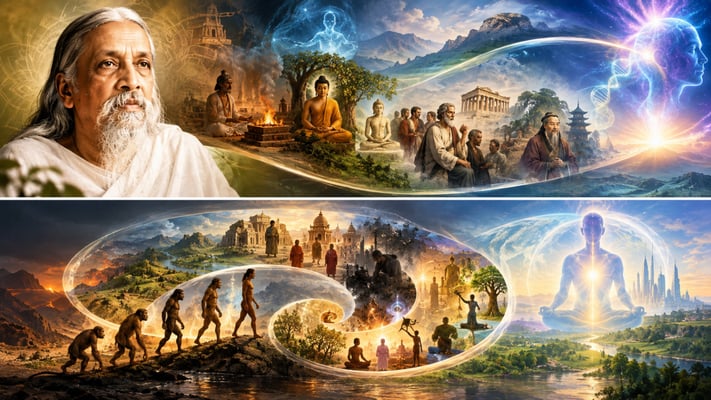

Sri Aurobindo and the recursive journey of human evolution
Human evolution is often presented as a linear movement from ignorance to knowledge, from primitive forms to more advanced ones. Sri Aurobindo's understanding of evolution suggests a more complex possibility.
Consciousness does not simply move forward. It differentiates, becomes increasingly complex, can lose its original coherence, and then seeks to recover and reorganise itself at a new level. Evolution is therefore recursive rather than merely linear.
History provides several indications of such turning points. The period broadly known as the Axial Age, between approximately 800 and 200 BCE, witnessed profound changes in human thought across different civilisations.
In India, the Upanishadic, Buddhist and Jain traditions opened new fields of inquiry into consciousness, selfhood, suffering and liberation. In China, Confucian and Daoist thought transformed understandings of human conduct and cosmic order. In Greece, philosophical inquiry developed new approaches to nature, knowledge and ethics.
These developments should not be interpreted as a simple replacement of one inferior consciousness by another. They demonstrate that established modes of understanding can reach a point where new questions emerge and reorganise the civilisational field.
Sri Aurobindo's reading of India's Vedic inheritance is especially significant in this context. He rejected the interpretation of the Veda as merely a primitive system of ritual that was subsequently superseded by the spirituality of the Upanishads.
For him, Vedic ritual was simultaneously material and spiritual. Its physical forms carried symbolic and psychological meanings that had progressively become obscured. The loss was not necessarily of the ritual itself, but of the consciousness through which its meaning had originally been apprehended.
The subsequent history of Indian spirituality can therefore be seen as containing repeated attempts to recover different dimensions of this deeper meaningfulness.
Knowledge, devotion, meditation, action, bodily discipline and renunciation each developed as powerful paths of inquiry and transformation. Yet differentiation can also produce fragmentation when one dimension is elevated into a substitute for the whole.
Sri Aurobindo's distinctive contribution was his return to the question of totality. His Integral Yoga did not regard spiritual realisation as requiring withdrawal from earthly existence.
The body, life, mind and consciousness were all included in the evolutionary process. The objective was not simply liberation of the individual from life, but the transformation of life itself, extending ultimately to matter.
This gives his evolutionary vision a recursive character. What is recovered from the past is not reproduced unchanged. It is carried forward into a new configuration.
The movement is from coherence to differentiation, from differentiation towards fragmentation, from fragmentation towards recovery, and from recovery towards a more comprehensive coherence.
The question before humanity today is whether another such transition is possible. Our technological and material capacities have expanded enormously, while fragmentation has simultaneously intensified.
The challenge may therefore be to develop not merely greater external capability, but a consciousness capable of integrating that capability.
In this context, Sri Aurobindo's evolutionary vision acquires contemporary significance. It invites us to see development not as the accumulation of power, but as the progressive emergence of a more conscious human being and, through that transformation, a more coherent civilisation.
Human evolution is often presented as a linear movement from ignorance to knowledge, from primitive forms to more advanced ones. Sri Aurobindo's understanding of evolution suggests a more complex possibility.
{% module_block module "widget_38788153-9b75-4e55-9323-b768ef6f317d" %}{%...Human evolution is often presented as a linear movement from ignorance to knowledge, from primitive forms to more advanced ones. Sri Aurobindo's understanding of evolution suggests a more complex possibility.
Consciousness does not simply move forward. It differentiates, becomes increasingly complex, can lose its original coherence, and then seeks to recover and reorganise itself at a new level. Evolution is therefore recursive rather than merely linear.
History provides several indications of such turning points. The period broadly known as the Axial Age, between approximately 800 and 200 BCE, witnessed profound changes in human thought across different civilisations.
In India, the Upanishadic, Buddhist and Jain traditions opened new fields of inquiry into consciousness, selfhood, suffering and liberation. In China, Confucian and Daoist thought transformed understandings of human conduct and cosmic order. In Greece, philosophical inquiry developed new approaches to nature, knowledge and ethics.
These developments should not be interpreted as a simple replacement of one inferior consciousness by another. They demonstrate that established modes of understanding can reach a point where new questions emerge and reorganise the civilisational field.
Sri Aurobindo's reading of India's Vedic inheritance is especially significant in this context. He rejected the interpretation of the Veda as merely a primitive system of ritual that was subsequently superseded by the spirituality of the Upanishads.
For him, Vedic ritual was simultaneously material and spiritual. Its physical forms carried symbolic and psychological meanings that had progressively become obscured. The loss was not necessarily of the ritual itself, but of the consciousness through which its meaning had originally been apprehended.
The subsequent history of Indian spirituality can therefore be seen as containing repeated attempts to recover different dimensions of this deeper meaningfulness.
Knowledge, devotion, meditation, action, bodily discipline and renunciation each developed as powerful paths of inquiry and transformation. Yet differentiation can also produce fragmentation when one dimension is elevated into a substitute for the whole.
Sri Aurobindo's distinctive contribution was his return to the question of totality. His Integral Yoga did not regard spiritual realisation as requiring withdrawal from earthly existence.
The body, life, mind and consciousness were all included in the evolutionary process. The objective was not simply liberation of the individual from life, but the transformation of life itself, extending ultimately to matter.
This gives his evolutionary vision a recursive character. What is recovered from the past is not reproduced unchanged. It is carried forward into a new configuration.
The movement is from coherence to differentiation, from differentiation towards fragmentation, from fragmentation towards recovery, and from recovery towards a more comprehensive coherence.
The question before humanity today is whether another such transition is possible. Our technological and material capacities have expanded enormously, while fragmentation has simultaneously intensified.
The challenge may therefore be to develop not merely greater external capability, but a consciousness capable of integrating that capability.
In this context, Sri Aurobindo's evolutionary vision acquires contemporary significance. It invites us to see development not as the accumulation of power, but as the progressive emergence of a more conscious human being and, through that transformation, a more coherent civilisation.





Leave a Comment