

KiwiSaver: New Zealand’s path to financial independence
New Zealand has an opportunity to strengthen its financial future by making better use of the savings already held by its own people. A greater investment of KiwiSaver funds in domestic government bonds could help reduce dependence on overseas lenders and, over time, support a shift from net borrower to net lender to the world. At its heart, this is about greater financial stability for our country, our retirement and the generations that follow.
Every year, New Zealand relies on borrowing from international markets to meet its financial needs. The Government borrows, banks borrow, and a significant portion of the interest paid on that debt flows overseas. However, the country already has a substantial pool of domestic savings that could play a greater role in financing its future: KiwiSaver.
I believe New Zealand has the potential to become a net lender to the world within a generation. The financial resources to support this ambition already belong to New Zealanders. What is needed is a long-term strategy to make better use of them.
Rising government debt highlights the need for change
New Zealand's government debt has increased considerably over the past decade. Gross government debt stood at $86.9 billion in 2016 before climbing to $227.4 billion by June 2026, an increase of approximately $14 billion annually.
During the same period, the NZ Super Fund, the Government's principal long-term savings vehicle, grew from $29.5 billion to $94.4 billion. Although this represents significant progress, the growth in national savings has not kept pace with the increase in government liabilities.
Consequently, the gap between government debt and savings more than doubled, rising from $57 billion to $133 billion.
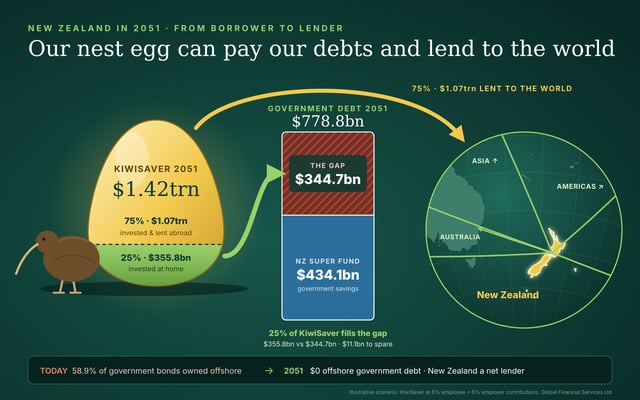
Looking ahead to 2051, projections based on the borrowing trend of the previous decade, alongside two additional major financial shocks of $100 billion each, suggest that gross debt could reach approximately $779 billion. Meanwhile, the NZ Super Fund could grow to around $434 billion, leaving a substantial financing gap of $345 million.
The result is a continuing outflow of interest payments, with money that could otherwise support domestic wealth creation leaving the country. Without reliance on overseas borrowings, we can continue to have higher credit rating.
KiwiSaver offers a domestic funding opportunity
One of New Zealand's most significant financial resources is already held by its citizens through KiwiSaver.
The retirement savings scheme reached a record $138.8 billion in March 2026, representing 3.44 million members and 70 per cent growth over five years.
Based on assumptions of annual returns of five per cent and employee and employer contributions of 3.5 per cent each, KiwiSaver funds could grow to between $1.2 trillion and $1.4 trillion by 2051, depending on contribution levels and future earnings.
This presents an opportunity to rethink how the country's retirement savings can contribute to its wider economic interests.
My proposal is to allocate 25 per cent of KiwiSaver investments to New Zealand government bonds. This would create a substantial domestic investor base and gradually reduce the Government's reliance on foreign bondholders. 25 per cent allocation of projected KiwiSaver funds in 2051 could amount to between $300 billion and $350 billion. According to these projections, that would be sufficient to cover the estimated $345 billion financing gap.
Such a strategy would not only eliminate government debt financing from Overseas market and also it would change who owns that debt. Rather than relying heavily on international investors, the Government could increasingly borrow from its own citizens through their retirement savings.
The interest paid on government bonds would then contribute to KiwiSaver balances, allowing more of the financial returns to remain within New Zealand and benefit local investors.
At the same time, the remaining 75 per cent of KiwiSaver investments, potentially about $1 trillion, could continue to be invested internationally. This would preserve diversification and maintain exposure to overseas investment opportunities.
In this way, New Zealand could strengthen its domestic financial position while continuing to participate in global markets.
A balanced approach is essential
Implementing such a proposal would require careful policy development and cooperation between the Government, KiwiSaver providers and the wider financial sector.
Government bonds must also remain attractive investment options based on their returns and overall value. Retirement savings should not be directed towards domestic investments at the expense of members' financial interests.
Furthermore, government borrowing is only one part of New Zealand's wider external debt challenge. Banks also depend significantly on offshore borrowing. Therefore, transforming the country into a net lender would require a broader financial strategy alongside the proposed KiwiSaver reforms.
Nevertheless, the opportunity deserves serious consideration. Establishing a clear policy direction sooner rather than later would give domestic savings more time to grow and contribute towards reducing the country's dependence on foreign borrowing.
KiwiSaver represents more than a retirement savings scheme. With members’ financial interests at the centre, it could help strengthen New Zealand’s financial independence and build a more stable economic future- one in which today’s savings serve both the people building them and the generations to come.
New Zealand already has the savings. With vision and a long-term plan, we can put that money to work for our own people- building financial stability for ourselves, our children and the generations who will inherit the country we shape today.

Ajay Kumar
Director, Global Financial Services Ltd.
New Zealand has an opportunity to strengthen its financial future by making better use of the savings already held by its own people. A greater investment of KiwiSaver funds in domestic government bonds could help reduce dependence on overseas lenders and, over time, support a shift from net...
New Zealand has an opportunity to strengthen its financial future by making better use of the savings already held by its own people. A greater investment of KiwiSaver funds in domestic government bonds could help reduce dependence on overseas lenders and, over time, support a shift from net borrower to net lender to the world. At its heart, this is about greater financial stability for our country, our retirement and the generations that follow.
Every year, New Zealand relies on borrowing from international markets to meet its financial needs. The Government borrows, banks borrow, and a significant portion of the interest paid on that debt flows overseas. However, the country already has a substantial pool of domestic savings that could play a greater role in financing its future: KiwiSaver.
I believe New Zealand has the potential to become a net lender to the world within a generation. The financial resources to support this ambition already belong to New Zealanders. What is needed is a long-term strategy to make better use of them.
Rising government debt highlights the need for change
New Zealand's government debt has increased considerably over the past decade. Gross government debt stood at $86.9 billion in 2016 before climbing to $227.4 billion by June 2026, an increase of approximately $14 billion annually.
During the same period, the NZ Super Fund, the Government's principal long-term savings vehicle, grew from $29.5 billion to $94.4 billion. Although this represents significant progress, the growth in national savings has not kept pace with the increase in government liabilities.
Consequently, the gap between government debt and savings more than doubled, rising from $57 billion to $133 billion.
Looking ahead to 2051, projections based on the borrowing trend of the previous decade, alongside two additional major financial shocks of $100 billion each, suggest that gross debt could reach approximately $779 billion. Meanwhile, the NZ Super Fund could grow to around $434 billion, leaving a substantial financing gap of $345 million.
The result is a continuing outflow of interest payments, with money that could otherwise support domestic wealth creation leaving the country. Without reliance on overseas borrowings, we can continue to have higher credit rating.
KiwiSaver offers a domestic funding opportunity
One of New Zealand's most significant financial resources is already held by its citizens through KiwiSaver.
The retirement savings scheme reached a record $138.8 billion in March 2026, representing 3.44 million members and 70 per cent growth over five years.
Based on assumptions of annual returns of five per cent and employee and employer contributions of 3.5 per cent each, KiwiSaver funds could grow to between $1.2 trillion and $1.4 trillion by 2051, depending on contribution levels and future earnings.
This presents an opportunity to rethink how the country's retirement savings can contribute to its wider economic interests.
My proposal is to allocate 25 per cent of KiwiSaver investments to New Zealand government bonds. This would create a substantial domestic investor base and gradually reduce the Government's reliance on foreign bondholders. 25 per cent allocation of projected KiwiSaver funds in 2051 could amount to between $300 billion and $350 billion. According to these projections, that would be sufficient to cover the estimated $345 billion financing gap.
Such a strategy would not only eliminate government debt financing from Overseas market and also it would change who owns that debt. Rather than relying heavily on international investors, the Government could increasingly borrow from its own citizens through their retirement savings.
The interest paid on government bonds would then contribute to KiwiSaver balances, allowing more of the financial returns to remain within New Zealand and benefit local investors.
At the same time, the remaining 75 per cent of KiwiSaver investments, potentially about $1 trillion, could continue to be invested internationally. This would preserve diversification and maintain exposure to overseas investment opportunities.
In this way, New Zealand could strengthen its domestic financial position while continuing to participate in global markets.
A balanced approach is essential
Implementing such a proposal would require careful policy development and cooperation between the Government, KiwiSaver providers and the wider financial sector.
Government bonds must also remain attractive investment options based on their returns and overall value. Retirement savings should not be directed towards domestic investments at the expense of members' financial interests.
Furthermore, government borrowing is only one part of New Zealand's wider external debt challenge. Banks also depend significantly on offshore borrowing. Therefore, transforming the country into a net lender would require a broader financial strategy alongside the proposed KiwiSaver reforms.
Nevertheless, the opportunity deserves serious consideration. Establishing a clear policy direction sooner rather than later would give domestic savings more time to grow and contribute towards reducing the country's dependence on foreign borrowing.
KiwiSaver represents more than a retirement savings scheme. With members’ financial interests at the centre, it could help strengthen New Zealand’s financial independence and build a more stable economic future- one in which today’s savings serve both the people building them and the generations to come.
New Zealand already has the savings. With vision and a long-term plan, we can put that money to work for our own people- building financial stability for ourselves, our children and the generations who will inherit the country we shape today.
Ajay Kumar
Director, Global Financial Services Ltd.


Leave a Comment