

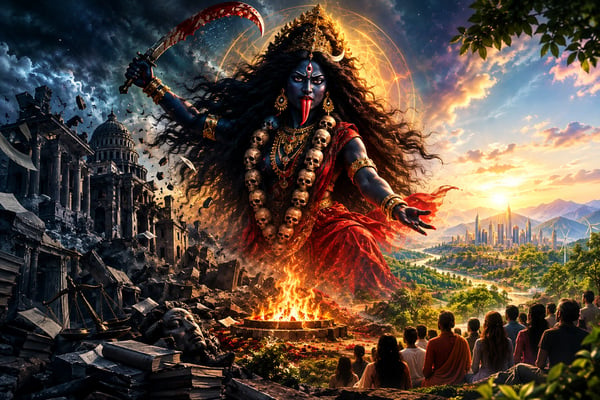

Bhadra Kali and the resurgence of a new civilisational order
Civilisations, like individuals, can reach a point where the structures that once enabled life begin to obstruct its further evolution.
Institutions become rigid, ideas become dogmas, identities become walls, and systems created to serve human beings begin to become an end, demanding that human beings serve them. At such moments, reform alone is not be enough. What is required is transformation.
This is where Mother Bhadra Kali acquires a significance far beyond the familiar image of a fierce Goddess. When I speak of Bhadra Kali, I do not mean a force that has been frozen into an external form on the outermost mandala of reality: the mandala of fragmented and discrete physical existence.
I mean Śakti anchored in the zero-field of conscious energy, the coherent centre from which all differentiated reality emerges. From that centre, Śakti moves radially across the mandalas of existence. She does not merely destroy forms. She enters them, exposes their loss of coherence, loosens their rigidity and makes transformation possible.
This distinction is fundamental.
Differentiation is necessary for creation. Fragmentation is not. A civilisation becomes vulnerable when its differentiated institutions, communities and knowledge systems lose their relationship with the deeper coherence from which they arose. What was once a living expression becomes an isolated structure defending its own existence.
Bhadra Kali represents the evolutionary response to such fragmentation. Her fierceness is therefore not violence for its own sake. It is the energy required to break the rigidity that prevents further becoming. Her saṃhāra is not mere destruction but withdrawal and reorganisation: the gathering back of what has become dispersed so that a greater coherence can emerge.
This is also why I see Yajna as central to the evolutionary process. Transformation requires offering, the offering of egoic isolation and ossified institutions. We must be willing to relinquish structures that have ceased to serve the larger movement of life. Only then can energy reorganise itself around a deeper centre.
A new civilisational order, therefore, cannot simply be constructed by rearranging institutions on the outer circumference. That would be too adaptive a response. Besides, that would be too long and arduous. It can only emerge as a transformative action of the Conscious Force at the coherent centre and move outward through every mandala: individual, social, economic, political, cultural and ecological.
The objective is not uniformity. It is coherence. The new civilisation would allow differentiation without fragmentation, individuality without isolation, diversity without division, and power without domination. In that sense, Bhadra Kali is not a Goddess of some distant mythological past. She is the evolutionary Śakti of the present.
She rises whenever life has outgrown the structures that contain it. She breaks what must be broken, gathers what has been scattered, and clears the way for a new expression of consciousness. The resurgence of civilisation, therefore, is not a return to an earlier order. It is the emergence of a new mandala of coherence.
And Bhadra Kali is the Śakti that makes its becoming possible.
Civilisations, like individuals, can reach a point where the structures that once enabled life begin to obstruct its further evolution.
{% module_block module "widget_03dd00bd-dd24-43e0-b6d5-67d42a247bb7" %}{% module_attribute "ads" is_json="true" %}{% raw...Civilisations, like individuals, can reach a point where the structures that once enabled life begin to obstruct its further evolution.
Institutions become rigid, ideas become dogmas, identities become walls, and systems created to serve human beings begin to become an end, demanding that human beings serve them. At such moments, reform alone is not be enough. What is required is transformation.
This is where Mother Bhadra Kali acquires a significance far beyond the familiar image of a fierce Goddess. When I speak of Bhadra Kali, I do not mean a force that has been frozen into an external form on the outermost mandala of reality: the mandala of fragmented and discrete physical existence.
I mean Śakti anchored in the zero-field of conscious energy, the coherent centre from which all differentiated reality emerges. From that centre, Śakti moves radially across the mandalas of existence. She does not merely destroy forms. She enters them, exposes their loss of coherence, loosens their rigidity and makes transformation possible.
This distinction is fundamental.
Differentiation is necessary for creation. Fragmentation is not. A civilisation becomes vulnerable when its differentiated institutions, communities and knowledge systems lose their relationship with the deeper coherence from which they arose. What was once a living expression becomes an isolated structure defending its own existence.
Bhadra Kali represents the evolutionary response to such fragmentation. Her fierceness is therefore not violence for its own sake. It is the energy required to break the rigidity that prevents further becoming. Her saṃhāra is not mere destruction but withdrawal and reorganisation: the gathering back of what has become dispersed so that a greater coherence can emerge.
This is also why I see Yajna as central to the evolutionary process. Transformation requires offering, the offering of egoic isolation and ossified institutions. We must be willing to relinquish structures that have ceased to serve the larger movement of life. Only then can energy reorganise itself around a deeper centre.
A new civilisational order, therefore, cannot simply be constructed by rearranging institutions on the outer circumference. That would be too adaptive a response. Besides, that would be too long and arduous. It can only emerge as a transformative action of the Conscious Force at the coherent centre and move outward through every mandala: individual, social, economic, political, cultural and ecological.
The objective is not uniformity. It is coherence. The new civilisation would allow differentiation without fragmentation, individuality without isolation, diversity without division, and power without domination. In that sense, Bhadra Kali is not a Goddess of some distant mythological past. She is the evolutionary Śakti of the present.
She rises whenever life has outgrown the structures that contain it. She breaks what must be broken, gathers what has been scattered, and clears the way for a new expression of consciousness. The resurgence of civilisation, therefore, is not a return to an earlier order. It is the emergence of a new mandala of coherence.
And Bhadra Kali is the Śakti that makes its becoming possible.





Leave a Comment