

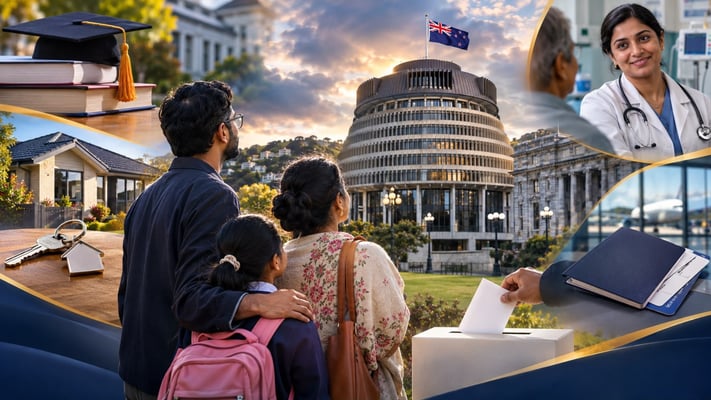
What could New Zealand’s election result mean for Kiwi Indians?
New Zealand’s 2026 general election has produced a closely contested preliminary result, leaving questions about the composition of the next government and the policy direction the country will take over the next three years. The outcome remains subject to the counting of special votes, with the official results due on November 27.
For New Zealand’s migrant communities, the election outcome carries significance beyond party politics.
Decisions made by the incoming government will have implications for access to healthcare, education opportunities, housing and property ownership, as well as immigration settings.
With these issues affecting migrant families, the key question is what the election result could mean for their lives in New Zealand.
We speak to experts across health, education, property and immigration to examine policy priorities, potential changes and practical considerations migrants should be watching as the country moves towards forming its next government.
Education: Strong foundations and future-ready learning
For migrant families, education priorities should include strong foundational learning, a consistent curriculum and an education system that is "future-ready", says Dr Paula Ray, Academic Director

at a large Private Tertiary Institution in Auckland.
"Better English support for migrant students. Cultural inclusion in educational institutions. Affordable tertiary education and meaningful career pathways, especially for mature international students," she told The Indian Weekender.
Dr Ray says one of the key considerations for migrant families is how political changes will translate into classroom learning, and whether they will improve educational outcomes or lead to another round of policy restructuring.
"Will it lead to increased ESOL funding?," she shared.
"Recognition of their cultural identity could be impacted."
She also highlighted the affordability of tertiary education and immigration pathways for mature international students as important considerations for migrants when assessing what they can expect from the next government.
Immigration: The importance of clear pathways
For migrants, pathways to residence are rarely straightforward, making it important to understand the available options and how

any changes to immigration policy could affect their plans.
With the results still preliminary, the eventual coalition agreement will help shape immigration policy. Kiwi Indians have diverse priorities, but many want a fair and predictable system that recognises their contribution and gives families who have built their lives here, greater certainty, Anish Rana, NZ Licensed Immigration Adviser and Executive Director of Millennials Immigration NZ told The Indian Weekender.
"Since August 2026, we have seen what we consider an excessively high decline rate in the Indian student visa applications."
Other education stakeholders, Rana said, say they have seen nothing like it in 20 years of promoting New Zealand education.
"The government should review these trends and ensure genuine applicant has a fair chance to get their genuine study intentions be assessed fairly as India is one of the top markets for NZ International Education," Rana said.
Work and residence visa policies also need stability, according to Rana.
He explained frequent changes create uncertainty for migrants, families and employers.
"When changes are necessary, the government should give people clear notice and reasonable time to adjust."
With the composition of the government, Rana said he expects a continued focus on skilled migration and stronger verification.
"New Zealand should attract and retain people with the skills it needs, especially where employers face genuine shortages. Maintaining immigration integrity is equally important," he added.
Healthcare: Medical technology, affordability and waiting times
Dr Chellaraj Satyasdas Benjamin, a leading oncologist in New Zealand, said that while Indians have access to good healthcare in

India, there are opportunities for New Zealand governments to focus on improving medical equipment, technology and training, as well as exploring medical tourism and related fields.
Highlighting the high cost of medical procedures in New Zealand and Australia, Dr Benjamin said greater attention could be given to reducing the cost of surgeries.
“A cardiac surgery that costs around $100,000 in a private centre in Auckland can be done in India for $20,000," he estimates.
Dr Benjamin noted that while medical tourism is not widely advertised, there is scope to market the sector.
He identified institutions such as Apollo and Fortis as key players in India's medical tourism industry and suggested that these hospitals could consider expanding into Pacific countries such as Fiji and Samoa, as well as New Zealand.
"Waiting time is a disaster," he said.
He said greater investment in healthcare infrastructure, along with policies focused on improving healthcare services, would benefit everyone accessing the system in New Zealand, including migrant communities.
Property: Financial preparedness and opportunities for home ownership
Ajay Kumar, Director, Global Financial Services Ltd said it remains to be seen how market trends and government policies will develop following the final election results, particularly for migrant
families.
However, he said the key issue for many new migrants "is not necessarily access to lending itself, but their level of commitment and preparedness to enter the property market."
He explained that for those committed to home ownership, there are generally pathways available to achieve that goal.
"Currently, there are relatively few structural barriers to purchasing a home. In many cases, properties can be purchased with deposits as low as 5% of the purchase price, which is a reasonable threshold. These funds can often come from a variety of legitimate sources, including savings accumulated overseas," he shared.
Kumar also raised the issue of New Zealand's longer-term financial independence, saying the country has an opportunity to strengthen its financial future by making better use of savings already held by its own people.
"A greater investment of KiwiSaver funds in domestic government bonds could help reduce dependence on overseas lenders and, over time, support a shift from net borrower to net lender to the world. At its heart, this is about greater financial stability for our country, our retirement and the generations that follow," he said.
New Zealand’s 2026 general election has produced a closely contested preliminary result, leaving questions about the composition of the next government and the policy direction the country will take over the next three years. The outcome remains subject to the counting of special votes, with the...
New Zealand’s 2026 general election has produced a closely contested preliminary result, leaving questions about the composition of the next government and the policy direction the country will take over the next three years. The outcome remains subject to the counting of special votes, with the official results due on November 27.
For New Zealand’s migrant communities, the election outcome carries significance beyond party politics.
Decisions made by the incoming government will have implications for access to healthcare, education opportunities, housing and property ownership, as well as immigration settings.
With these issues affecting migrant families, the key question is what the election result could mean for their lives in New Zealand.
We speak to experts across health, education, property and immigration to examine policy priorities, potential changes and practical considerations migrants should be watching as the country moves towards forming its next government.
Education: Strong foundations and future-ready learning
For migrant families, education priorities should include strong foundational learning, a consistent curriculum and an education system that is "future-ready", says Dr Paula Ray, Academic Director
at a large Private Tertiary Institution in Auckland.
"Better English support for migrant students. Cultural inclusion in educational institutions. Affordable tertiary education and meaningful career pathways, especially for mature international students," she told The Indian Weekender.
Dr Ray says one of the key considerations for migrant families is how political changes will translate into classroom learning, and whether they will improve educational outcomes or lead to another round of policy restructuring.
"Will it lead to increased ESOL funding?," she shared.
"Recognition of their cultural identity could be impacted."
She also highlighted the affordability of tertiary education and immigration pathways for mature international students as important considerations for migrants when assessing what they can expect from the next government.
Immigration: The importance of clear pathways
For migrants, pathways to residence are rarely straightforward, making it important to understand the available options and how
any changes to immigration policy could affect their plans.
With the results still preliminary, the eventual coalition agreement will help shape immigration policy. Kiwi Indians have diverse priorities, but many want a fair and predictable system that recognises their contribution and gives families who have built their lives here, greater certainty, Anish Rana, NZ Licensed Immigration Adviser and Executive Director of Millennials Immigration NZ told The Indian Weekender.
"Since August 2026, we have seen what we consider an excessively high decline rate in the Indian student visa applications."
Other education stakeholders, Rana said, say they have seen nothing like it in 20 years of promoting New Zealand education.
"The government should review these trends and ensure genuine applicant has a fair chance to get their genuine study intentions be assessed fairly as India is one of the top markets for NZ International Education," Rana said.
Work and residence visa policies also need stability, according to Rana.
He explained frequent changes create uncertainty for migrants, families and employers.
"When changes are necessary, the government should give people clear notice and reasonable time to adjust."
With the composition of the government, Rana said he expects a continued focus on skilled migration and stronger verification.
"New Zealand should attract and retain people with the skills it needs, especially where employers face genuine shortages. Maintaining immigration integrity is equally important," he added.
Healthcare: Medical technology, affordability and waiting times
Dr Chellaraj Satyasdas Benjamin, a leading oncologist in New Zealand, said that while Indians have access to good healthcare in
India, there are opportunities for New Zealand governments to focus on improving medical equipment, technology and training, as well as exploring medical tourism and related fields.
Highlighting the high cost of medical procedures in New Zealand and Australia, Dr Benjamin said greater attention could be given to reducing the cost of surgeries.
“A cardiac surgery that costs around $100,000 in a private centre in Auckland can be done in India for $20,000," he estimates.
Dr Benjamin noted that while medical tourism is not widely advertised, there is scope to market the sector.
He identified institutions such as Apollo and Fortis as key players in India's medical tourism industry and suggested that these hospitals could consider expanding into Pacific countries such as Fiji and Samoa, as well as New Zealand.
"Waiting time is a disaster," he said.
He said greater investment in healthcare infrastructure, along with policies focused on improving healthcare services, would benefit everyone accessing the system in New Zealand, including migrant communities.
Property: Financial preparedness and opportunities for home ownership
Ajay Kumar, Director, Global Financial Services Ltd said it remains to be seen how market trends and government policies will develop following the final election results, particularly for migrant
families.
However, he said the key issue for many new migrants "is not necessarily access to lending itself, but their level of commitment and preparedness to enter the property market."
He explained that for those committed to home ownership, there are generally pathways available to achieve that goal.
"Currently, there are relatively few structural barriers to purchasing a home. In many cases, properties can be purchased with deposits as low as 5% of the purchase price, which is a reasonable threshold. These funds can often come from a variety of legitimate sources, including savings accumulated overseas," he shared.
Kumar also raised the issue of New Zealand's longer-term financial independence, saying the country has an opportunity to strengthen its financial future by making better use of savings already held by its own people.
"A greater investment of KiwiSaver funds in domestic government bonds could help reduce dependence on overseas lenders and, over time, support a shift from net borrower to net lender to the world. At its heart, this is about greater financial stability for our country, our retirement and the generations that follow," he said.


Leave a Comment