




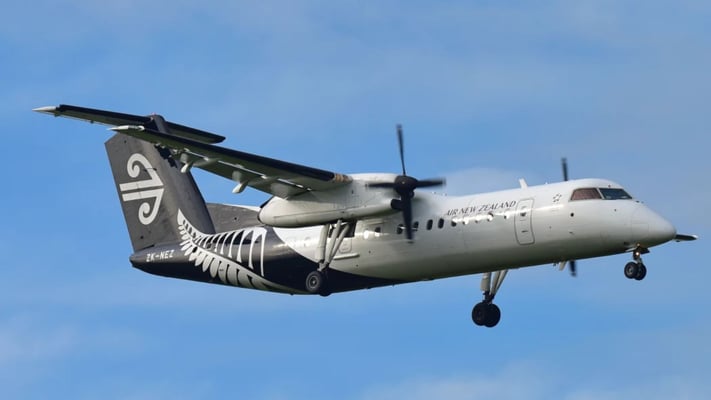



Two planes with a combined 42 people on board came within 41 seconds of a head-on collision over Northland, a report from the Transport Accident Investigation Commission (TAIC) has revealed.
TAIC put the near-miss down to failures in the way New Zealand's airspace is managed.

The Commission found there had been no review of Whangārei airspace for more than a decade, despite increasing air traffic and a rule that airspace should be reviewed every five years.
Also alarming was the finding that no agency in New Zealand had responsibility for conducting such reviews, an omission the commission said needed to be addressed urgently.
According to the report, which was released on Friday morning, an Air New Zealand Bombardier Q300 with 40 people on board was flying south from Whangārei to Auckland on the morning of 28 August 2023.
Around the same time a flying school's Beech Duchess, with two people on board, was heading north from Ardmore to Whangārei using the same flight path.
The report stated the air traffic controller instructed both aircraft to descend into "uncontrolled airspace" and pass each other there.
That meant responsibility for avoiding a collision passed from air traffic control to the two pilots.
That was at the time a commonly used work-around, due to air traffic control workload and the limited amount of controlled airspace available for keeping planes apart.
The Q300 was flying in cloud at 6000 feet when the Beech descended to the same altitude in front of it.
Over the Brynderwyn Hills the Q300 crew received an alert from the plane's airborne collision avoidance system (ACAS), described in the report as a "last line of defence".
Moments later an alert also showed up on the air controller's radar and the Q300 was given clearance to climb to 8000 feet, above the approaching Beech.
The Beech did not have, and was not required to have, an ACAS system.
At the closest point the aircraft were 8km from each other - or just 41 seconds apart at their 700km/h closing speed.
"Closing speed" describes how fast two objects are approaching each other.
TAIC chief commissioner David Clarke said no one was hurt and no damage resulted, but it was too close.
"It happened because the controller or flight service officer hadn't provided sufficiently timely traffic information after sending both flights into uncontrolled airspace," he said.
"This left each crew flying in cloud, unable to see the other plane, unaware of the immediacy of potential conflicts, and the crew of the Beech poorly placed to coordinate their own avoidance actions."
Clarke said the 42 crew and passengers ended up in that risky situation due to long-standing weaknesses in the design of the Whangārei area airspace.
"Despite recurring concerns raised by pilots, controllers and the aerodrome operator, the North Sector airspace hasn't had a comprehensive review since 2014, even though reviews are required every five years."
Nor was the problem limited to Whangārei.
"It's a nationwide issue because New Zealand needs clear responsibility for conducting comprehensive airspace reviews," Clarke said.
TAIC chief investigator, Louise Cook, told Morning Report there had been a large increase in flights since 2014.
Cook said it should look at how that airspace should be managed now to handle an increase in the number of planes in the area.
The Commission made a number of urgent recommendations as a result of the near-miss.
They included that the Civil Aviation Authority (CAA) carry out a full review of lower-level airspace around Whangārei and act on the findings.
The Commission also called on the Ministry of Transport to clarify which agency was responsible for ongoing nationwide airspace reviews, and ensure that agency identified any emerging risks before they led to more serious events.
In its response to the Commission, the CAA said it was working with Whangārei airspace stakeholders on safety improvements.
There had also been initial engagement with Kerikeri airspace users.
Throughout 2026 the CAA would carry out reviews of uncontrolled airspace at Timaru, Hokitika, Whakatāne and Kāpiti Coast aerodromes.
The CAA said it has accepted the Commission's recommendation and continues to work with local airspace users and stakeholders to improve safety.
Its deputy chief executive of aviation safety oversight, Catherine MacGowan, said they were continuously improving safety so people were safe when they flew.
"This was a serious incident, these aircraft came closer than they should have. While no-one was harmed we do take that reduction in safety margins very seriously and we are working on the system level findings," MacGowan said.
"Aviation safety is made up of many layers of protection so even in this event ... you can see the systems on board the aircraft acted to protect the passengers as well the professionalism of the pilots and air traffic controllers are always making sure that the overall aviation system stays safe."
She said an aeronautical study of Whangārei Aerodrome in 2023 also considered the surrounding airspace, and informed ongoing work between CAA and other airspace users to implement safety improvements.
"In this case we are working specifically with Whangārei Airport on a range of potential improvements that were identified in a 2022 report so there is work underway."
Meanwhile, the Aviation Industry Association said a national review of uncontrolled airspace is urgent.
Its chief executive Simon Wallace said the review needs to look at other areas of uncontrolled airspace, not just Whangarei.

"We are very concerned about the report, and it has identified that there were a number of failings that led to this happening. We would like there to be an immediate review not only of this airspace but of other uncontrolled airspace in New Zealand."
He said the CAA was undertaking a rules refresh and there was an opportunity for it to review uncontrolled airspace nationally.
"That is something that will need to be looked at as a matter of absolute urgency."
-By RNZ


ISSUE


Leave a Comment