

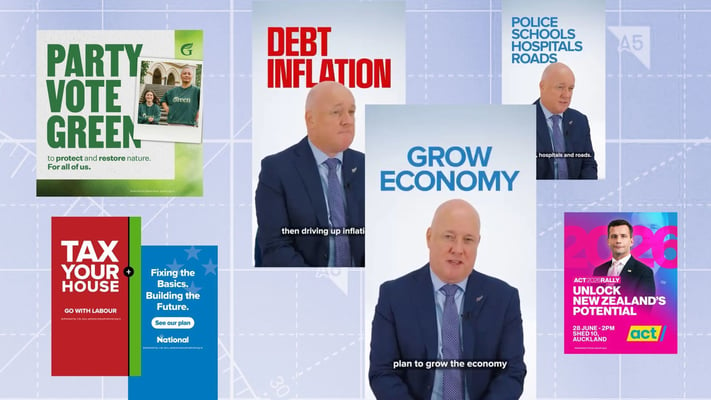

The National Party's 92 political ads seen by only men
An RNZ analysis of Facebook advertising by political parties in the election year shows some seem to be chasing specific genders and age groups.
Out of more than 500 ads National has run on Facebook and Instagram this year, 92 were seen exclusively by men and only one solely by women.
National spent up to $21,000 on the male-only ads, which were seen up to 3.9 million times, compared with up to $99 on the female-only ad, which ran for just one day and was seen up to 999 times. National denies even placing that one ad, which was briefly seen only by women.
ACT appears to be pursuing a similar strategy. Of the 63 ads it has placed, 14 were seen solely by men up to 518,000 times, and none were viewed solely by women. ACT spent up to $4000 for its male-only ads on the Meta platforms.
The Green Party appears to have the opposite approach. It seems to have targeted 13 of its 103 ads at women and none solely at men. It spent up to $5000 on female-only ads, which were seen up to 768,000 times.
How the ads work
RNZ analysed Facebook and Instagram advertising data made public by Meta, from 1 January to 7 August this year, when the regulated advertising period began and spending caps kicked in.
Ads paid for by Parliamentary Service, which funds communications, rather than campaign spending, were excluded from the analysis.
Labour did not run any advertisements funded by itself during this timeframe, and NZ First did not run any paid ads on Facebook or Instagram.
Political parties can target people by age, gender and region. Publicly available data on Meta doesn't allow people to see this targeting, but it does show who saw the ad. For an ad to be only seen by one gender it's highly likely this was a conscious targeting decision made by the party.
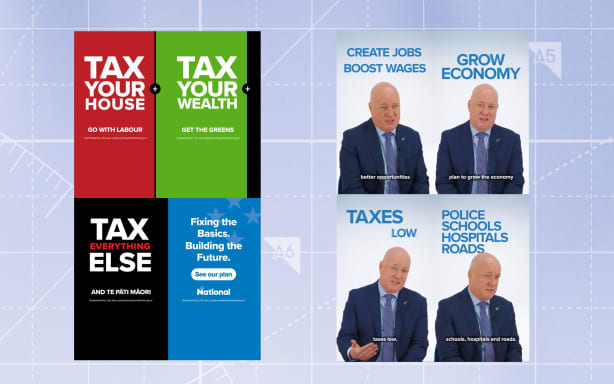
Left: National's only ad just seen by women ran on 12 June. It cost National less than $100 and Facebook estimates it was seen between 100 and 999 times by females 65 and older. Right: This ad, seen only by men, had up to $2000 spent on it and was seen up to 700,000 times. RNZ composite / Facebook screenshot
Why the parties target by gender
RNZ asked National, ACT and the Greens why they appeared to have targeted one gender over another, and what message this sent to voters of the neglected gender. No party directly answered the questions.
National's spokesperson said ads placed by the party were targeted to a range of demographics, with 80 percent seen by both men and women.
The spokesperson denied Meta's record of an ad aimed at women.
"We don't know what the $99 spend is you are referring to, but it was not placed by the National Party campaign."
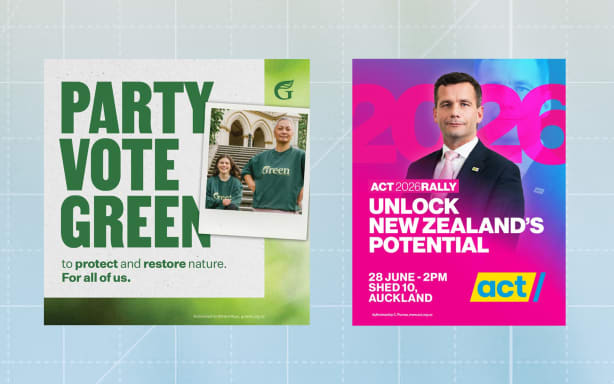
Left: This ad from the Greens was only seen by females, it cost up to $2499 and was seen up to 449,999 times. Right: ACT's ad was only seen by men. It cost up to $999 and was seen up to 399,999 times. RNZ composite / Facebook screenshot
An ACT party spokesperson said the party doesn't share details of its digital strategy with the media.
"Our values and policies are for all New Zealanders - that is reflected in the range of candidates who have chosen to stand for ACT and unlock New Zealand's potential."
One quarter of the party's candidates currently listed on its website are women. NZ First and National have only marginally higher proportions of women on their lists than ACT.
Limited funding and resources were among the reasons a Green party spokesperson gave for the lack of male-only ads saying, "it's important we're strategic and intentional about where we put those resources and how to best cut through to certain audiences."
The spokesperson said online advertising allows the party to see what different groups care about.
Overall ad views
Viewership on ads that didn't appear to be targeted to a single gender also showed a skew for some parties, meaning they were seen more by one gender than another.
Two-thirds of the viewers of ACT's ads were male, while National and Opportunity had a male viewership of around 60 percent.
The Greens viewership was 54 percent female and Te Pāti Māori had a nearly even split between genders.
How gender voting patterns can swing results
A survey conducted after each recent general election showed more women voted for National in 2023 than men. The New Zealand Election Study surveyed almost 2000 people. It found 41 percent of the women surveyed voted for National compared to 37 percent of men.
Victoria University of Wellington political science researcher Sam Crawley said there's a generalisation that female voters often support left-leaning parties, but 2023 saw an upswing of women turning to National.
Crawley wonders if the cost of living was a factor in this change, causing swing voters to turn away from the incumbent party and give their support to National.
He was surprised at the percentage of ads National has run that appear to target men.
"Maybe they're focusing a bit more on their base and winning votes back off ACT and New Zealand First."
Social media and audience strategist Anna Rawhiti-Connell was puzzled that National ran the female only version for one day.
"You want to run it for maybe five to seven days, generally, because that is the ad's learning phase," she said.
The data from running an ad over a week can be used to fine-tune it to improve its performance.
She couldn't say if the ad was run as a mistake, but did describe it as a "funny one."
What they're spending
National has outspent all other parties on Meta this year, with up to $113,904 spent. They're followed by the Greens with an upper estimate of $42,883. ACT has spent up to $26,927, Opportunity up to $9342 and Te Pāti Māori up to $6285.
Labour has only run advertisements funded by Parliamentary Service and NZ First has not run any advertising on Meta at all.
National's bigger spend meant its ads were seen more times than the ads of other parties, with Meta estimating close to 19 million views.
As well as gender differences, RNZ's analysis shows age differences in who has seen party messages.
Advertisements run by Te Pāti Māori and the Greens had the youngest audiences, while ACT appeared to have reached more people 65 and older.
The days of manually targeting social media ads by demographic may be coming to an end, according to Rawhiti-Connell.
Meta's AI targeting tool called Andromeda focuses on what the company refers to as "creative diversification" rather than niche demographic targeting.
Rawhiti-Connell gave the example of an advertiser wanting to sell a sports drink to young, urban males. Traditionally, the advertiser would manually select an audience they wanted by selecting gender and an age range, and regions. They might also select interests, such as gyms, or protein.
Now, the advice is to leave the targeting broad and load several different versions of an ad.
"You might have an ad for this hypothetical sports drink brand where it's a guy looking happy, and then you might have one where it's a guy looking determined, and you might have one where it's a guy getting ready to go work out."
The way the audience reacts to different versions of an ad is then used by the AI to maximise the reach of the advertisers.
In some cases Meta's AI tools can even generate text in the ads tailored to different audiences, create image variations and resize video.
She's not sure political parties will be using all of Meta's AI tools due to possible audience backlash.
"Imagine if you have a video of Christopher Luxon and all the AI enhancements are running. You can see people reacting quite badly to that."
AI has been used by National to build a campaign microsite called 18 billion. The site has AI-generated imagery of stacks of cash including $2 notes. It features a scale and allows users to attempt to balance proposed taxes against the pile of cash. No methodology is included in the site.
At the time of writing, no paid Facebook advertising promoted the site.
How RNZ analysed the data: Advertisements that commenced running on or after 1 January 2026 were included in the analysis. Ads that were funded by Parliamentary Service were excluded from the analysis. Meta doesn't publish data on ads with fewer than 99 views, so these ads were also excluded from the analysis.
-RNZ
An RNZ analysis of Facebook advertising by political parties in the election year shows some seem to be chasing specific genders and age groups.
Out of more than 500 ads National has run on Facebook and Instagram this year, 92 were seen exclusively by men and only one solely by women.
{%...An RNZ analysis of Facebook advertising by political parties in the election year shows some seem to be chasing specific genders and age groups.
Out of more than 500 ads National has run on Facebook and Instagram this year, 92 were seen exclusively by men and only one solely by women.
National spent up to $21,000 on the male-only ads, which were seen up to 3.9 million times, compared with up to $99 on the female-only ad, which ran for just one day and was seen up to 999 times. National denies even placing that one ad, which was briefly seen only by women.
ACT appears to be pursuing a similar strategy. Of the 63 ads it has placed, 14 were seen solely by men up to 518,000 times, and none were viewed solely by women. ACT spent up to $4000 for its male-only ads on the Meta platforms.
The Green Party appears to have the opposite approach. It seems to have targeted 13 of its 103 ads at women and none solely at men. It spent up to $5000 on female-only ads, which were seen up to 768,000 times.
How the ads work
RNZ analysed Facebook and Instagram advertising data made public by Meta, from 1 January to 7 August this year, when the regulated advertising period began and spending caps kicked in.
Ads paid for by Parliamentary Service, which funds communications, rather than campaign spending, were excluded from the analysis.
Labour did not run any advertisements funded by itself during this timeframe, and NZ First did not run any paid ads on Facebook or Instagram.
Political parties can target people by age, gender and region. Publicly available data on Meta doesn't allow people to see this targeting, but it does show who saw the ad. For an ad to be only seen by one gender it's highly likely this was a conscious targeting decision made by the party.
Left: National's only ad just seen by women ran on 12 June. It cost National less than $100 and Facebook estimates it was seen between 100 and 999 times by females 65 and older. Right: This ad, seen only by men, had up to $2000 spent on it and was seen up to 700,000 times. RNZ composite / Facebook screenshot
Why the parties target by gender
RNZ asked National, ACT and the Greens why they appeared to have targeted one gender over another, and what message this sent to voters of the neglected gender. No party directly answered the questions.
National's spokesperson said ads placed by the party were targeted to a range of demographics, with 80 percent seen by both men and women.
The spokesperson denied Meta's record of an ad aimed at women.
"We don't know what the $99 spend is you are referring to, but it was not placed by the National Party campaign."
Left: This ad from the Greens was only seen by females, it cost up to $2499 and was seen up to 449,999 times. Right: ACT's ad was only seen by men. It cost up to $999 and was seen up to 399,999 times. RNZ composite / Facebook screenshot
An ACT party spokesperson said the party doesn't share details of its digital strategy with the media.
"Our values and policies are for all New Zealanders - that is reflected in the range of candidates who have chosen to stand for ACT and unlock New Zealand's potential."
One quarter of the party's candidates currently listed on its website are women. NZ First and National have only marginally higher proportions of women on their lists than ACT.
Limited funding and resources were among the reasons a Green party spokesperson gave for the lack of male-only ads saying, "it's important we're strategic and intentional about where we put those resources and how to best cut through to certain audiences."
The spokesperson said online advertising allows the party to see what different groups care about.
Overall ad views
Viewership on ads that didn't appear to be targeted to a single gender also showed a skew for some parties, meaning they were seen more by one gender than another.
Two-thirds of the viewers of ACT's ads were male, while National and Opportunity had a male viewership of around 60 percent.
The Greens viewership was 54 percent female and Te Pāti Māori had a nearly even split between genders.
How gender voting patterns can swing results
A survey conducted after each recent general election showed more women voted for National in 2023 than men. The New Zealand Election Study surveyed almost 2000 people. It found 41 percent of the women surveyed voted for National compared to 37 percent of men.
Victoria University of Wellington political science researcher Sam Crawley said there's a generalisation that female voters often support left-leaning parties, but 2023 saw an upswing of women turning to National.
Crawley wonders if the cost of living was a factor in this change, causing swing voters to turn away from the incumbent party and give their support to National.
He was surprised at the percentage of ads National has run that appear to target men.
"Maybe they're focusing a bit more on their base and winning votes back off ACT and New Zealand First."
Social media and audience strategist Anna Rawhiti-Connell was puzzled that National ran the female only version for one day.
"You want to run it for maybe five to seven days, generally, because that is the ad's learning phase," she said.
The data from running an ad over a week can be used to fine-tune it to improve its performance.
She couldn't say if the ad was run as a mistake, but did describe it as a "funny one."
What they're spending
National has outspent all other parties on Meta this year, with up to $113,904 spent. They're followed by the Greens with an upper estimate of $42,883. ACT has spent up to $26,927, Opportunity up to $9342 and Te Pāti Māori up to $6285.
Labour has only run advertisements funded by Parliamentary Service and NZ First has not run any advertising on Meta at all.
National's bigger spend meant its ads were seen more times than the ads of other parties, with Meta estimating close to 19 million views.
As well as gender differences, RNZ's analysis shows age differences in who has seen party messages.
Advertisements run by Te Pāti Māori and the Greens had the youngest audiences, while ACT appeared to have reached more people 65 and older.
The days of manually targeting social media ads by demographic may be coming to an end, according to Rawhiti-Connell.
Meta's AI targeting tool called Andromeda focuses on what the company refers to as "creative diversification" rather than niche demographic targeting.
Rawhiti-Connell gave the example of an advertiser wanting to sell a sports drink to young, urban males. Traditionally, the advertiser would manually select an audience they wanted by selecting gender and an age range, and regions. They might also select interests, such as gyms, or protein.
Now, the advice is to leave the targeting broad and load several different versions of an ad.
"You might have an ad for this hypothetical sports drink brand where it's a guy looking happy, and then you might have one where it's a guy looking determined, and you might have one where it's a guy getting ready to go work out."
The way the audience reacts to different versions of an ad is then used by the AI to maximise the reach of the advertisers.
In some cases Meta's AI tools can even generate text in the ads tailored to different audiences, create image variations and resize video.
She's not sure political parties will be using all of Meta's AI tools due to possible audience backlash.
"Imagine if you have a video of Christopher Luxon and all the AI enhancements are running. You can see people reacting quite badly to that."
AI has been used by National to build a campaign microsite called 18 billion. The site has AI-generated imagery of stacks of cash including $2 notes. It features a scale and allows users to attempt to balance proposed taxes against the pile of cash. No methodology is included in the site.
At the time of writing, no paid Facebook advertising promoted the site.
How RNZ analysed the data: Advertisements that commenced running on or after 1 January 2026 were included in the analysis. Ads that were funded by Parliamentary Service were excluded from the analysis. Meta doesn't publish data on ads with fewer than 99 views, so these ads were also excluded from the analysis.
-RNZ





Leave a Comment