




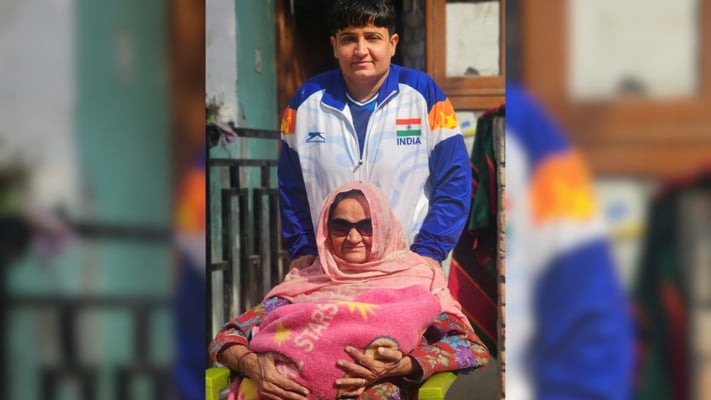





Sharmila Dhankar's inspiring journey from unimaginable hardship to Commonwealth Games glory has become one of the most remarkable stories of resilience in Indian sport.
According to The Indian Express, the para athlete's husband, Ajit Singh, once promised to turn "narak se swarag" (hell into heaven) for Sharmila and her two daughters.
Fourteen years after she was thrown out of her home, that promise has culminated in India's first-ever Commonwealth Games gold medal in para athletics.
Sharmila still vividly remembers the traumatic day in 2012 when her then husband, who struggled with drug addiction, stripped her naked and forced her and her two young daughters out of their home in Gurkawas village in Rewari.
Neighbours came to her aid by covering her with a quilt before her parents, Jai Lal and Santosh, took her back to their village, Chithhrauli, in Mahendragarh. As reported by The Indian Express, that painful chapter marked the beginning of a long fight to rebuild her life.
On Monday night in Glasgow, the 40-year-old scripted history by winning India's first-ever Commonwealth Games gold medal in para athletics.
Her season-best throw of 9.81 metres secured the women's shot put F57 title and ended India's 20-year wait for a gold medal in the discipline. According to The Indian Express, moments after her victory, she celebrated by calling her mother, daughters, and husband Ajit Singh.
“Mere ko nangi kar ke meri betiyon ke sath sadak pe faink diya tha mere pehle husband ne. (My first husband stripped me naked and threw me and my daughters out of the house.)
My neighbours wrapped me in a quilt and my parents took us away. I was married at 19; he was a drug addict, and things only got worse after my second daughter was born.
As I hold this gold medal in Glasgow, my message to every woman and daughter in India is to fight back against abuse,” Sharmila, who suffered polio in one leg at the age of two, told The Indian Express minutes after her win.
Her mother, Santosh, who has been blind since birth, listened to her daughter's historic victory on television. According to The Indian Express, despite living through financial hardships, Santosh always believed in Sharmila's abilities and determination.
“My daughter was the topper from class one to class ten. But our financial condition wasn’t good, so we had to marry her off. When it happened, I told my husband we had to go bring her back. This gold is Sharmila’s jazba (spirit),” Santosh says.
Six years after returning to her parents' home and following her divorce, Sharmila remarried in 2018. Her parents arranged her marriage to Ajit Singh, a submersible pump technician, who would go on to become the biggest pillar of support in her sporting journey.
That same year, she briefly worked as Haryana's first female bus conductor after being hired on a three-month contract during a Haryana Roadways Employees Union strike. However, according to The Indian Express, the job ended once the strike was over, adding another setback to her life.
“Relatives called me a home wrecker when I stayed at my parents’ home. I worked for eighteen days as a conductor before I lost that job too. All I asked of Ajit, when his proposal came, was that he support me and my daughters,” she says.
Ajit introduced Sharmila to kabaddi before taking her to Tula Ram Stadium in Rewari, where Paralympian and coach Tek Chand recognised her potential. He also encouraged her daughters, Anuj and Laxmi, to pursue athletics. As reported by The Indian Express, Ajit eventually left his own job and took loans to ensure the family could continue training and competing.
“Narak se swarag banana chahta tha main Sharmila aur betiyon ke liye. I wanted to turn hell into heaven for Sharmila and our daughters. I saw para sports on TV and started her on kabaddi, then took her to Tek Chand,” Ajit says.
Tek Chand, who had himself competed in the F57 category, trained Sharmila to throw while standing with the support of a pole.
“He made sure my basics became very strong,” Sharmila says.
Her dedication soon began producing results. She won her first national championship, represented India at the Birmingham Commonwealth Games, and later finished fourth at the Hangzhou Asian Para Games.
According to The Indian Express, another emotional setback came a year before Glasgow when her father passed away. To ensure Sharmila's training continued uninterrupted, her mother sold half an acre of the family's farmland.
“I was born without vision, but I have raised four children and run this house. When Sharmila needed money, we sold our land,” Santosh says.
Sharmila later shifted to Sonepat to train under coach Virender Dhankar. She rewrote her own national record with a 9.77-metre throw in Dubai last year and followed it up by winning shot put gold and discus bronze at the Fazza International Para Athletics Meet this year.
In Glasgow, India celebrated another success as teammate Shilpa K. Shyla secured the bronze medal in the same event, completing a rare Indian double podium.
According to The Indian Express, Para Committee of India chief coach Satya Narayana believes Sharmila's journey is far from over and that her best performances are still ahead.
“It was cold here, and Sharmila showed this is the start of a dominating phase. She’s 40, but the way she trains, she can carry on for another four or five years,” he says.
Despite reaching the pinnacle of her career, Sharmila still has one dream left to fulfil.
“I started competing at 33. I want to see both my daughters qualify for the Games too, Anuj in javelin, Laxmi in long jump, so the three of us can compete together one day,” she says.
Back home, her daughters, Anuj and Laxmi, celebrated their mother's historic achievement by bursting crackers late into the night.
“Mummy suffered a lot, especially after I was born. But she never stopped pushing us,” Laxmi says.
As the celebrations continue, Santosh already knows how she wants to welcome her daughter home.
“She likes dahi churma, or bajre ka churma, to celebrate,” she says.



ISSUE

Leave a Comment