




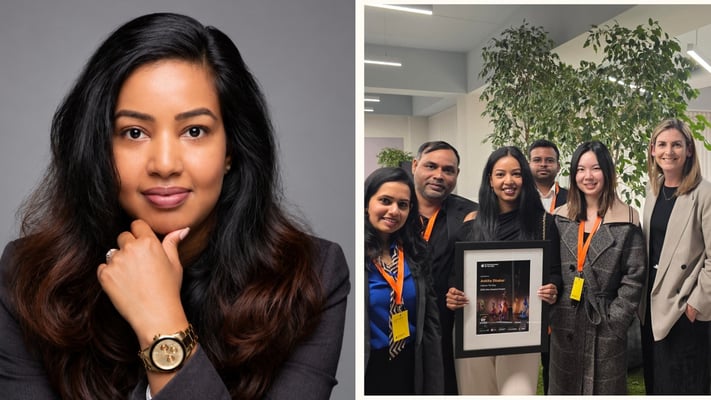



When Ankita Dhakar moved to New Zealand from Jaipur at the age of 21, she arrived alone, without family, an established network or a clear idea of where her career would eventually take her.
What followed was not a straight path. Today, she has been selected as a 2026 EY Entrepreneur Of The Year New Zealand finalist
First working across customer service, real estate, IT support, accounting and database administration, Dhakar eventually found her way into cybersecurity, and, later, entrepreneurship.
“I didn’t arrive with a big career plan. I was young, trying to build a life in a completely new country and, like many migrants, starting without the networks or support system that you often don’t realise are so valuable until you don’t have them.”
Her career, she says, was “anything but linear”.
Before founding Capture The Bug, a cybersecurity company in New Zealand, Dhakar had already tried entrepreneurship once, and failed.
“At the time, failure felt enormous. Looking back, it was probably one of the most valuable experiences I could have had. It taught me that starting something is very different from building something sustainable, and that failure doesn’t have to be the end of your entrepreneurial story.”
She later founded Security Lit in 2020 and left her full-time job in January 2022 to commit fully to entrepreneurship.
Capture The Bug followed in 2023.
Today, the cybersecurity company works with a range of organisations, including large businesses and NZX-listed companies.
That journey carries another meaning for Dhakar, as an Indian migrant woman who entered an industry where she did not fit the conventional mold.
“I’m an Indian migrant, a woman of colour, and I entered cybersecurity without the conventional technical background,” she said.
There have been rooms, Dhakar shared, where she has looked around and realised she was one of very few women, and sometimes the only woman of colour.
For Dhakar, recognition today is therefore about more than professional achievement.
“So being recognised today isn’t just about an award or having my name on a finalist list. For me, it’s about representation.”
She wants young migrant women to be able to see someone like her and understand that there is no single image of what a technology or cybersecurity founder should look like.
“You can have an accent. You can have a non-traditional background. You can fail at something first. You can arrive in a country without connections. None of those things have to determine where you finish.”
“That’s why recognition matters to me.”
But building a business in a country she did not grow up in came with challenges that went well beyond work.
-jpg.jpeg?width=1919&height=1081&name=Media%20(6)-jpg.jpeg)
There was also the loneliness of trying to build something without family nearby or a professional network accumulated over years.
“When things go wrong, there isn’t necessarily a family network nearby to fall back on. Professionally, you also have to build your network from zero.”
Some of the harder challenges were quieter ones, confidence, belonging and wondering whether people would take her seriously.
Her earlier business failure remained somewhere in the background when she decided to try again. Over time, however, that experience began to feel less like a warning and more like preparation.
For Dhakar, resilience came to mean not avoiding failure altogether, but being willing to begin again with more knowledge than before.
Being a migrant without an established network also forced her to learn how to build relationships from the ground up, one conversation and one connection at a time.
That same instinct to ask, listen and learn would eventually lead to Capture The Bug.
While working in cybersecurity, Dhakar began noticing a disconnect.
Technology companies were releasing software rapidly, sometimes making changes every day, while penetration testing was still often carried out only once or twice a year.
Rather than assume she understood the problem, she spoke to more than 45 CTOs, CISOs and Heads of Engineering before building the product.
“The conversations kept confirming the same problem: traditional penetration testing wasn’t keeping pace with modern software development.”
That led to a simple question that would become central to the company.
“If you ship every day, why would you only test your security once a year?”
“That question eventually became Capture The Bug.”
For someone unfamiliar with cybersecurity, Dhakar compares the company’s work to getting a house inspected before buying it.
“Before you buy it, you might get someone to inspect it and find the problems you can’t see yourself - a weak lock, damaged wiring or something that could become a much bigger problem later.”
“We do something similar for technology.”
Capture The Bug helps organisations identify weaknesses in their applications and digital systems before cybercriminals can exploit them.
The platform connects organisations with security experts and allows customers to see vulnerabilities as they are discovered, communicate directly with researchers, fix issues, retest them and monitor their security over time.
“The important part is speed. Companies don’t build software once a year anymore. They’re constantly changing it. We believe security testing needs to evolve in the same way.”
For Dhakar, however, the story of Capture The Bug is also tied closely to the lessons she wishes she had understood earlier.
Asked about one mistake she would never want a young person to make, her answer was simple.
“Thinking that one failure defines you.”
“If you’d asked me after my first business failed, I probably wouldn’t have described it as a gift.”
“Today I would.”
Dhakar believes young people can become so afraid of making the wrong decision that they end up avoiding brave ones.
When she first landed in New Zealand, her ambitions were far simpler than building a cybersecurity company.
“Honestly, it wasn’t Capture The Bug.”
“At 21, my dream was much simpler. I wanted to build a good life, become independent, have a successful career and make my family proud.”
Thousands of kilometres away from home, success at first meant proving to herself that she could make a life here.
She did not imagine becoming a cybersecurity entrepreneur. She did not imagine building a technology company in New Zealand.
“My ambition expanded as my world expanded.”
And while New Zealand became the place where that ambition grew, Jaipur remained the foundation beneath it.
“I grew up in Jaipur, Rajasthan, and those roots are still a huge part of who I am.”
“India gave me my foundations. New Zealand gave me the environment and opportunities to build on them.”
Looking ahead, Dhakar wants Capture The Bug to grow beyond New Zealand and become a global cybersecurity company that New Zealand can be proud was built here.
The company is investing in research and development around artificial intelligence and autonomous security testing, an area she believes will change significantly in the coming years.
But for Dhakar, growth is not only about scale.
She also wants to create opportunities for people who may otherwise be overlooked,people who arrive without networks, without the conventional background and perhaps without certainty that they belong in the room.
“If, years from now, Capture The Bug is globally successful and I’ve also helped make that journey slightly easier for people coming after me, I would consider that a pretty meaningful outcome.”
Her career, perhaps, is best understood through the number of times she entered spaces where, on paper, she did not appear to be the obvious person to be there.
So when she did not know, she asked.
When she did not have a network, she built one.
And when something did not work, Dhakar started again.



ISSUE

Friday, September 18, 2026
Volume 17 . Issue 37

Leave a Comment