


Slopaganda is the new propaganda
The use of memes driven by tension with Donald Trump was an early indicator of a more fundamental change going forward through Iran in terms of their messages.
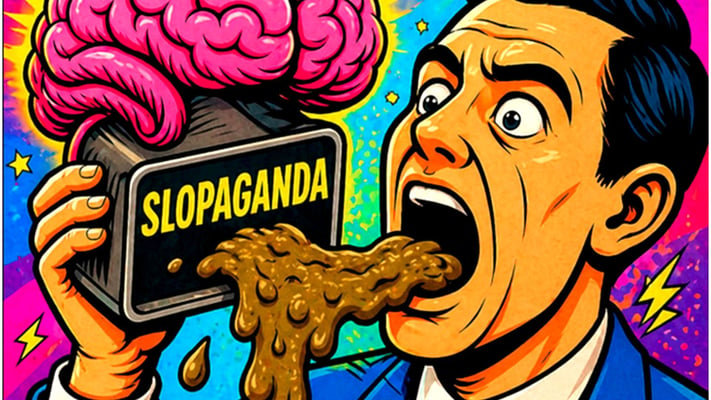
Today, analysts refer to this phase of information warfare as "slopaganda," which consists of mass-producing low-quality content through AI-generated images or text - with the primary goal of overwhelming and not convincing.
The idea is that influencing the public does not consist of crafting a single strong narrative but rather, has shifted to an entirely new concept of flooding misinformation through many variations of the same narrative.
The impact of this new slopaganda mechanism is staggering. Cybersecurity reports predict that, by 2025, more than 50%-60% of all internet traffic will be automated or bot-assisted activity.
With the advent of generative AI, many propaganda campaigns can now be produced at virtually no cost, with hundreds of images, memes, and video clips created every minute, and some of these increasing their output to thousands of posts following the Killing of Qasem Soleimani via accounts or groups with an Iranian connection.
This new slopaganda approach can be seen across the entire world. In the case of the Russia-Ukraine War, researchers counted millions of posts each week on platforms like Telegram, X (formerly Twitter), and TikTok as part of competing narratives during that conflict.
The strategy of Ukraine, promoted through President Volodymyr Zelenskyy, was based upon being authentic and relatable; the videos produced by Pro-Russian efforts were based upon creating as much content as possible to dominate attention spans based upon reposting and recycling.
Furthermore, China's use of high-volume messaging is also a notable example of how slopaganda works. During COVID-19, analysts noted the high level of coordinated posting by state-linked accounts that provided polished messaging and repeating and meme-like images to confuse others and reinforce narratives through frequency.
In addition, the same tactics have been used against democratic systems. Reports about investigations into the 2016 US elections showed how the Internet Research Agency created tens of thousands of posts a month that reached millions of users through algorithmic amplification.
According to Freedom House, the increased amount of organized digital manipulation campaigns are going on in over 40 countries, which suggests these tactics are becoming normalized around the world.
What differentiates slopaganda from traditional propaganda is not about the credibility or cohesiveness of the content. Rather, it is all about exploiting platform algorithms that provide a reward for engagement to help ensure that, as people encounter a number of narratives similar to each other within minutes, it creates a perception of consensus.
The risk of slopaganda is cumulative. With an increase in AI-generated content creation, it would become much more difficult to determine where satire, misinformation, and truth start to blend together. It will create a sense of familiarity through repetition and build belief regardless of the quality of the content being circulated.
Tehran's experience with memes to the international digital flooding of AI-generated content is a new type of soft power. Rather than arguing, persuading, or clearly deceiving, slopaganda is simply saturating. Ultimately, in a world with only so much attention, whichever side can fill the feed will define what truth will be accepted by the majority.
The use of memes driven by tension with Donald Trump was an early indicator of a more fundamental change going forward through Iran in terms of their messages.
Today, analysts refer to this phase of information warfare as "slopaganda," which consists of mass-producing low-quality content through...
The use of memes driven by tension with Donald Trump was an early indicator of a more fundamental change going forward through Iran in terms of their messages.
Today, analysts refer to this phase of information warfare as "slopaganda," which consists of mass-producing low-quality content through AI-generated images or text - with the primary goal of overwhelming and not convincing.
The idea is that influencing the public does not consist of crafting a single strong narrative but rather, has shifted to an entirely new concept of flooding misinformation through many variations of the same narrative.
The impact of this new slopaganda mechanism is staggering. Cybersecurity reports predict that, by 2025, more than 50%-60% of all internet traffic will be automated or bot-assisted activity.
With the advent of generative AI, many propaganda campaigns can now be produced at virtually no cost, with hundreds of images, memes, and video clips created every minute, and some of these increasing their output to thousands of posts following the Killing of Qasem Soleimani via accounts or groups with an Iranian connection.
This new slopaganda approach can be seen across the entire world. In the case of the Russia-Ukraine War, researchers counted millions of posts each week on platforms like Telegram, X (formerly Twitter), and TikTok as part of competing narratives during that conflict.
The strategy of Ukraine, promoted through President Volodymyr Zelenskyy, was based upon being authentic and relatable; the videos produced by Pro-Russian efforts were based upon creating as much content as possible to dominate attention spans based upon reposting and recycling.
Furthermore, China's use of high-volume messaging is also a notable example of how slopaganda works. During COVID-19, analysts noted the high level of coordinated posting by state-linked accounts that provided polished messaging and repeating and meme-like images to confuse others and reinforce narratives through frequency.
In addition, the same tactics have been used against democratic systems. Reports about investigations into the 2016 US elections showed how the Internet Research Agency created tens of thousands of posts a month that reached millions of users through algorithmic amplification.
According to Freedom House, the increased amount of organized digital manipulation campaigns are going on in over 40 countries, which suggests these tactics are becoming normalized around the world.
What differentiates slopaganda from traditional propaganda is not about the credibility or cohesiveness of the content. Rather, it is all about exploiting platform algorithms that provide a reward for engagement to help ensure that, as people encounter a number of narratives similar to each other within minutes, it creates a perception of consensus.
The risk of slopaganda is cumulative. With an increase in AI-generated content creation, it would become much more difficult to determine where satire, misinformation, and truth start to blend together. It will create a sense of familiarity through repetition and build belief regardless of the quality of the content being circulated.
Tehran's experience with memes to the international digital flooding of AI-generated content is a new type of soft power. Rather than arguing, persuading, or clearly deceiving, slopaganda is simply saturating. Ultimately, in a world with only so much attention, whichever side can fill the feed will define what truth will be accepted by the majority.




Leave a Comment