




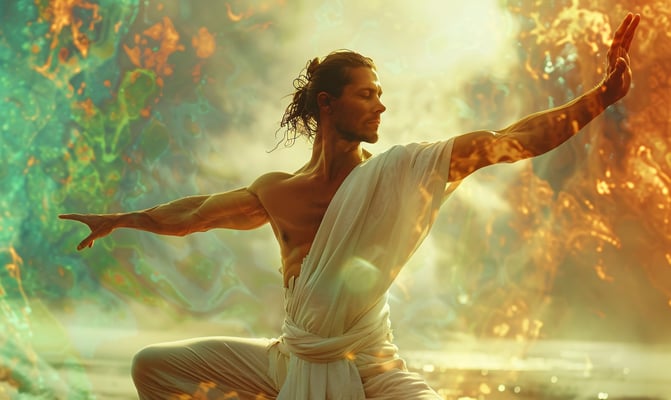



Rasa Siddhanta, as articulated in the Natyashastra by Bharata Muni, has traditionally been understood as a theory of aesthetic emotion—the relish (rasa) experienced by a sensitive spectator.
Later, Abhinavagupta deepened this insight by suggesting that rasa resembles brahmāsvāda, a taste of universal consciousness. However, these formulations can be further enriched by interpreting rasa not merely as emotion, but as an energetic transformation within consciousness.

From a yogic perspective, particularly in the light of the Yoga Sutras of Patanjali, inner transformation proceeds through stages that stabilize the body, regulate energy, and refine awareness.
This process begins with the cultivation of balance and stillness, creating a condition in which deeper energetic flows can emerge. As rigidity dissolves, fluidity arises, followed by rhythmic harmonization of breath and awareness, eventually leading to absorption and integration.
A striking parallel can be observed in aesthetic experience. A work of art, like the human body in yogic practice, presents a structured and bounded form—an expression of stability analogous to the earth element (prithvi tattva).
Through engagement with this form, the spectator’s attention is stabilized. As the experience deepens, emotional and perceptual fluidity emerges, corresponding to the water element (jala tattva).
This is followed by rhythmic entrainment—through sound, movement, or narrative—reflecting the operation of the air element (vayu tattva), wherein the internal rhythms of the spectator align with those of the artwork.
At a certain point, the artwork draws the spectator inward, functioning analogously to pratyahara (withdrawal of the senses). Attention becomes absorbed, and a state of resonance emerges between the internal processes of the spectator and the structure of the artistic form.
It is within this resonance that a crucial transformation occurs: the release of energies that were previously constrained or “calcified” within the individual.
From a tantric perspective, particularly within Kashmir Shaivism, such release can be understood as the free movement of Shakti, the dynamic energy of consciousness. Rasa, in this sense, is not merely the enjoyment of emotion but the felt experience of liberated and harmonized energy.
Thus, aesthetic experience may be understood as a form of subtle yoga—an externally mediated process that mirrors inner transformation. Rasa is not simply tasted; it is the moment in which consciousness, freed from its constraints, experiences its own dynamic fullness.


ISSUE


Leave a Comment