



Cockroach Janta Party and the politics of digital dissent
The sudden rise — and equally sudden suppression — of the Cockroach Janta Party (CJP) says more about India’s political climate than any election rally or television debate.
What began as an internet satire inspired by a controversial “cockroach” remark by Chief Justice of India Surya Kant rapidly transformed into one of the country’s most viral youth-led political movements. And perhaps that is exactly why it became uncomfortable for the establishment.
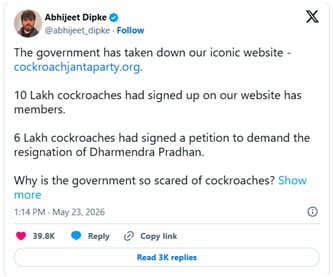
Within a week of its launch on May 16, the CJP reportedly claimed nearly 10 lakh members and amassed a staggering 22.1 million Instagram followers — numbers that rival or even surpass the online reach of major political parties.
Its founder, Abhijeet Dipke, used humour, memes and digital mobilisation to tap into something deeper: growing frustration among young Indians over unemployment, exam paper leaks, political fatigue and the feeling that their voices are increasingly ignored.
The timing was politically explosive. Over six lakh people reportedly signed a petition demanding the resignation of Union Education Minister Dharmendra Pradhan following the NEET-UG 2026 paper leak controversy. The CJP became more than satire; it became a digital protest space.
That is where the state’s response becomes deeply troubling.
The withholding of CJP-linked social media accounts under Section 69A of the Information Technology Act, allegations of website takedowns, hacking attempts and reported death threats against Dipke raise uncomfortable questions about freedom of expression in the digital age.
If satire, parody and online mobilisation are increasingly treated as “national security concerns,” then India risks shrinking the democratic space for dissent.
Political satire has always existed in healthy democracies. Democracies survive criticism not by silencing it, but by tolerating discomfort. When governments appear threatened by memes, parody parties or online petitions, it often reflects insecurity rather than strength.
The real significance of the Cockroach Janta Party lies not in whether it becomes electorally relevant, but in what it reveals about India’s youth.
Gen Z citizens are politically aware, digitally organised and increasingly unwilling to engage through traditional party structures. They communicate through irony, satire and viral culture — tools older political systems often fail to understand.
The “cockroach” metaphor itself became powerful because it symbolised resilience. Attempts to suppress such movements may temporarily remove accounts or websites, but they rarely erase the frustration that fuels them.
The bigger danger for Indian democracy is not a satirical political party. It is the growing perception among young citizens that dissent itself is becoming unwelcome.

The sudden rise — and equally sudden suppression — of the Cockroach Janta Party (CJP) says more about India’s political climate than any election rally or television debate.
What began as an internet satire inspired by a controversial “cockroach” remark by Chief Justice of India Surya Kant rapidly...
The sudden rise — and equally sudden suppression — of the Cockroach Janta Party (CJP) says more about India’s political climate than any election rally or television debate.
What began as an internet satire inspired by a controversial “cockroach” remark by Chief Justice of India Surya Kant rapidly transformed into one of the country’s most viral youth-led political movements. And perhaps that is exactly why it became uncomfortable for the establishment.
Within a week of its launch on May 16, the CJP reportedly claimed nearly 10 lakh members and amassed a staggering 22.1 million Instagram followers — numbers that rival or even surpass the online reach of major political parties.
Its founder, Abhijeet Dipke, used humour, memes and digital mobilisation to tap into something deeper: growing frustration among young Indians over unemployment, exam paper leaks, political fatigue and the feeling that their voices are increasingly ignored.
The timing was politically explosive. Over six lakh people reportedly signed a petition demanding the resignation of Union Education Minister Dharmendra Pradhan following the NEET-UG 2026 paper leak controversy. The CJP became more than satire; it became a digital protest space.
That is where the state’s response becomes deeply troubling.
The withholding of CJP-linked social media accounts under Section 69A of the Information Technology Act, allegations of website takedowns, hacking attempts and reported death threats against Dipke raise uncomfortable questions about freedom of expression in the digital age.
If satire, parody and online mobilisation are increasingly treated as “national security concerns,” then India risks shrinking the democratic space for dissent.
Political satire has always existed in healthy democracies. Democracies survive criticism not by silencing it, but by tolerating discomfort. When governments appear threatened by memes, parody parties or online petitions, it often reflects insecurity rather than strength.
The real significance of the Cockroach Janta Party lies not in whether it becomes electorally relevant, but in what it reveals about India’s youth.
Gen Z citizens are politically aware, digitally organised and increasingly unwilling to engage through traditional party structures. They communicate through irony, satire and viral culture — tools older political systems often fail to understand.
The “cockroach” metaphor itself became powerful because it symbolised resilience. Attempts to suppress such movements may temporarily remove accounts or websites, but they rarely erase the frustration that fuels them.
The bigger danger for Indian democracy is not a satirical political party. It is the growing perception among young citizens that dissent itself is becoming unwelcome.


Leave a Comment