








National remains best placed to form the next government, but the final election results have turned what appeared to be a narrow victory into a complex political negotiation.
New Zealand's voters have delivered their verdict, but the question of who will govern remains largely unanswered.

The official election results released by the Electoral Commission on Friday have stripped the incumbent National-led coalition of its parliamentary majority, placing the Opportunity Party at the centre of one of the country's most consequential government formation processes under the mixed-member proportional (MMP) system.
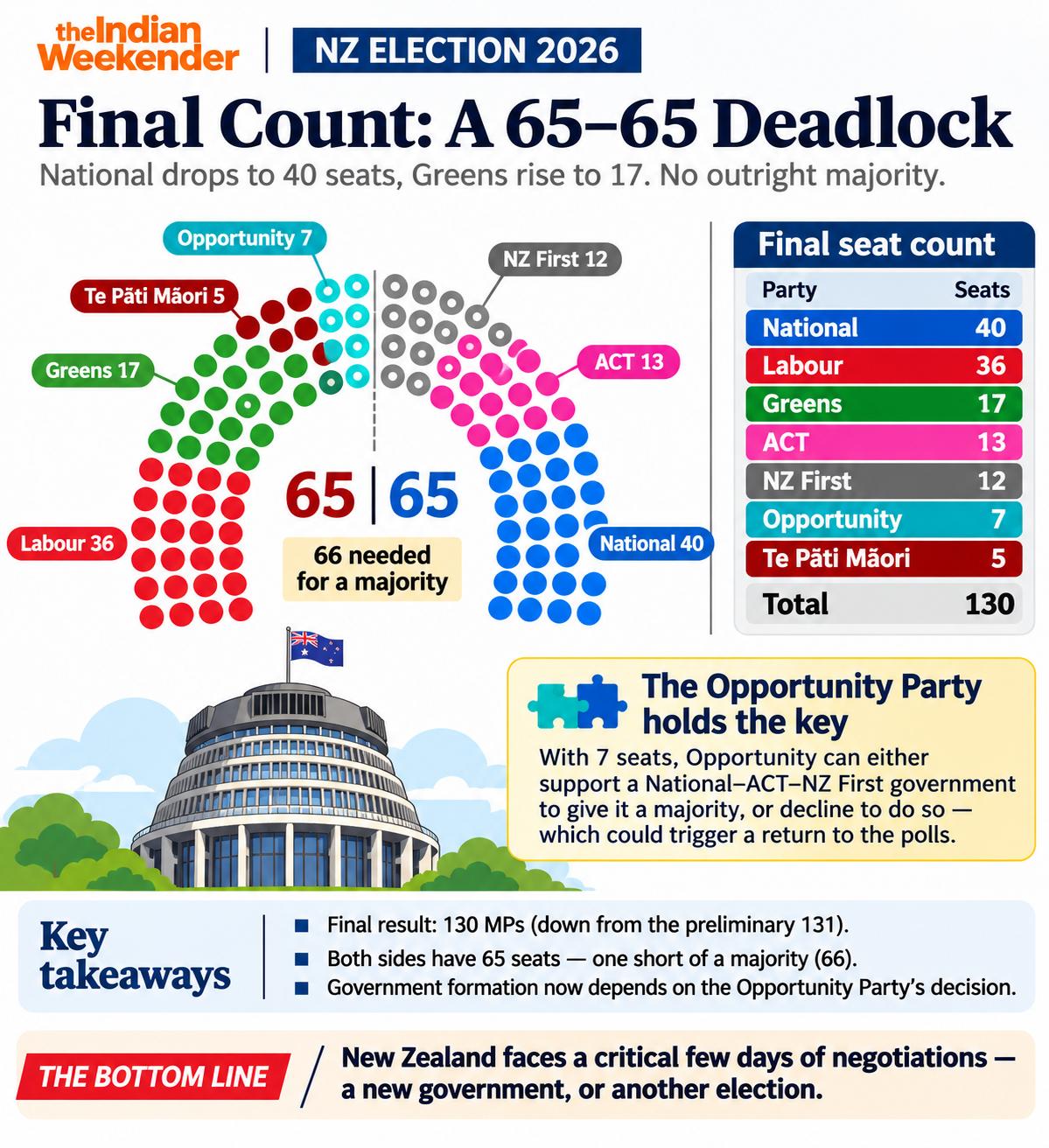
With all votes counted, National has fallen from 42 to 40 seats, while the Greens have increased their representation from 16 to 17. Labour retains 36 seats, ACT 13, NZ First 12, Opportunity seven and Te Pāti Māori five.

The incoming Parliament will have 130 members, including 10 overhang seats, with 66 required for an outright majority.
National, ACT and NZ First collectively hold 65 seats. Labour, the Greens and Te Pāti Māori have 58. Even with Opportunity supporting the latter grouping, the numbers would produce only 65 seats, leaving it one short of a majority.
Neither grouping can command an outright parliamentary majority on its own.
Special votes change the political landscape
The final count included 484,865 special votes, significantly higher than the election-night estimate of 399,365. They represented 16.5 per cent of all votes cast.
Three electorate results proved particularly consequential.
Labour's Georgie Dansey overturned National's election-night lead in Hamilton East, securing the seat with a majority of 173 votes. Kieran McAnulty also won Wairarapa for Labour, defeating National's Mike Butterick by 81 votes.
The Greens' Julie Anne Genter overturned Labour's preliminary lead in Wellington Bays, winning by a margin of 1,610 votes over Craig Renney.
National's two electorate losses reduced its parliamentary representation, while the Greens' additional seat further narrowed the gap between the competing political groupings.
National nevertheless remains the largest parliamentary party, despite Labour securing a higher share of the nationwide party vote, at 29.88 per cent against National's 28.35 per cent.
The difference between party-vote share and parliamentary representation reflects the way MMP allocates seats, including the overhang created when parties win more electorate seats than their proportional entitlement.
Opportunity's power comes with limitations
For Opportunity and its leader Qiulae Wong, the election has delivered considerable political influence. Yet the party's negotiating position is more complicated than the traditional role of a kingmaker.
Supporting National, ACT and NZ First would create a grouping of 72 MPs, providing a clear parliamentary majority.
Supporting Labour, the Greens and Te Pāti Māori would produce only 65 seats, leaving the grouping one short of a majority.
Consequently, the existing National-led coalition has the clearest numerical pathway to government, although securing an agreement involving four parties could present substantial political challenges.
Opportunity could also remain outside Cabinet and negotiate a confidence-and-supply arrangement. Another possibility is an agreement to abstain on confidence votes rather than formally join the government.
Under such an arrangement, the incumbent coalition could potentially govern with 65 votes against 58, provided the remaining MPs abstain and the voting numbers hold.
Entering government is therefore not Opportunity's only option.
However, negotiations are unlikely to be straightforward. Opportunity has indicated that its policy priorities are non-negotiable and has raised objections to Winston Peters holding the Foreign Affairs portfolio in any potential governing arrangement involving NZ First.
The challenge for the party will be balancing its policy priorities, political independence and responsibility towards voters who supported an alternative to the established parties.
Could Labour still return to power?
Labour's pathway is considerably more difficult, although alternative parliamentary combinations are mathematically possible.
A significant political realignment involving NZ First could change the parliamentary arithmetic.
Labour, the Greens, Te Pāti Māori and NZ First would collectively command 70 seats, enough to form a government without Opportunity.
However, the mathematical possibility of such an arrangement should not be confused with its political likelihood. It would require considerable compromises between parties with differing policy priorities and publicly stated positions.
Labour leader Chris Hipkins has acknowledged that his party does not have a viable pathway to forming the next government under the current numbers.
National, meanwhile, remains the only party with a realistic route to securing a centre-right government, provided it reaches an agreement with Opportunity.
Should negotiations fail to produce a government capable of commanding parliamentary confidence, another election remains a possibility. It would not, however, follow automatically from the current deadlock.
What this means for Kiwi Indians
For New Zealand's Indian community, the uncertainty extends beyond political personalities and parliamentary numbers.
Immigration pathways, family reunification, migrant worker protections, retail crime, business confidence and household affordability remain important community concerns.
The eventual governing arrangement will influence how these issues are addressed, particularly where coalition partners have competing policy positions and priorities.
For migrants, students, skilled workers and business owners, the outcome of negotiations could shape the policy environment in which they make decisions about their future in New Zealand.
Immigration settings and skilled-worker pathways will be particularly important for Indian professionals and families looking to settle in the country. Similarly, business owners and entrepreneurs will be watching for clarity on taxation, employment regulations, retail crime and economic policy.
Community organisations will also have reason to monitor commitments relating to social cohesion, migrant protections and equal opportunities.
However, the final coalition agreement, rather than individual campaign promises, will ultimately provide a clearer indication of the direction of government policy.
Political stability and clarity over government priorities will be particularly important for migrants and businesses making long-term decisions.
The election is over, but the contest for power is not
The final result underlines both the complexity and representative nature of MMP.
National remains best placed numerically to lead the next government, but it can no longer do so simply by renewing its existing coalition arrangements.
Labour has secured a higher party-vote share without gaining a viable route back to office.
Opportunity, meanwhile, faces a defining decision in its political development.
New Zealand has elected its Parliament. The responsibility now rests with its political leaders to demonstrate whether they can turn that result into a stable, workable government.


ISSUE


Leave a Comment