

Christopher Luxon signals immigration policy, more capital spending in Budget 2026
Prime Minister Christopher Luxon has promised "careful" immigration policy and signalled more capital spending than expected in an annual pre-Budget speech.
Speaking about the need for social cohesion, Luxon highlighted his own electorate of Botany as "more diverse than most", saying many of Chinese, Korean, Malaysian and Indian New Zealanders were being "unfairly and unreasonably vilified".
He said during the Covid-19 pandemic, ministers had "too often prioritised their own political interests over the interests of the public", and the media "determined to flatter New Zealand's relative performance, also failed".
"Since then, failed immigration policies in Europe and North America have also stoked a politics of division online. Despite prudent policies and the natural advantages of geography, immigration now seems to be an emerging political issue in New Zealand, too," he said, in what could be seen as a swipe at New Zealand First's criticisms of the India free trade deal.
He pointed to the government's moves to tighten immigration law and said National would be watching closely.
"And you should expect to see careful policy on immigration from National as we get closer to the election ... when it comes to immigration, when faced with a choice between social stability and your bottom line, I will choose the former every single time."
Pointing to the United States "now focusing more exclusively on its own view of its own interests - America first", and Russia having made "its brutal intentions clear in Europe" and China "expanding its influence", Luxon painted a now-familiar picture of an erosion of the international rule of law.
"When you turn on the news at night and see alliances straining, trade wars flaring and the rules being rewritten by the powerful, it is only natural to feel as though the ground is shifting beneath you," he said, before offering an optimistic observation.
"We have faced similar challenges before, and we have overcome them."
He hearkened back to world wars, giving a message of hope in an increasingly volatile world.
"The outcome was not inevitable. It was not guaranteed. People were frightened, and they were right to be frightened," he said. "They didn't just win a war. They built the peace that followed."
Also addressing a need for cooperation with like-minded partners on defence and trade, he also drew attention to the need for energy independence.
"On too many occasions, private capital, eager to bolster domestic energy production, has been pushed to the sidelines by overzealous planners and politicians in recent years," he said.
"The reality is that when faced with energy shock after energy shock, it's very hard to justify backing the skink over the solar farm."
He pointed to the government's responses to the fuel crisis, while noting "more action is required".
That could be delivered through changes to Budget allowances - with less operational spending at $2.1b, down from $2.4b; but more capital spending at $5.7b.
"The recent crisis has acted as a timely reminder that significant levels of capital investment will be required in the coming years," Luxon said.
"That doesn't reflect a permanently higher rate of borrowing - we'll need to get the balance right in the years ahead, as we rebuild our fiscal buffers ... The truth is that as a country we don't save nearly enough, and rely too much on money borrowed from overseas to support our lifestyles. That must change."
Finance Minister Nicola Willis will deliver her third Budget on 28 May in what are constrained fiscal times.
The conflict in Iran and the global fuel crisis it has triggered required a certain level of re-forecasting and reprioritising of the Budget in recent months.
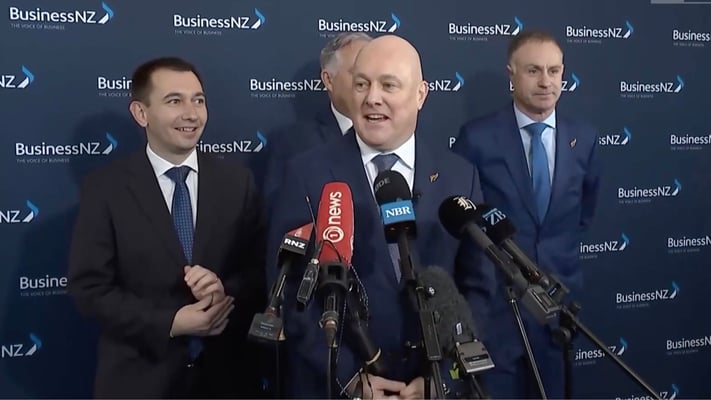
There were no pre-Budget announcements expected in Christopher Luxon's speech to a Business NZ audience on Wednesday, though some are due to trickle out from other ministers in the coming days.
The only policy announced to date is the scrapping of the third year of fees-free tertiary study.
-RNZ
Prime Minister Christopher Luxon has promised "careful" immigration policy and signalled more capital spending than expected in an annual pre-Budget speech.
Speaking about the need for social cohesion, Luxon highlighted his own electorate of Botany as "more diverse than most", saying many of...
Prime Minister Christopher Luxon has promised "careful" immigration policy and signalled more capital spending than expected in an annual pre-Budget speech.
Speaking about the need for social cohesion, Luxon highlighted his own electorate of Botany as "more diverse than most", saying many of Chinese, Korean, Malaysian and Indian New Zealanders were being "unfairly and unreasonably vilified".
He said during the Covid-19 pandemic, ministers had "too often prioritised their own political interests over the interests of the public", and the media "determined to flatter New Zealand's relative performance, also failed".
"Since then, failed immigration policies in Europe and North America have also stoked a politics of division online. Despite prudent policies and the natural advantages of geography, immigration now seems to be an emerging political issue in New Zealand, too," he said, in what could be seen as a swipe at New Zealand First's criticisms of the India free trade deal.
He pointed to the government's moves to tighten immigration law and said National would be watching closely.
"And you should expect to see careful policy on immigration from National as we get closer to the election ... when it comes to immigration, when faced with a choice between social stability and your bottom line, I will choose the former every single time."
Pointing to the United States "now focusing more exclusively on its own view of its own interests - America first", and Russia having made "its brutal intentions clear in Europe" and China "expanding its influence", Luxon painted a now-familiar picture of an erosion of the international rule of law.
"When you turn on the news at night and see alliances straining, trade wars flaring and the rules being rewritten by the powerful, it is only natural to feel as though the ground is shifting beneath you," he said, before offering an optimistic observation.
"We have faced similar challenges before, and we have overcome them."
He hearkened back to world wars, giving a message of hope in an increasingly volatile world.
"The outcome was not inevitable. It was not guaranteed. People were frightened, and they were right to be frightened," he said. "They didn't just win a war. They built the peace that followed."
Also addressing a need for cooperation with like-minded partners on defence and trade, he also drew attention to the need for energy independence.
"On too many occasions, private capital, eager to bolster domestic energy production, has been pushed to the sidelines by overzealous planners and politicians in recent years," he said.
"The reality is that when faced with energy shock after energy shock, it's very hard to justify backing the skink over the solar farm."
He pointed to the government's responses to the fuel crisis, while noting "more action is required".
That could be delivered through changes to Budget allowances - with less operational spending at $2.1b, down from $2.4b; but more capital spending at $5.7b.
"The recent crisis has acted as a timely reminder that significant levels of capital investment will be required in the coming years," Luxon said.
"That doesn't reflect a permanently higher rate of borrowing - we'll need to get the balance right in the years ahead, as we rebuild our fiscal buffers ... The truth is that as a country we don't save nearly enough, and rely too much on money borrowed from overseas to support our lifestyles. That must change."
Finance Minister Nicola Willis will deliver her third Budget on 28 May in what are constrained fiscal times.
The conflict in Iran and the global fuel crisis it has triggered required a certain level of re-forecasting and reprioritising of the Budget in recent months.
There were no pre-Budget announcements expected in Christopher Luxon's speech to a Business NZ audience on Wednesday, though some are due to trickle out from other ministers in the coming days.
The only policy announced to date is the scrapping of the third year of fees-free tertiary study.
-RNZ





Leave a Comment