

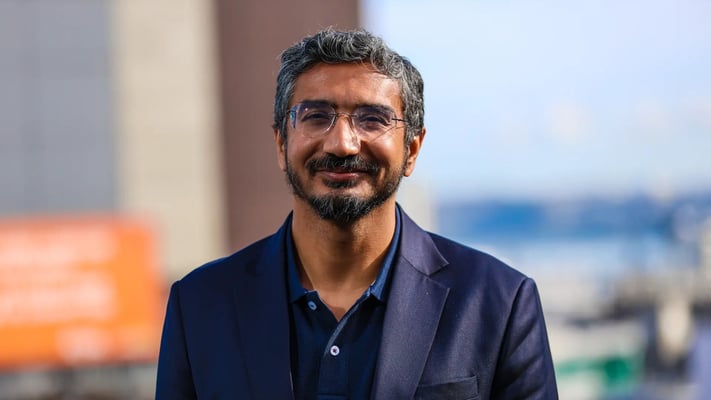

‘Acting east’: Foreign policy analyst Dhruva Jaishankar on why India is widening its Pacific ambitions
Indian Prime Minister Narendra Modi's recent visit to New Zealand was notable due to announcements on the two countries' elevated strategic partnership and a joint working group on counterterrorism.
Foreign policy experts believe both announcements reflect India's ongoing attempts to mitigate future security threats that may emerge from the region.
"[India's] idea is to have security partnerships around the world," said Dhruva Jaishankar, executive director of the US arm of one of India's leading public policy think tanks, Observer Research Foundation.
"Today, the challenge of transnational crime, transnational terrorism and counternarcotics ... [is] not relegated to one country. A problem in one country will have links to places in other countries as well."
Jaishankar is also the son of India's external affairs minister, S. Jaishankar, and a notable foreign analyst in current Indian policy circles.
The executive director was in New Zealand recently as part of his senior fellow role with the Asian New Zealand Foundation.
"India has a wide variety of national security concerns, international as well as domestic," Jaishankar said.
"As we have a growing Indian community all over the world, the concern is if there are problems in future, the two governments need to be able to work together more seamlessly," he said.
"We've had some difficulties, for example, in India's relations with Canada, and to a lesser degree with Australia. They've now been managed," he said.
"Partly, having these joint [counterterrorism] mechanisms is a way to mitigate that," he said.
"So that if in future any challenges emerge, they are dealt appropriately by the two governments."
Jaishankar cut through the jargon to explain what a strategic partnership means to New Zealand and India in practice.
"It's a signal of intent to the governments itself, and to the bureaucracies in the two countries, as to how much and how frequently to engage, at what levels, with their counterparts," he said.
"[In essence] the prime ministers have told the foreign ministers and other ministers, and the bureaucrats below them, to meet at regular intervals to achieve certain outcomes."
Such interactions have already begun, with Jaishankar saying that India's external affairs minister meets his New Zealand counterpart, Winston Peters, "quite frequently".
He dismissed a suggestion that the recent July meeting between the two ministers on the sidelines of the Association of Southeast Asian Nations summit in the Philippines was "awkward".
The Manila meeting was the first time Peters met Indian officials after publicly declaring his opposition to the free trade deal in December.
Peters was overseas on official business during Modi's Auckland visit in July.
"One part of diplomacy is meeting with people who disagree with you ... it is actually working through differences as well," he said.
"My sense is ... there is broad-based support for a free trade agreement [with India] across party lines in New Zealand," he said.
"Obviously, New Zealand First has opposed it in the run-up to the election, but there was a lot of enthusiasm for it amongst National, Labour and other parties as well," he said.
"The reality is New Zealand is going into an election season. [But] I didn't see in Wellington a concern that [the India trade deal] would not be ratified."
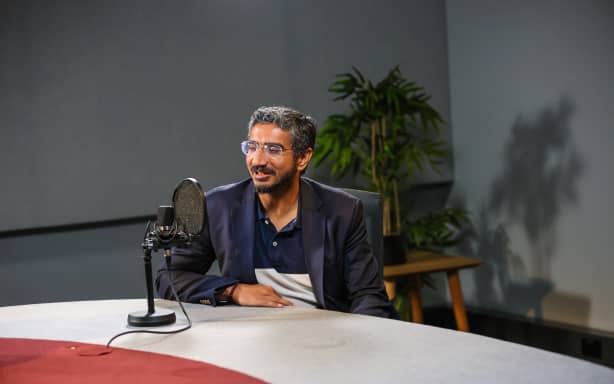
Dhruva Jaishankar is the son of India's minister of external affairs, S. Jaisankar. RNZ / Blessen Tom
Jaishankar pushed back on the prevailing wisdom in geopolitical circles that India signed the trade deal with New Zealand solely to increase its influence in the Pacific.
To claim the trade deal was not really about trade but instead an attempt to make a geopolitical statement would be inaccurate, he said.
"It's a combination thereof," he said.
"In this day and age, we can't completely separate economics and strategy. They're very tied together," he said.
"The reality is we're in a world which is in great disorder. We have growing competition between the US and China," he said.
"Yet all of us, whether it's India, whether it's New Zealand, whether it's other countries, depend a lot on the US for market access," he said.
"[However], the US is putting tariffs on everyone. And we depend a lot on China for supply chains and, in some cases, exports as well.
"So it makes sense, in this very disorderly world for India, New Zealand and others - including Europe, Japan, Australia, Canada - to start working more closely together, to deepen trade ties [and] deepen security relationships."
The Indian foreign policy expert acknowledged the South Asian nation's relationship with the US went south in May last year after the early uptick following US President Donald Trump's re-election in November 2024.
Clashes between India and Pakistan as well as Washington's imposition of tariffs on India had played a role, he said.
"In the last few months, we have seen a recovery with PM Modi and President Trump meeting in France recently ... And, actually, at the working level, things have continued - in fact deepened," he said.
"American companies are making massive investments in artificial intelligence infrastructure in India, about US$70 billion of investment in the next few years. The two countries signed a defence framework agreement last October, again at a low point in relations."
Jaishankar said Indians currently had a 45 percent approval rating of the US, which is down from a high of 80 percent about a year or two ago.
"This is a big drop and it might drop even further," he said.
"[But] despite the political uncertainty, the day-to-day cooperation continues."
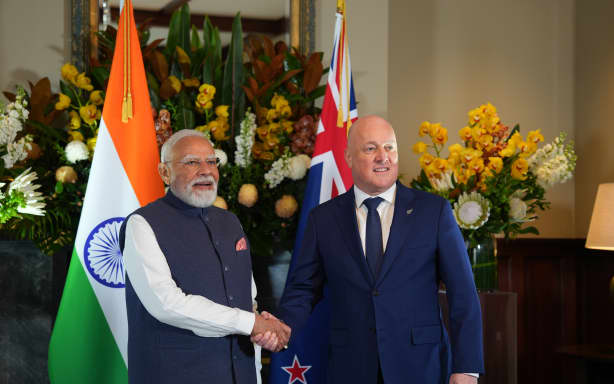
Indian Prime Minister Narendra Modi shakes hands with Prime Minister Christopher Luxon in July. Supplied/PMO
Jaishankar rejected the idea that India's interest in New Zealand was part of an attempt to counterbalance China or leverage the South Asian nation's influence in the Pacific.
"That's a very narrow way of looking at it because the fact is China has much deeper pockets and China does other things well," he said.
"There are certain areas China can be very competitive in that India cannot be, and vice versa," he said.
"There are other reasons India is interested in this. I mean, not least because of the support of 12 sovereign member states in the United Nations."
Jaishankar was referring to India's recently launched campaign for a two-year non-permanent seat on the United Nations for which it would need as many votes as possible from all member states.
"[Not] only for the Security Council, but also for other global initiatives that India would like," he said.
The foreign policy expert said India was involved in a joint port development project in Fiji and a joint 5G telecommunications network development in Palau.
"There are initiatives like these that India can do jointly with other countries, including possibly New Zealand," he said.
"New Zealand has a big presence in these places. So, working with the New Zealand government in coordinated projects ... [such as] humanitarian assistance, disaster relief and disaster mitigation," he said.
"India has a record of supporting countries in such efforts. Solar production and solar development, something called digital public infrastructure, which is India's payments system identification system.
"There are active attempts underway now for India to export some of that, and there's a need for it in some of these Pacific Island countries as well."
The term Jaishankar often used to describe India's interests and investments in the Indo-Pacific was "modest".
However, he said the way India tended to look east in terms of its own world view was not something new.
He presented such an argument in a 2024 book titled Vishwa Shastra: India and the World, in which he traced India's long tradition of statecraft from ancient times to the modern world.
"Vishwa" means "world" in classical Sanskrit, while "shastra" means "treatise".
"In the book, I have tried to document historically how India has interacted with the world at different points of time, sometimes going back thousands of years. [Moreover] the last part of the book looks at what are India's priorities in the future," he said.
"Before independence, India had a prior cultural phase. So, if you travel today to Cambodia or Indonesia or Vietnam, you see a very strong Indian cultural imprint there," he said.
"Angkor Wat [in Cambodia] is the largest Hindu temple in the world ... the scripts of Southeast Asia all came from India. [But] we lost that a little bit during the colonial period. It was disrupted," he said.
"[Then] in the '90s, there was something called the 'look east policy' started by the Indian prime minister at the time, P.V. Narasimha Rao, which was motivated by economics and focused on economic engagement with East Asia, Northeast Asia and Southeast Asia," he said.
"Things have changed. There's a bigger security focus now and India's interests have widened to include the South Pacific. The urgency has also increased with focus shifting to delivery.
"Rather than simply 'looking east', it's 'acting east'.
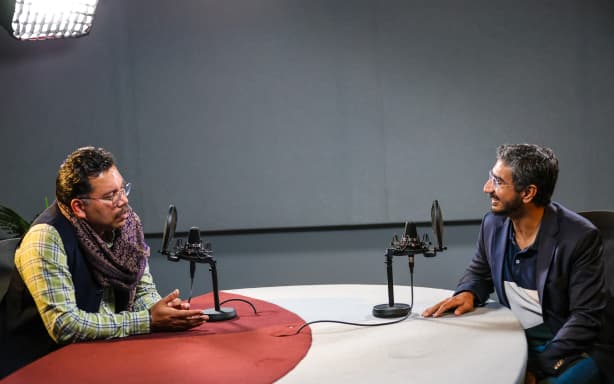
Dhruva Jaishankar speaks to RNZ journalist Gaurav Sharma in August. RNZ / Blessen Tom
Returning to trade, New Zealand's interest in India's burgeoning middle-class market has been well documented.
However, but what India could sell New Zealand - a country of 5 million - was still up for debate.
Not for Jaishankar, though. He singled out petroleum products, IT services such as AI-adjacent technologies, auto parts and electronics such as smartphones as potential imports from India.
Collaboration in the creative industry, the space sector and sports was also on the cards, he said.
"Some of that is happening already, but I think we'll see growth," he said.
Jaishankar also saw a potential role for Indian infrastructure companies in New Zealand.
"A two-way investment ... [maybe] investment in port infrastructure here," he said.
"India has grown its port capacity by 50 percent in the last decade. It has set up 90 new airports. So, there has been a big infrastructure boom in India ... we have very competitive and world-class infrastructure companies now emerging in India," he said.
These companies might come to New Zealand to build infrastructure projects here, he said.
On the future of bilateral relations between the two countries, Jaishankar wanted a "more broad-based relationship".
"[A future] where there's more coordination and substantive cooperation on security, ... more fully-fledged people-to-people ties, which include potentially New Zealand universities setting up campuses in India, ... more comprehensive economic ties beyond commodity exports from New Zealand to India, ... looking beyond services, more inbound manufactured imports from India to New Zealand," he said.
"[Finally] more cooperation on regional and multilateral issues," he said.
"New Zealand and India have often been on opposite sides on nuclear issues, for example, in the past. But at a time when the international order is under stress, the more New Zealand and India can cooperate in regional and global institutions, the better."
-RNZ
Indian Prime Minister Narendra Modi's recent visit to New Zealand was notable due to announcements on the two countries' elevated strategic partnership and a joint working group on counterterrorism.
{% module_block module "widget_d215e6a8-89fb-4cd2-b6f9-56f31dea3299" %}{% module_attribute "ads"...Indian Prime Minister Narendra Modi's recent visit to New Zealand was notable due to announcements on the two countries' elevated strategic partnership and a joint working group on counterterrorism.
Foreign policy experts believe both announcements reflect India's ongoing attempts to mitigate future security threats that may emerge from the region.
"[India's] idea is to have security partnerships around the world," said Dhruva Jaishankar, executive director of the US arm of one of India's leading public policy think tanks, Observer Research Foundation.
"Today, the challenge of transnational crime, transnational terrorism and counternarcotics ... [is] not relegated to one country. A problem in one country will have links to places in other countries as well."
Jaishankar is also the son of India's external affairs minister, S. Jaishankar, and a notable foreign analyst in current Indian policy circles.
The executive director was in New Zealand recently as part of his senior fellow role with the Asian New Zealand Foundation.
"India has a wide variety of national security concerns, international as well as domestic," Jaishankar said.
"As we have a growing Indian community all over the world, the concern is if there are problems in future, the two governments need to be able to work together more seamlessly," he said.
"We've had some difficulties, for example, in India's relations with Canada, and to a lesser degree with Australia. They've now been managed," he said.
"Partly, having these joint [counterterrorism] mechanisms is a way to mitigate that," he said.
"So that if in future any challenges emerge, they are dealt appropriately by the two governments."
Jaishankar cut through the jargon to explain what a strategic partnership means to New Zealand and India in practice.
"It's a signal of intent to the governments itself, and to the bureaucracies in the two countries, as to how much and how frequently to engage, at what levels, with their counterparts," he said.
"[In essence] the prime ministers have told the foreign ministers and other ministers, and the bureaucrats below them, to meet at regular intervals to achieve certain outcomes."
Such interactions have already begun, with Jaishankar saying that India's external affairs minister meets his New Zealand counterpart, Winston Peters, "quite frequently".
He dismissed a suggestion that the recent July meeting between the two ministers on the sidelines of the Association of Southeast Asian Nations summit in the Philippines was "awkward".
The Manila meeting was the first time Peters met Indian officials after publicly declaring his opposition to the free trade deal in December.
Peters was overseas on official business during Modi's Auckland visit in July.
"One part of diplomacy is meeting with people who disagree with you ... it is actually working through differences as well," he said.
"My sense is ... there is broad-based support for a free trade agreement [with India] across party lines in New Zealand," he said.
"Obviously, New Zealand First has opposed it in the run-up to the election, but there was a lot of enthusiasm for it amongst National, Labour and other parties as well," he said.
"The reality is New Zealand is going into an election season. [But] I didn't see in Wellington a concern that [the India trade deal] would not be ratified."
Dhruva Jaishankar is the son of India's minister of external affairs, S. Jaisankar. RNZ / Blessen Tom
Jaishankar pushed back on the prevailing wisdom in geopolitical circles that India signed the trade deal with New Zealand solely to increase its influence in the Pacific.
To claim the trade deal was not really about trade but instead an attempt to make a geopolitical statement would be inaccurate, he said.
"It's a combination thereof," he said.
"In this day and age, we can't completely separate economics and strategy. They're very tied together," he said.
"The reality is we're in a world which is in great disorder. We have growing competition between the US and China," he said.
"Yet all of us, whether it's India, whether it's New Zealand, whether it's other countries, depend a lot on the US for market access," he said.
"[However], the US is putting tariffs on everyone. And we depend a lot on China for supply chains and, in some cases, exports as well.
"So it makes sense, in this very disorderly world for India, New Zealand and others - including Europe, Japan, Australia, Canada - to start working more closely together, to deepen trade ties [and] deepen security relationships."
The Indian foreign policy expert acknowledged the South Asian nation's relationship with the US went south in May last year after the early uptick following US President Donald Trump's re-election in November 2024.
Clashes between India and Pakistan as well as Washington's imposition of tariffs on India had played a role, he said.
"In the last few months, we have seen a recovery with PM Modi and President Trump meeting in France recently ... And, actually, at the working level, things have continued - in fact deepened," he said.
"American companies are making massive investments in artificial intelligence infrastructure in India, about US$70 billion of investment in the next few years. The two countries signed a defence framework agreement last October, again at a low point in relations."
Jaishankar said Indians currently had a 45 percent approval rating of the US, which is down from a high of 80 percent about a year or two ago.
"This is a big drop and it might drop even further," he said.
"[But] despite the political uncertainty, the day-to-day cooperation continues."
Indian Prime Minister Narendra Modi shakes hands with Prime Minister Christopher Luxon in July. Supplied/PMO
Jaishankar rejected the idea that India's interest in New Zealand was part of an attempt to counterbalance China or leverage the South Asian nation's influence in the Pacific.
"That's a very narrow way of looking at it because the fact is China has much deeper pockets and China does other things well," he said.
"There are certain areas China can be very competitive in that India cannot be, and vice versa," he said.
"There are other reasons India is interested in this. I mean, not least because of the support of 12 sovereign member states in the United Nations."
Jaishankar was referring to India's recently launched campaign for a two-year non-permanent seat on the United Nations for which it would need as many votes as possible from all member states.
"[Not] only for the Security Council, but also for other global initiatives that India would like," he said.
The foreign policy expert said India was involved in a joint port development project in Fiji and a joint 5G telecommunications network development in Palau.
"There are initiatives like these that India can do jointly with other countries, including possibly New Zealand," he said.
"New Zealand has a big presence in these places. So, working with the New Zealand government in coordinated projects ... [such as] humanitarian assistance, disaster relief and disaster mitigation," he said.
"India has a record of supporting countries in such efforts. Solar production and solar development, something called digital public infrastructure, which is India's payments system identification system.
"There are active attempts underway now for India to export some of that, and there's a need for it in some of these Pacific Island countries as well."
The term Jaishankar often used to describe India's interests and investments in the Indo-Pacific was "modest".
However, he said the way India tended to look east in terms of its own world view was not something new.
He presented such an argument in a 2024 book titled Vishwa Shastra: India and the World, in which he traced India's long tradition of statecraft from ancient times to the modern world.
"Vishwa" means "world" in classical Sanskrit, while "shastra" means "treatise".
"In the book, I have tried to document historically how India has interacted with the world at different points of time, sometimes going back thousands of years. [Moreover] the last part of the book looks at what are India's priorities in the future," he said.
"Before independence, India had a prior cultural phase. So, if you travel today to Cambodia or Indonesia or Vietnam, you see a very strong Indian cultural imprint there," he said.
"Angkor Wat [in Cambodia] is the largest Hindu temple in the world ... the scripts of Southeast Asia all came from India. [But] we lost that a little bit during the colonial period. It was disrupted," he said.
"[Then] in the '90s, there was something called the 'look east policy' started by the Indian prime minister at the time, P.V. Narasimha Rao, which was motivated by economics and focused on economic engagement with East Asia, Northeast Asia and Southeast Asia," he said.
"Things have changed. There's a bigger security focus now and India's interests have widened to include the South Pacific. The urgency has also increased with focus shifting to delivery.
"Rather than simply 'looking east', it's 'acting east'.
Dhruva Jaishankar speaks to RNZ journalist Gaurav Sharma in August. RNZ / Blessen Tom
Returning to trade, New Zealand's interest in India's burgeoning middle-class market has been well documented.
However, but what India could sell New Zealand - a country of 5 million - was still up for debate.
Not for Jaishankar, though. He singled out petroleum products, IT services such as AI-adjacent technologies, auto parts and electronics such as smartphones as potential imports from India.
Collaboration in the creative industry, the space sector and sports was also on the cards, he said.
"Some of that is happening already, but I think we'll see growth," he said.
Jaishankar also saw a potential role for Indian infrastructure companies in New Zealand.
"A two-way investment ... [maybe] investment in port infrastructure here," he said.
"India has grown its port capacity by 50 percent in the last decade. It has set up 90 new airports. So, there has been a big infrastructure boom in India ... we have very competitive and world-class infrastructure companies now emerging in India," he said.
These companies might come to New Zealand to build infrastructure projects here, he said.
On the future of bilateral relations between the two countries, Jaishankar wanted a "more broad-based relationship".
"[A future] where there's more coordination and substantive cooperation on security, ... more fully-fledged people-to-people ties, which include potentially New Zealand universities setting up campuses in India, ... more comprehensive economic ties beyond commodity exports from New Zealand to India, ... looking beyond services, more inbound manufactured imports from India to New Zealand," he said.
"[Finally] more cooperation on regional and multilateral issues," he said.
"New Zealand and India have often been on opposite sides on nuclear issues, for example, in the past. But at a time when the international order is under stress, the more New Zealand and India can cooperate in regional and global institutions, the better."
-RNZ


Leave a Comment