




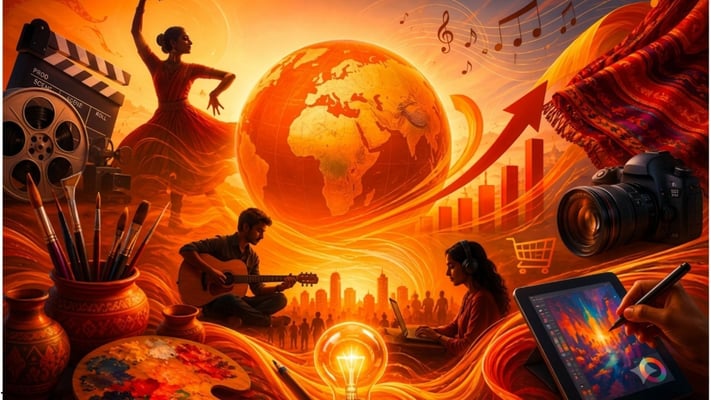



The Orange Economy, introduced by the economists Iván Duque and Felipe Buitrago, is no longer used narrowly to describe a concept limited to certain industries in which value comes from creativity and culture rather than from raw materials and capital.

Currently, the Union Budget 2026-27 and the Economic Survey have embraced this topic, positioning it alongside the manufacturing and services sectors as a basis for economic development, and statistics confirm this shift.
According to data from the Ministry of Information and Broadcasting, the value of the creative economy in India is around $30 billion, accounting for 2.5 percent of the country's GDP while employing roughly 8 percent of the workforce.

Besides that, the performance doesn’t seem impressive on a global scale, as data published by UNCTAD indicate that the contribution of the creative industries ranges from 0.5 to more than 7 percent of GDP across countries, with industry leaders able to achieve higher values per capita.
The sector comprises industries such as media and entertainment, animation, visual effects, gaming, OTT platform providers, design, publishing, live events, fashion, and cultural tourism, all of which are developing rapidly. In particular, India’s media and entertainment industry reached almost ₹2.5 trillion in 2024 and is estimated to reach ₹3.06 trillion by 2027.
We have witnessed gaming grow to one of the fastest-growing sectors in the world. India is now listed as one of the largest gaming markets in the world, with almost 500 million gamers generating industry revenue of nearly ₹232 billion.
The impact of VFX in film production in India has prompted many film producers to use VFX, with many modern-day Indian films allocating 25 to 30 percent of their budgets towards VFX, and government initiatives are underway to establish 15,000 Content Creator Labs in our educational centers, along with ₹250 crore funds planned in the Budget for the year 2026.
The statistics coming from the creator economy itself are hard-hitting. There are already about 2-2.5 million active creators in India, with an impact on consumer spending of about $350-400 billion annually.
According to Boston Consulting Group, this may exceed $1 trillion by 2030, which is one-fourth of India’s GDP. YouTube's contribution to India’s GDP in 2024 alone was more than ₹16,000 crores, and it has also provided 930,000 full-time equivalent jobs.
The funding was announced at the WAVES Summit in March 2025, totaling $1 billion, and aimed at providing capital support for creative businesses, which is generally hard to attract for traditional businesses.
On the contrary, export statistics are not as promising. The growth of creative services exports in India reached 20 percent in 2023 and will most likely exceed $11 billion annually.
Still, compared to other countries, this figure is relatively small, as South Korea, which developed the Hallyu Wave strategy after the 1997 Asian financial crisis, benefits from cultural exports amounting to over $12 billion.
Thus, despite having a population about 10 times India's, South Korea’s cultural exports do not exceed India’s. The global animation market is worth about $430 billion, according to the prime minister, and will need about 2 million specialists over the next 7 years.
India experiences many challenges to developing its creative economy. One of the main challenges is that India still lacks a dedicated Creative Economy, meaning the sector's actual contribution to the GDP is not calculated.



ISSUE

Leave a Comment