




-Sep-10-2026-04-33-28-4678-AM.jpg?width=740&height=400&name=OPINION%20(3)-Sep-10-2026-04-33-28-4678-AM.jpg)



As 120 members of New Zealand's Alig community prepare to gather in Auckland, Sir Syed Ahmad Khan's belief in education, service and harmony continues to speak powerfully across generations and continents.
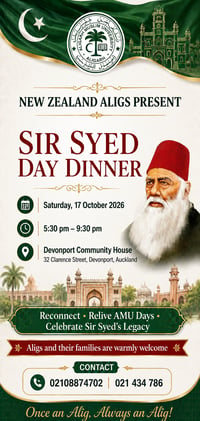
On Saturday, 17 October 2026, alumni of Aligarh Muslim University and their families will gather at Devonport Community House in
Auckland for the Sir Syed Day Dinner. The response has already exceeded expectations, with 120 guests confirmed. The event has therefore reached its planned capacity and is no longer seeking further registrations. What began as an alumni reunion has grown into a celebration of an idea that travelled from nineteenth-century Aligarh to communities across the world.
An educational vision larger than an institution
Sir Syed Ahmad Khan understood that a community could not progress without education, scientific inquiry and confidence in engaging with a changing world. In the difficult years following 1857, he urged Indians, particularly Muslims who had fallen behind in modern education, to acquire knowledge rather than retreat from it. His efforts led to the establishment of the Muhammadan Anglo-Oriental College in 1875. It later became Aligarh Muslim University in 1920.
Yet Sir Syed's achievement cannot be understood simply through the founding of a college. He helped create a movement: one that connected learning with character, reason with faith, and personal advancement with responsibility towards society. He wanted education to open minds, create leadership and equip people to participate confidently in public life.
A university shaped by shared belonging
Communal harmony is not an ornamental phrase in the Aligarh tradition; it is part of the university's lived identity. Students from different religions, regions, languages and social backgrounds have studied, debated, played sport, shared meals and formed lifelong friendships on the same campus. Historian Ishwari Prasad, remembered as AMU's first graduate, remains an early symbol of the university's inclusive approach to learning. This composite culture, often described as Ganga-Jamuni tehzeeb, teaches that identity need not become a barrier and that disagreement need not destroy mutual respect.
 At its best, AMU represents an India in which intellectual confidence and cultural generosity stand together. Its residential life has enabled young people to encounter difference at close quarters, not as an abstract lesson but through roommates, classmates, teachers, teammates and friends. That experience has helped generations of Aligs carry an instinct for dialogue and coexistence into public service, education, medicine, law, business, science and the arts.
This is why Sir Syed's legacy remains urgently relevant. At a time when public discourse can become divided and suspicious, education must do more than provide qualifications. It must also teach us to listen, question prejudice and recognise one another's dignity. AMU's contribution to communal harmony lies not only in speeches or ceremonies, but in the countless human bonds created across communities over more than a century.
From literature and cinema to cricket and public service
AMU's intellectual reach is reflected in former Indian President Dr Zakir Husain and former Vice-President Mohammad Hamid Ansari, as well as marine scientist Dr Zahoor Qasim, who led India's first expedition to Antarctica. Their achievements express Sir Syed Ahmad Khan's belief that education should develop individual ability while strengthening responsibility towards society.
The breadth of AMU's cultural influence can be seen in Javed Akhtar, one of India's most celebrated lyricists and screenwriters; Naseeruddin Shah, whose work has shaped Indian theatre and cinema for decades; and filmmaker Anubhav Sinha, known for bringing difficult social questions to mainstream audiences.
Aligarh's contribution to Urdu literature is equally remarkable. Saadat Hasan Manto brought an unflinching honesty to the human consequences of Partition and social hypocrisy. Ismat Chughtaichallenged convention with courage, wit and a fiercely independent voice, while poets Kaifi Azmiand Ali Sardar Jafri enriched India's literary and progressive traditions. Shahryar combined lyricism with intellectual depth and later taught at AMU, strengthening the literary culture that had nurtured him. Together, these figures show that universities serve society not only by producing professionals, but also by protecting the freedom to imagine, question and create.
Sport forms another proud strand of AMU's story. Legendary cricketer Lala Amarnath was a student of the university, while its celebrated hockey tradition includes Major Dhyan Chand, Zafar Iqbal, Akhtar Hussain, B. P. Govinda, S. M. Ali Sayeed and Inamur Rehman. AMU alumna Annu Raj Singh represented India in shooting at the 2012 London Olympics and won Commonwealth Games gold. These achievements reflect the discipline, teamwork, resilience and excellence fostered on Aligarh's playing fields.
An Alig connection to a historic Auckland visit
Prime Minister Narendra Modi's visit to Auckland on 10 and 11 July 2026 - the first visit by an Indian Prime Minister to New Zealand in four decades - gave the local Indian community a renewed sense of connection between the two countries. It also carried a special Aligarh association. Alok Sharma, the Director of India's Special Protection Group, is an AMU alumnus from Mechanical Engineering. For event organiser Mohammad Ather, who counts Sharma as a friend, his rise to such a position of national responsibility is a particularly personal source of Alig pride.
This one connection reflects a much wider reality. Across the world, Aligs are serving as doctors, engineers, academics, civil servants, entrepreneurs, artists, journalists and community leaders. Their careers differ, but the best of them share a recognisable inheritance: respect for learning, professional discipline, social responsibility and an enduring attachment to Aligarh.
Sir Syed Day in New Zealand
Sir Syed Day is celebrated wherever Aligs have made a home. These gatherings are not exercises in nostalgia alone. They allow alumni to renew friendships, honour educational achievement, introduce their children to AMU's heritage and consider how Sir Syed's mission should be carried forward in a new country and a new century.
New Zealand's first Sir Syed Day celebration was organised by Mohammad Ather in Hamilton in 2011, with the support of Albina Abbas and Imran Zaid. The 2026 Auckland celebration builds on that early effort. It is being led by Mohammad Ather and Mohammad Afraaz Siddiqui. The organising team includes Nawed Ali Khan, Safwan Mirza, Saleem Nisar, Sana Ur Rahman Kidwai and Nasir Ahmad.
The evening will bring together senior alumni, younger graduates, spouses and children for reflection, cultural performances, the AMU Tarana, shared memories and dinner. Behind the celebration is a simple hope: that the next generation will understand why Aligarh occupies such a deep place in the hearts of its alumni, and that they will inherit not merely its nostalgia but its commitment to education, service and harmony.
A living legacy
Sir Syed Ahmad Khan belonged to the nineteenth century, but the questions he confronted remain with us: How can education overcome disadvantage? How can reason and moral purpose strengthen one another? How can communities progress without losing their humanity? AMU's lasting value lies in continuing to ask these questions - and in sending people into the world determined to answer them through their lives.
When 120 guests gather in Auckland this October, they will celebrate much more than an alma mater. They will honour a vision of learning that crosses borders, a culture that turns diversity into fellowship, and a legacy that asks every Alig to become a source of knowledge, dignity and unity wherever they live.
About the author Mohammad Ather is an enthusiastic Alig and community organiser who enjoys connecting people. He organised New Zealand's first Sir Syed Day celebration in Hamilton in 2011 and is leading the 2026 Auckland gathering.




ISSUE


Leave a Comment