







The re-emergence of Cuba’s ruling family is not a sign of political renewal—it is a symptom of systemic stagnation under acute external and internal pressure. As the United States escalates its campaign for regime change, the island is witnessing a paradox: instead of opening up, power appears to be consolidating once again around the Castro network, raising serious questions about dynastic resilience in a nominally socialist republic.
The backdrop is one of severe national distress. Since early 2026, Cuba has been gripped by an escalating economic and energy crisis triggered largely by a U.S.-led oil blockade. The country, which depends heavily on imported fuel, lost its primary suppliers after the U.S. intervention in Venezuela and disruptions in Mexican shipments.
As a result, Cuba has faced prolonged blackouts, with some outages lasting over 30 hours, crippling hospitals, transport systems, and food supply chains.
The arrival of a Russian tanker carrying roughly 700,000 barrels of oil offers only temporary relief—barely enough for weeks under rationing conditions. Meanwhile, Cuba produces only about 40% of its domestic fuel needs, exposing structural vulnerability.
Washington’s strategy is explicit. The administration of Donald Trump has openly called for leadership change, even floating the idea of a “friendly takeover.” The U.S. has pressured Havana to release political prisoners (at least 51 were freed in March 2026) and demanded broader political liberalization as a condition for easing sanctions.

Simultaneously, it has engaged in backchannel talks not just with the Cuban government, but with figures tied directly to the Castro family—revealing a pragmatic, if controversial, acknowledgment that real power still lies within that inner circle.
It is in this context that the “Castro comeback” becomes visible. Although Raúl Castro officially stepped down years ago, he remains a central power broker at age 94, retaining influence through military and الحزب structures.
More telling, however, is the rise of a new generation of Castro-linked figures. Raúl Guillermo Rodríguez Castro—a colonel and grandson of Raúl—has emerged as a key intermediary in sensitive negotiations with U.S. officials, despite lacking formal top-level office. His role illustrates how authority in Cuba often flows through personal networks rather than institutional transparency.
Another example is Oscar Pérez-Oliva Fraga, a great-nephew of Fidel and Raúl Castro, who now serves as deputy prime minister and trade minister.
His promotion in 2025 and reformist rhetoric—such as allowing diaspora investment—suggest an attempt to modernize the system without relinquishing familial control. The pattern is unmistakable: while Cuba faces calls for democratization, key economic and political posts are increasingly occupied by individuals with direct lineage to the revolutionary elite.
This raises the provocative comparison some observers are making: could Cuba produce its own version of a “Delcy Rodríguez”-type figure—an influential insider who blends ideological loyalty with pragmatic diplomacy? The analogy points to a broader concern: that instead of systemic reform, Cuba may pursue controlled adaptation led by loyalists tied to the old guard, preserving the regime under a new generational façade.
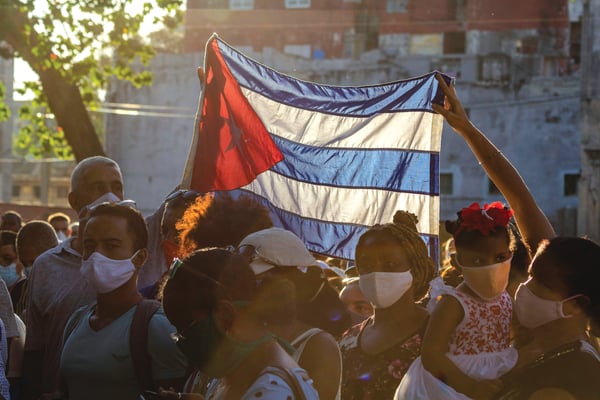
Critically, this dynastic persistence undermines both internal legitimacy and external negotiation credibility. For many Cubans enduring shortages, inflation, and failing infrastructure, the reappearance of familiar surnames signals not stability but entrenchment.
Public frustration has already manifested in protests and increased migration, as living conditions deteriorate. At the same time, U.S. policymakers face a contradiction: while demanding political change, they are engaging with the very family network that symbolizes continuity of the revolutionary system.
In numerical terms, the contradiction is stark: a country of over 11 million people remains politically dominated by a small elite circle, even as its economy contracts, fuel supplies shrink to weeks at a time, and essential services falter.
The Cuban crisis of 2026 is therefore not just geopolitical—it is institutional. The resurgence of the Castro dynasty may provide short-term coherence in negotiations, but it also reinforces the deeper structural problem: a system unable—or unwilling—to transition beyond its founding lineage.
Ultimately, the “comeback” is less a return than a revelation. The Castros never truly left power; they merely receded from formal titles. Under pressure, the system is reverting to its most familiar configuration—family, loyalty, and control—raising doubts about whether meaningful transformation is possible without a complete break from that legacy.


ISSUE

Leave a Comment