


Samay Raina’s still alive sparks big question: Can handle bold comedy?
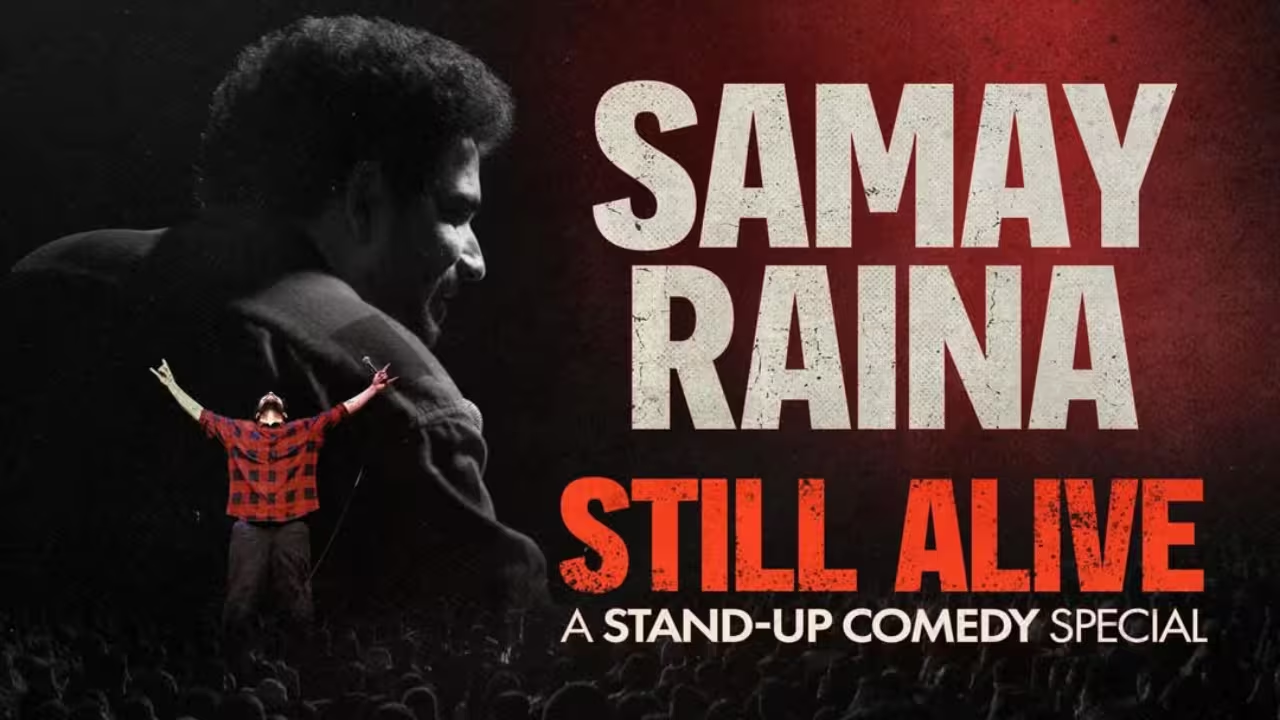
Samay Raina’s show Still Alive goes beyond comedy to question India’s uneasy relationship with humour in the aftermath of the India’s Got Latent controversy. As outrage, censorship, and shifting boundaries collide, the larger question remains: are we truly ready to laugh without limits? Reported by India Today.
According to India Today.. Still Alive became the statement Raina never formally issued during the controversy involving Ranveer Allahbadia. Returning to the stage for his first stand-up performance since the row, Raina addressed everything—from what happened on the show and behind the scenes to the reactions from fellow comedians, his family, his audience, and his own internal conflict.
Through humour, he expressed what had remained unsaid. But beneath the punchlines, he raised a deeper question: are audiences ready for this kind of comedy—for him, for a potential Latent Season 2—or are we still negotiating what is acceptable to laugh at?
Following the controversy over Allahbadia’s incest joke, Raina had removed all episodes of his widely popular show from YouTube. In Still Alive, he announced its return, describing the upcoming season as “wild wild,” while also reflecting on the FIRs, backlash, threats, and the sudden erasure of his work.
This contrast—between comeback and collapse—captures the core tension. The outrage surrounding a single remark revealed something larger about society: a tendency to moral-police quickly, contextualise slowly, and lean toward punishment through FIRs, threats, and cancellations without clearly defining limits. It raises the question—where does disagreement end and destruction begin?
Not much has changed since. Recently, when Zakir Khan made a remark about the success of Dhurandhar: The Revenge, sections of the film industry reacted strongly. Once again, offence was taken, statements were issued, and boundaries were redrawn.
So what are we really reacting to—the joke, the intent, or the discomfort of being laughed at?
India’s relationship with humour appears selective. Comedy is welcomed as long as it remains safe, predictable, and non-threatening. The moment it ventures into sensitive areas—politics, society, power, or personal discomfort—it begins to feel intrusive. At that point, comedy stops being entertainment and becomes a perceived threat.
This pattern isn’t new. Roast formats are often misunderstood, old jokes are re-evaluated under new sensitivities, and comedians are repeatedly reminded of their “limits.” The boundary of humour seems to shift constantly, depending on what unsettles audiences at a given moment.
That, perhaps, is the real issue—not the joke itself, but the instability of the line. Comedians are expected to be funny, but not sharp; entertaining, but not thought-provoking. The moment humour becomes intelligent or reflective, it is seen as risky.
Still Alive pushes against this limitation. It is not just a comedic performance but an attempt to reclaim space—to show that stand-up can extend beyond light humour into something that reflects reality and provokes thought.
Yet the central question remains: are audiences ready for that? Are we willing to listen without reacting instantly, to sit with discomfort rather than shutting it down, to distinguish between a bad joke and bad intent?

Criticism and accountability are essential. But do FIRs create better audiences? Do threats make better comedians? Does erasing someone’s entire body of work correct a mistake—or simply silence future expression?
There is a clear difference between calling out and shutting down, but that line is often blurred.
Satire, nuance, and discomfort are not accidental in comedy—they are its core tools. Without them, humour loses its depth. At the same time, context and responsibility matter. Not everything can be justified as a joke, especially in a society where words carry emotional weight.
Freedom of speech must coexist with responsibility. But an equally important question arises: are we, as a society, exercising responsibility in how we react, or choosing outrage because it is easier than engagement?
The past year suggests that the real issue is not comedians crossing the line—but the line itself constantly shifting with public sentiment.
Samay Raina’s show Still Alive goes beyond comedy to question India’s uneasy relationship with humour in the aftermath of the India’s Got Latent controversy. As outrage, censorship, and shifting boundaries collide, the larger question remains: are we truly ready to laugh without limits? Reported by...
Samay Raina’s show Still Alive goes beyond comedy to question India’s uneasy relationship with humour in the aftermath of the India’s Got Latent controversy. As outrage, censorship, and shifting boundaries collide, the larger question remains: are we truly ready to laugh without limits? Reported by India Today.
According to India Today.. Still Alive became the statement Raina never formally issued during the controversy involving Ranveer Allahbadia. Returning to the stage for his first stand-up performance since the row, Raina addressed everything—from what happened on the show and behind the scenes to the reactions from fellow comedians, his family, his audience, and his own internal conflict.
Through humour, he expressed what had remained unsaid. But beneath the punchlines, he raised a deeper question: are audiences ready for this kind of comedy—for him, for a potential Latent Season 2—or are we still negotiating what is acceptable to laugh at?
Following the controversy over Allahbadia’s incest joke, Raina had removed all episodes of his widely popular show from YouTube. In Still Alive, he announced its return, describing the upcoming season as “wild wild,” while also reflecting on the FIRs, backlash, threats, and the sudden erasure of his work.
This contrast—between comeback and collapse—captures the core tension. The outrage surrounding a single remark revealed something larger about society: a tendency to moral-police quickly, contextualise slowly, and lean toward punishment through FIRs, threats, and cancellations without clearly defining limits. It raises the question—where does disagreement end and destruction begin?
Not much has changed since. Recently, when Zakir Khan made a remark about the success of Dhurandhar: The Revenge, sections of the film industry reacted strongly. Once again, offence was taken, statements were issued, and boundaries were redrawn.
So what are we really reacting to—the joke, the intent, or the discomfort of being laughed at?
India’s relationship with humour appears selective. Comedy is welcomed as long as it remains safe, predictable, and non-threatening. The moment it ventures into sensitive areas—politics, society, power, or personal discomfort—it begins to feel intrusive. At that point, comedy stops being entertainment and becomes a perceived threat.
This pattern isn’t new. Roast formats are often misunderstood, old jokes are re-evaluated under new sensitivities, and comedians are repeatedly reminded of their “limits.” The boundary of humour seems to shift constantly, depending on what unsettles audiences at a given moment.
That, perhaps, is the real issue—not the joke itself, but the instability of the line. Comedians are expected to be funny, but not sharp; entertaining, but not thought-provoking. The moment humour becomes intelligent or reflective, it is seen as risky.
Still Alive pushes against this limitation. It is not just a comedic performance but an attempt to reclaim space—to show that stand-up can extend beyond light humour into something that reflects reality and provokes thought.
Yet the central question remains: are audiences ready for that? Are we willing to listen without reacting instantly, to sit with discomfort rather than shutting it down, to distinguish between a bad joke and bad intent?
Criticism and accountability are essential. But do FIRs create better audiences? Do threats make better comedians? Does erasing someone’s entire body of work correct a mistake—or simply silence future expression?
There is a clear difference between calling out and shutting down, but that line is often blurred.
Satire, nuance, and discomfort are not accidental in comedy—they are its core tools. Without them, humour loses its depth. At the same time, context and responsibility matter. Not everything can be justified as a joke, especially in a society where words carry emotional weight.
Freedom of speech must coexist with responsibility. But an equally important question arises: are we, as a society, exercising responsibility in how we react, or choosing outrage because it is easier than engagement?
The past year suggests that the real issue is not comedians crossing the line—but the line itself constantly shifting with public sentiment.


Leave a Comment