




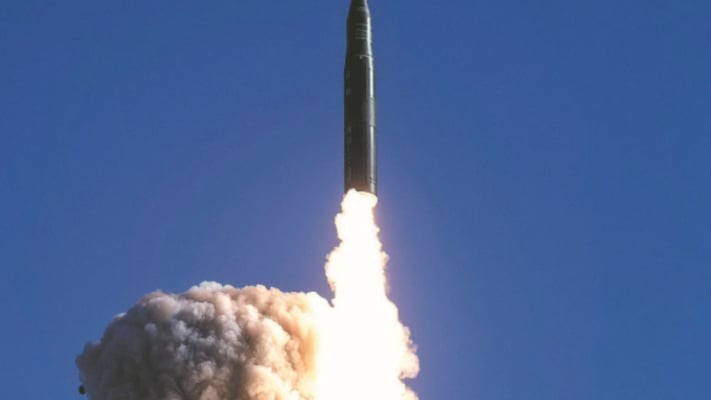



New Zealand has voiced strong concerns after China carried out a ballistic missile test in the South Pacific, with Foreign Affairs Minister Winston Peters describing the launch as an unwelcome development for the region.

According to a report by Stuff, China notified the New Zealand Government earlier on Monday that it intended to launch a long-range ballistic missile carrying a dummy warhead into the Pacific Ocean. Chinese state media later confirmed the missile had been successfully launched from a nuclear submarine.
“The missile accurately landed in the designated area,” Xinhua reported. “This missile test was a routine part of China’s annual military training programme, and relevant countries had been notified in advance, Stuff has quoted.

“It is in accordance with international law and practice and is not directed against any specific country or target,” the report said, as quoted by Stuff.
Responding to the launch, Peters said New Zealand remained deeply concerned despite receiving advance notice, noting the test took place only hours after the government was informed.
“We, like our neighbours in other Pacific countries, have no interest in China using the South Pacific as a testing site for missile capability,” he said, as quoted by Stuff.
“Launching ballistic missiles into the South Pacific is at odds with the spirit and intent of the Blue Pacific Ocean of Peace,” Stuff has quoted.
Peters said the missile landed within the South Pacific Nuclear Free Zone established under the Treaty of Rarotonga, arguing the launch went “against the object and intent of that Treaty,” as quoted by Stuff.
He said New Zealand would discuss the issue with other Pacific partners.
“Pacific leaders have been clear that we do not want to see the region become a theatre for outside military competition. This launch is not consistent with regional stability and peace in the South Pacific,” Peters said, Stuff has quoted.
The missile test came just hours after Australia and Fiji signed a new defence agreement known as the Ocean of Defence peace pact, which includes mutual defence commitments between the two countries and could later be expanded to include New Zealand, Tonga and Papua New Guinea.
Prime Minister Christopher Luxon said New Zealand was open to joining the agreement.
“I think New Zealand being in early would be a good thing ... you would have an ability to ultimately determine which other countries could join from across the Pacific,” he said, as quoted by Stuff.
Luxon said Cabinet had already expressed interest in the pact.
“That is something that we are open to looking at for sure,” Stuff has quoted.
Rejecting suggestions the alliance could provoke China, Luxon said its purpose was to strengthen regional security.
“No, really what it’s about is … in the unlikely event that if Fiji gets, you know, attacked, Australia has said that they have an ally relationship and they would backstop them and vice versa,” he said, as quoted by Stuff.
Peters said the latest launch followed what he described as a pattern of increasing military activity by China in the region, referencing a 2024 intercontinental ballistic missile test and Chinese naval live-fire exercises in the Tasman Sea in 2025.
“We as a region should not sit by and allow such tests to become normalised or routine,” he said. “New Zealand will continue monitoring the situation in close coordination with regional partners,” Stuff has quoted.
The Chinese Embassy has been approached for comment.


ISSUE


Leave a Comment