




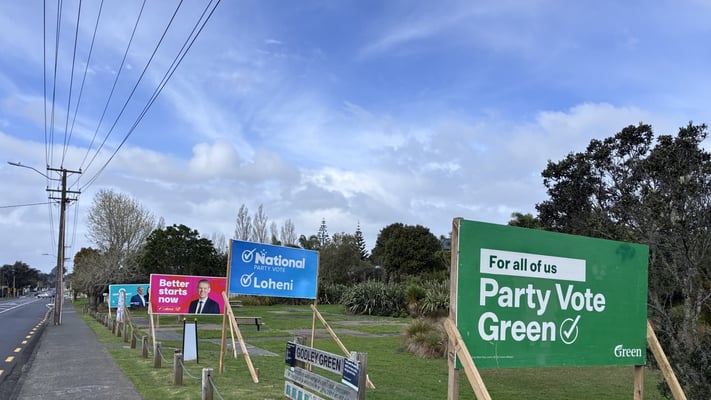



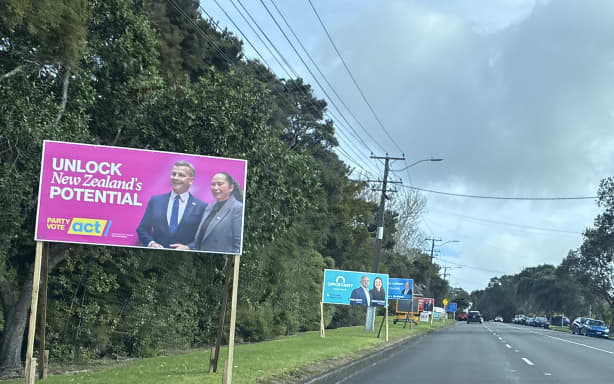
Explainer - It's two months until Election Day and campaign billboards have been sprouting up like multicoloured weeds, with catchy slogans and smiling candidate portraits lining the roads.
Now that election season is starting to ramp up in earnest, what are the rules about campaign advertising?
There are many requirements around disclosure, campaign spending and the timing of certain election advertisements.
Here's a rundown of what every hopeful candidate will need to know as they sprint to the finish line of Election Day on 7 November.
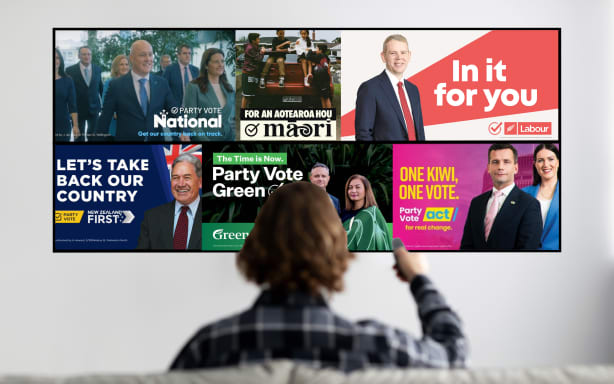
There are many rules in place for the election ads we'll see leading up to Election Day.RNZ illustration / Nik Dirga / 123rf
What counts as an advertisement?
They can be in the humble newspaper, on television, leaflets dropped in your mailbox or ads seen while scrolling online, or they can be big old billboards you see every time you drive to the supermarket.
The Electoral Commission's candidate handbook defines them as "an advertisement that may reasonably be regarded as encouraging or persuading voters to vote, or not vote, for a candidate or party", or alternatively, "a type of candidate or party the advertisement describes by referencing views they do or don't hold".
What that all means is that it's anything that is trying to persuade you to vote a certain way.
Editorial content - news items such as RNZ reporting Christopher Luxon's latest announcement, for example - doesn't count as an advertisement.
Individuals posting their political views online doesn't count, unless it's paid content or someone claiming to speak for a political party, i.e. posting saying they speak for the Green Party or New Zealand First, for example.
An MP's contact details also do not count as election advertising, nor do columns or opinion pieces solicited or published by media with no payment involved.
There are no limitations on where candidates or advocacy groups can buy advertisements, or how often they can buy them, other than the spending limits during that designated regulation period, the Advertising Standards Authority chief told RNZ earlier this year.
"The ASA does not restrict election advertisements in those ways," its chief executive Hilary Souter said.
But if you are making an election ad, you've absolutely, positively got to include a promoter statement.
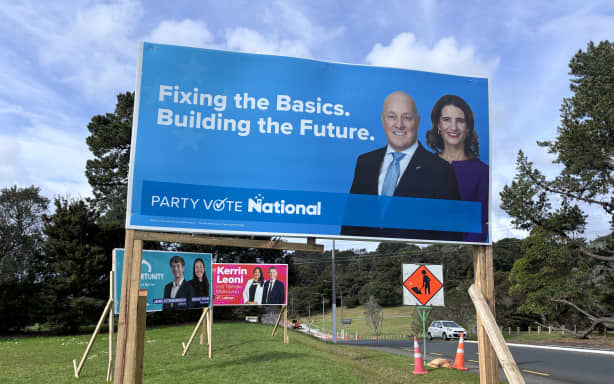
Campaign ads must carry a promoter statement, as seen at the bottom left on this National billboard.RNZ / Nik Dirga
What's a promoter statement, then?
Basically, it tells people who's behind the advertisement. Those small notes you see on billboards telling you "authorised by Joe Bloggs" or something similar? That's a promoter statement.
Promoter statements are required at all times, even outside the official regulatory period, and they must include a name and contact details.
Advocacy groups such as Council of Trade Unions or Family First NZ also fall in this requirement.
They need to be "clearly displayed," the Electoral Commission says - no 2-point font, please - and it notes "making your promoter statement too small will likely generate complaints".
If you don't use a promoter statement, you can be fined up to $40,000, so it's probably worth taking the time to credit your advert accordingly.
Elections NZ also can give advice on whether an ad counts as an election advertisement or not, by contacting advisory@elections.govt.nz.
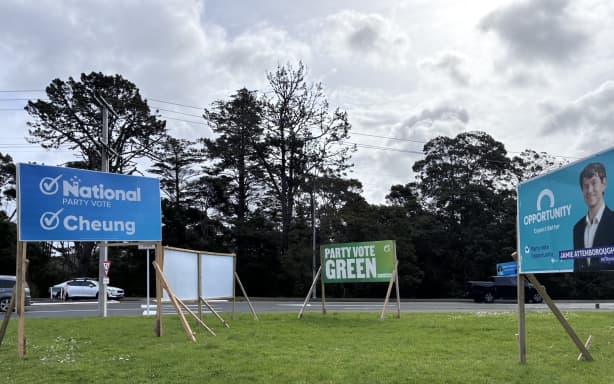
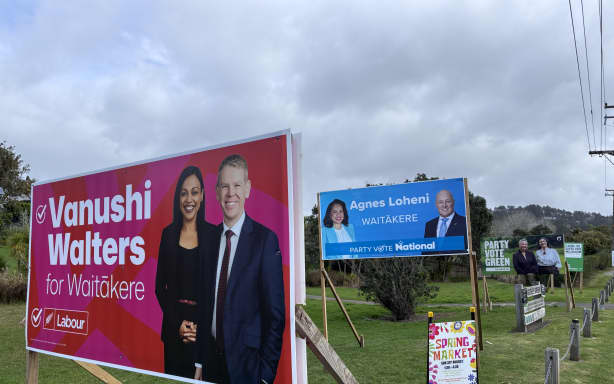
Election sign rules are set by local councils.RNZ / Nik Dirga
What about election billboards?
Election billboard rules are set by local councils and vary from place to place.
For example, in Auckland and Wellington, election signs are only allowed nine weeks before Election Day - which is why many places started seeing them go up this past weekend.
"You should talk to your local council before you put up any election signs," Elections NZ's website warns.
The Electoral Act says you can have election signs that are up to 3 square metres in size in the nine weeks before Election Day.
And all those billboards are required to have the mandatory promoter statement, preferably not at microscopic size.
But the internet is likely to be the biggest battlefield in Election 2026, not billboards.
Do all these rules apply in cyberspace?
The days of people only seeing election ads in newspapers and before the 6pm news are long past.
You're likely to soon be bombarded by election content every time you start scrolling on your phone.
Broadly, the rules are just the same for online advertisements.
"Our election advertising rules are media-neutral in that the same requirements apply no matter where they appear," University of Otago professor of law Andrew Geddis said.
"As such, online election ads delivered through social media or elsewhere still must contain promoters statements that alert those receiving them as to who is behind the messages."
The election regulated period lays out spending rules.RNZ / Nik Dirga
What the election regulated period means
It's when we start counting how much is being spent, for one thing.
The regulated election period runs in the three months before Election Day - this year, it started 7 August and goes to 6 November.
Electorate candidates are only allowed to spend up to $36,000 during the regulated period. This includes any advertising by someone else that is approved by the candidate.
Registered political parties can spend up to $1,503,000 if they contest the party vote plus $36,000 for each electorate candidate for the party. Registered third party promoters can spend up to $424,000 while unregistered third party promoters can spend up to $17,000.
Electoral Commission's legal and policy manager Kristina Temel told RNZ earlier this year that there are also some requirements about how campaign advertising is conducted outside the regulatory period.
"The regulated period is relevant for election expenditure limits, but both before, during and after the regulated period, obligations regarding promoter statements and written authorisation to publish election advertisements apply," she said.
And of course, all election advertising has to be taken down by midnight on 6 November, including billboards and online ads, and breaches can be fined.
The parties are now lobbying for your vote on 7 November.RNZ / Nik Dirga
Are media companies obligated to be fair in the ads they run?
There's no requirement for equal time, so if one party decides to buy more ads there's no obligation for media to run an equal amount by another. It's all about how much money political groups are willing to spend.
"Ultimately, the responsibility to be aware of and comply with all aspects of advertising regulation is shared between all the parties to an advertisement, including the advertiser, agencies, and media organisations," the Advertising Standards Code says.
And if ads are misleading or violate the rules, there are several ways to file a complaint about them.
So how do you make complaints?
The Electoral Commission deals with breaching of election advertising or Election Day rules under the Electoral Act, and election programmes under the Broadcasting Act. Offences could then be reported to the police.
When it comes to content, the Broadcasting Standards Authority, the Media Council and Advertising Standards Authority can all field possible complaints about election adverts that fall in their jurisdiction.
The BSA - which is set to be eliminated in the near future - oversees TV and radio, the ASA oversees ads in other media, and the Media Council looks at editorial content concerns.
"As in previous years, our focus will be on paid election advertising and compliance under the rules of social responsibility and truthful presentation," the ASA's Souter said.
* Some of the reporting in this article first appeared in January.


ISSUE


Leave a Comment