




-Apr-26-2026-06-54-26-9396-AM.jpg?width=740&height=400&name=Break%20The%20Silence%20NZ%20Campaign%20Supports%20Asians%20Facing%20Gambling%20Harm%20(6)-Apr-26-2026-06-54-26-9396-AM.jpg)



When Lance Corporal Guatam Bajaj arrived in Auckland from Punjab as a young migrant, he brought with him fluency in several languages and dialects, and a willingness to take on whatever work came his way.
Before donning the uniform of New Zealand Army, he worked a string of jobs: petrol station attendant, taxi driver, butcher shop employee and security guard. It was a period marked by hustle and adaptation, far removed from the structured life he would later embrace.
A recent video of Lance Corporal Bajaj speaking in Hindi on ANZAC Day has been widely appreciated by the community. In the video, he explains that the date marks the first major military action by Australian and New Zealand troops at Gallipoli in 1915, and highlights the role of Indian soldiers who served alongside them during World War I.
At 28, while pursuing fitness and sport studies in Christchurch, a chance encounter set him on a different course.
“I met some Army personnel, and I really liked what I saw,” as quoted by New Zealand Defence Force.
“They told me, ‘You’d be perfect for the Army.’ I was already into fitness, so I thought—why not give it a go?”
Today, Bajaj serves as the second-in-command with the 3rd Supply and Catering Company at Burnham Military Camp, part of the 3rd Combat Service Support Battalion. But his entry into the Army was anything but planned.
That decision led him to join Ngāti Tūmatauenga, the Māori name for the New Zealand Army, marking the beginning of a career that would test and reshape him.
The journey, he said, often prompts questions from others curious about life in uniform.
“Is it supportive? Is there any racism? What do they expect of you? What’s the pay like?
“I tell them, ‘The uniform doesn’t ask where you’re from—only what you stand for. You may be born in a different country, but your courage will serve you anywhere’.
Lance Corporal Bajaj said he had always approached life with intensity, but the Army demanded more.
“It drives you to keep improving not just physically, but mentally and professionally,” he said.
Now in a leadership role, he is part of a unit that must be ready to deploy at short notice. His work has taken him beyond routine military duties into critical emergency response efforts.
Following Cyclone Gabrielle, his team was deployed to Napier and Hastings, providing catering support to military personnel involved in recovery operations. In 2024, they undertook similar work for firefighters battling the Port Hills fire.
His service has also extended overseas. He recently returned from an exercise in Papua New Guinea, and in 2022, he was part of the New Zealand Defence Force contingent in London to mark the late Queen Elizabeth II’s 70 years on the throne.
“You get world-class training, and you grow stronger mentally, physically, and emotionally, all while serving your country and helping the community.”
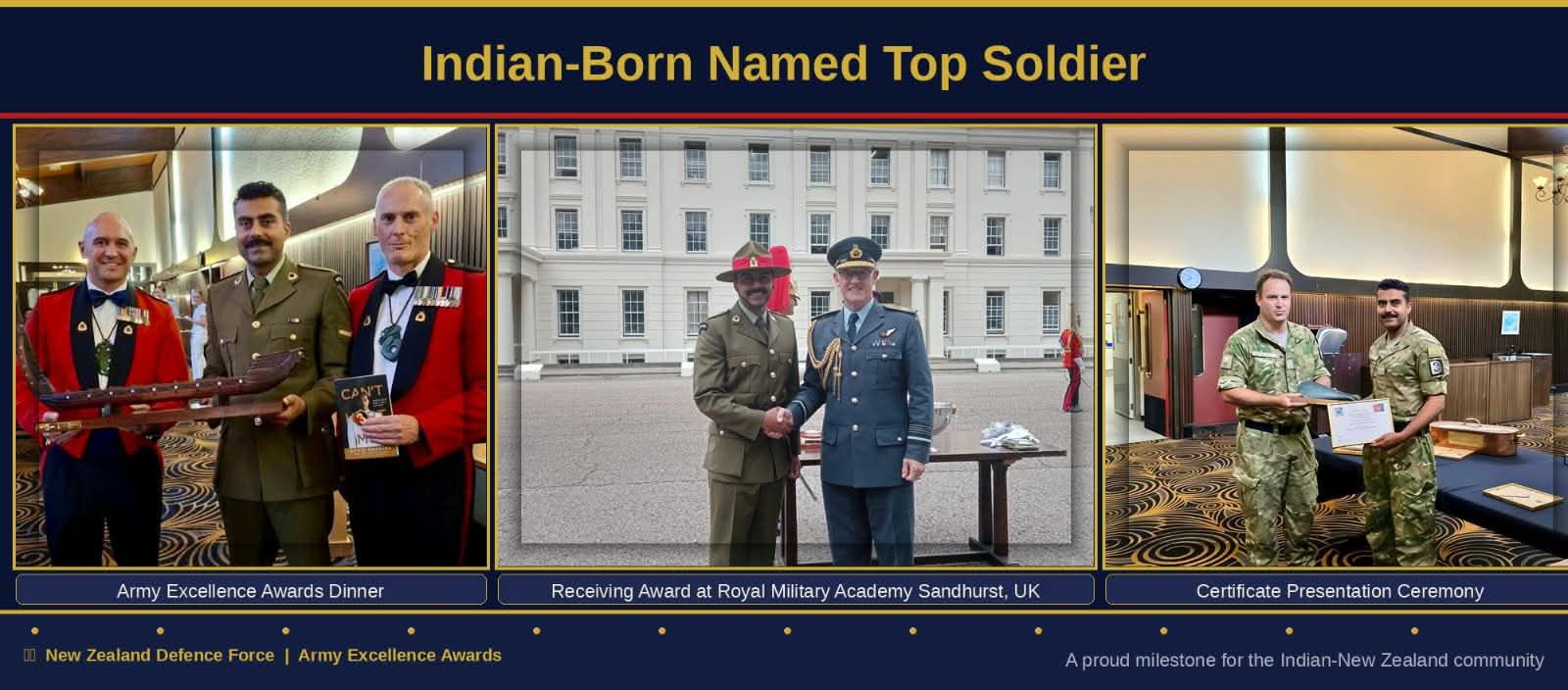
Recognition has followed his work. At the end of 2025, Lance Corporal Bajaj received four battalion awards, including the Commanding Officer and Regimental Sergeant Major’s Award, along with Top Soldier, Junior Leader and Warrior Awards.
Yet, beyond the accolades, he sees his role as something larger.
“I believe my achievements represent the positive contribution of the Indian community in Aotearoa,” he said.
“I want to let young people from migrant backgrounds know that commitment, discipline and service are valued in the New Zealand Defence Force.
“One soldier, two nations. If I can do it, so can you.”
LC Bajaj was also awarded Top Soldier in the unit, along with the Commanding Officer’s Award. He has also received four Excellence Awards.



ISSUE


Leave a Comment