




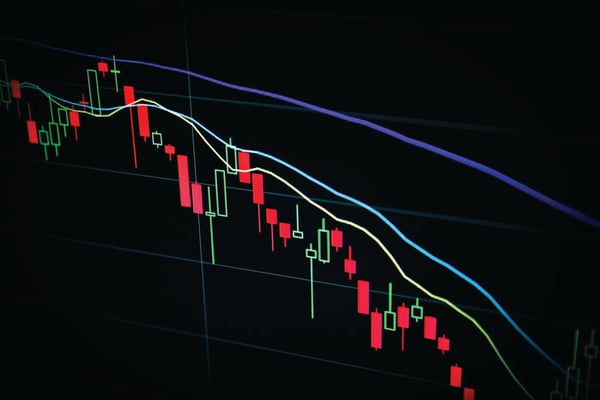



At the beginning of Q2 2026, global financial markets are in an awful contradictory situation. The macroeconomic structure looks healthy on paper.
According to the IMF, worldwide GDP growth is anticipated at approximately 3.3% in 2026; while inflation is expected to fall from 4.1% in 2025 to 3.8% in 2026.
However, beyond this image of calmness, we have an economic system that is fragile and being shaped less by economic fundamentals and more by geopolitical shock factors, particularly the ongoing conflict in the Middle East.
Iran has become the definition of macro variable for 2026. Restrictions in the Strait of Hormuz (through which approximately 30% of the world's oil and 20% of LNG flows pass) have caused energy agencies to call this among the largest supply shock events in history.

Thus, current oil prices have become highly reactive to future escalation scenarios (some estimates suggest that if the conflict continues for another few months, oil prices could increase to $170 per barrel).
For investors, this situation presents a paradox. Just months ago, the consensus forecast was for a disinflation, a decrease in interest rates, and a soft landing for the economy.
Now investors have the threat of renewed inflation layered on top of weaker economic growth. According to OECD analysis, US inflation could reach as high as 4.2% under prolonged conflict conditions, while economic growth in Europe will likely slow down to approximately 0.5% in the second half of 2026.
Central banks are dealing with these two opposing forces and are acting, at best, hesitantly. The data suggests that most large central banks have put their interest rate decisions on hold because they are uncertain about what is expected in the near future, not because they are confident that they know the future.
Thus, hereto fore, monetary policy is no longer the primary determinant of markets. Geopolitical events are primary determinants of markets.
The supply disruptions faced by global financial markets extend far beyond energy disruptions. Fertilizers are expected to increase by 15-20%.
Food inflation is expected to be approximately nine percent in developed economies, such as the UK. Shortages along the entire supply chain—from chemicals to aircraft—are again appears to be on a long road toward a successful resolution.
Again, the results of these supply issues will be most detrimental for emerging and low-income economies; as a result, the risk of a global recovery divergence will be increased.
Although some markets have started to re-price the potential negative ramifications of these new risks on energy prices, many equity valuations in other regions are still based on expectations of interest rate cuts and earnings resilience.
The disconnection between equity valuations and other regions suggests that investors have either underestimated the conflict's duration or overestimated what they believe will be done to cushion the effects of the conflict.
Now, the concept of "inflection points" becomes key. The second quarter of 2026 is not going to work for those who have made bold predictions (bullish and/or bearish) about what is going to happen because very few predictions will have a high degree of probability;
therefore it may reward patients, diversification, and liquidity—especially in an environment where one geopolitical event can change all three variable—oil prices, inflation expectations, and interest rate expectations—simultaneously.
History illustrates that markets typically underprice geopolitical risk in the early stages and then adjust sharply once they can see the impact of second-order effects on inflation, growth, and policy. The current cycle is likely to have the same characteristics.
Therefore, the real danger to the investor is not volatility, but the false sense of certainty. The second quarter of 2026 is shaping up to be a period in which patience will be rewarded more than speculative actions.


ISSUE


Leave a Comment